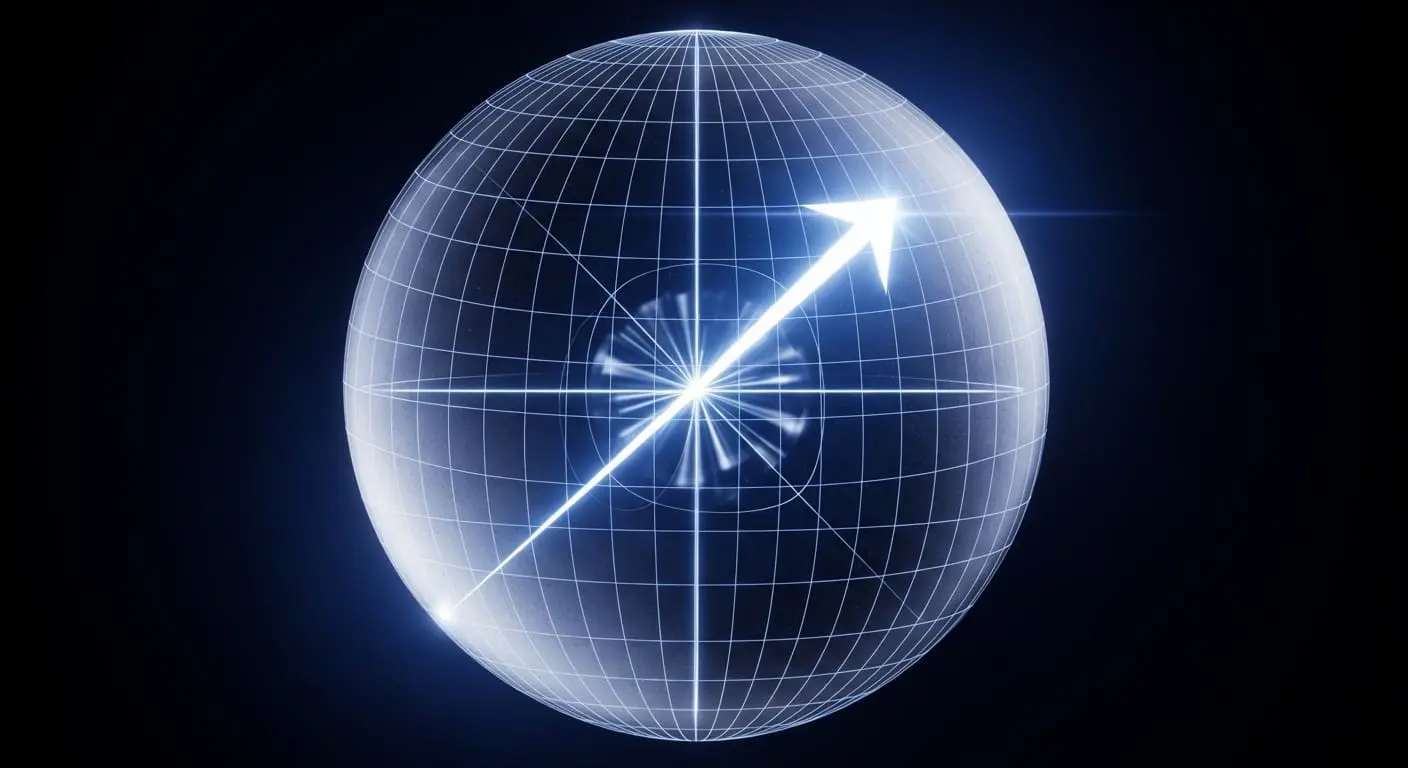
A new protocol for generating and superposing squeezed magnonic states has been demonstrated by Gang Liu and colleagues at Lanzhou University. The protocol links a superconducting flux qubit to an yttrium iron garnet sphere, as part of a collaboration between Lanzhou University and Wenzhou University. The approach achieves key magnon quadrature noise reduction, exceeding 8 dB, and creates superpositions exhibiting interference fringes. It explores a bosonic logical encoding potentially capable of protecting against errors in future magnonic computing platforms.
Squeezed magnons and superposition states enable strong noise reduction in a qubit-magnon
Magnon quadrature noise reduction exceeding 8 dB has now been achieved, a threshold previously unattainable due to limitations in controlling magnon states. This level of noise suppression is vital for advancing quantum technologies. A new protocol generating squeezed magnonic states and their superpositions within a hybrid system enabled this success, magnetically coupling a superconducting flux qubit to an yttrium iron garnet sphere. Preparing the qubit in a superposition allowed scientists to obtain symmetric and antisymmetric superpositions of squeezed magnons, exhibiting interference fringes indicative of quantum coherence.
The fourfold rotational symmetry of these states supports bosonic logical encoding, offering a potential pathway for protecting quantum information from errors in future magnonic computing platforms. Detailed numerical simulations, incorporating realistic dissipation, validate that magnon quadrature noise reduction surpasses 8 dB. These calculations closely match experimental predictions using both a full and effective Hamiltonian model. Analysis of the magnon’s principal quadrature variance confirms the squeezing effect, with simulations showing a peak exceeding the 8 dB threshold and minimal discrepancy, less than 0.02 dB, between the two modelling approaches. Further investigation reveals that increasing the magnon damping rate degrades squeezing performance, although a level above 8 dB remains achievable with a damping rate of 0.5MHz, a value reported in recent experiments.
Flux qubit control of magnon fluctuations via parametric amplification
Magnetic coupling proved central to generating these magnonic states, acting as a bridge between a superconducting flux qubit and an yttrium iron garnet (YIG) sphere. The YIG sphere functions as a tiny, controllable magnetic resonator, responding to changes in the qubit’s state. However, this interaction is not simply a connection, but a carefully tuned response where the flux qubit’s two current states create opposing magnetic fields at the sphere’s location.
Consequently, resonant microwave driving induces a process akin to parametric amplification, effectively tailoring the magnon mode’s fluctuations based on the qubit’s configuration. This qubit-state-dependent squeezing is vital, allowing scientists to reduce quantum noise in specific properties of the magnons and paving the way for more stable quantum information processing. This approach avoids the need for intermediary components like cavity modes or additional modulation tones required by alternative methods. Experiments were conducted under resonant microwave driving to tailor magnon fluctuations, utilising the YIG sphere’s response to the flux qubit’s state.
Squeezed magnons and the persistent challenge of decoherence in quantum computing
This protocol offers a promising route to manipulating magnons, quasiparticles embodying magnetic movement, and achieving strong noise reduction, but the simulations rely on idealised conditions. Maintaining this level of ‘squeezing’, effectively silencing unwanted quantum fluctuations, over extended periods presents a considerable challenge, as the authors acknowledge. Decoherence, the loss of quantum information, remains a persistent obstacle in all quantum systems.
This limitation is particularly acute given the current focus on bosonic logical encoding, a method of error correction demanding sustained, high-fidelity squeezed states. Despite the challenges of maintaining these delicate quantum states for practical durations, this demonstration remains significant because it establishes a viable pathway towards building more durable quantum information processors. Manipulating magnons, wave-like disturbances in magnetic materials, offers a potentially scalable alternative to superconducting qubits currently dominating the field. Achieving substantial noise reduction, exceeding 8 decibels in simulations, is a key step as it directly addresses a major hurdle in building reliable quantum computers. This work establishes a protocol for generating and superposing squeezed magnons within a hybrid system combining a superconducting flux qubit and a yttrium iron garnet sphere, demonstrating precise control over these magnons and validating the potential for bosonic logical encoding through the resulting symmetric and antisymmetric superpositions exhibiting interference. This technique offers a pathway to protect quantum information from errors.
The researchers successfully generated and controlled squeezed magnons, quasiparticles representing magnetic movement, within a hybrid system of a superconducting flux qubit and a yttrium iron garnet sphere. This achievement demonstrates noise reduction exceeding 8 decibels, which is important because it addresses a key challenge in building stable quantum computers. By creating superpositions of these squeezed magnons, they also validated a potential method for error correction known as bosonic logical encoding. The resulting states exhibit interference, supporting the possibility of protecting quantum information from decoherence.
👉 More information
🗞 Generation of magnonic squeezed state and its superposition in a hybrid qubit-magnon system
🧠 ArXiv: https://arxiv.org/abs/2604.02924


See today’s quantum computing news on Quantum Zeitgeist for the latest breakthroughs in qubits, hardware, algorithms, and industry deals.