

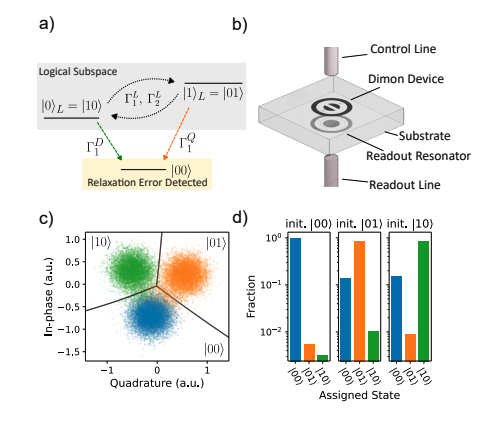
Researchers demonstrate significant reductions in bit-flip and phase-flip error rates, exceeding one order of magnitude compared to physical rates, using a dual-rail encoding scheme within a fixed-frequency superconducting transmon qubit. This architecture, utilising a three-island, two-junction device, exhibits stability and enables investigation into noise and decoherence mechanisms.
The pursuit of stable quantum computation necessitates innovative strategies to mitigate the effects of decoherence, the loss of quantum information resulting from interactions with the environment. Amplitude damping, a specific decoherence mechanism, poses a significant challenge to maintaining qubit fidelity. Researchers are increasingly exploring error conversion techniques, transforming undetectable errors into measurable leakage states, and dual-rail encoding represents a promising avenue for achieving this. A team led by James Wills, Mohammad Tasnimul Haque, and Brian Vlastakis, all from Oxford Quantum Circuits, details a novel implementation of dual-rail encoding within a fixed-frequency superconducting multimode transmon qubit, a type of superconducting circuit used as a qubit. Their work, presented in the article “Error-detected coherence metrology of a dual-rail encoded fixed-frequency multimode superconducting qubit”, demonstrates substantially reduced logical error rates compared to physical rates, alongside repeatable performance across multiple devices, and offers a platform for deeper investigation into the origins of noise and decoherence within these advanced qubit architectures.
Superconducting qubits currently experience limitations due to amplitude damping, a process where quantum information is lost as the qubit transitions to its ground state. Researchers are actively investigating erasure conversion as a potential solution, transforming these damping events into detectable leakage states, effectively making the loss of information visible rather than simply lost. Dual-rail encoding, a specific method for achieving this conversion, represents quantum information using two physical qubits instead of one, and exhibits unique sensitivities to various noise and decoherence sources, making it a valuable tool for qubit development and refinement. Recent work details the implementation of a dual-rail encoding scheme within a single, fixed-frequency superconducting transmon qubit, a type of superconducting qubit known for its relative simplicity and ease of fabrication, representing a step towards building more stable and reliable quantum processors.
This innovative device incorporates three superconducting islands and
This innovative device incorporates three superconducting islands and two Josephson junctions, non-linear circuit elements crucial for creating the quantum behaviour, creating two transmon-like modes detuned by 0.75–1 GHz, meaning their energy levels are slightly different. It integrates into a coaxial circuit quantum electrodynamics (cQED) architecture, a method for precisely controlling and measuring qubit states using microwave signals delivered through coaxial cables. Experimental results demonstrate a significant reduction in error rates, with logical bit-flip and phase-flip rates, representing the probability of errors in the encoded qubit, more than one order of magnitude lower than the corresponding physical rates of the individual qubit modes. This substantial improvement highlights the efficacy of the dual-rail encoding scheme in mitigating decoherence, the loss of quantum information due to interaction with the environment, and protecting quantum information from environmental noise.
Furthermore, the architecture exhibits stability and repeatability, confirmed through extended measurements performed on three separate devices, demonstrating the robustness of the design and fabrication process. Researchers consistently observe the reduction in error rates across multiple devices, reinforcing the potential for practical implementation in larger quantum circuits and scalable quantum computing systems. This consistent performance validates the approach and paves the way for further exploration of error correction techniques, which aim to actively detect and correct errors in quantum computations.
This work not only enhances qubit performance but also provides a novel platform for investigating the fundamental mechanisms of noise and decoherence in fixed-frequency transmon qubits, offering valuable insights into the limitations of current qubit technology. By carefully analysing the behaviour of the encoded qubit, researchers gain deeper insights into the origins of errors and can develop more effective strategies for improving qubit coherence, the length of time a qubit maintains its quantum state, and fidelity, a measure of the accuracy of quantum operations, ultimately leading to more powerful and reliable quantum computers. The ability to probe these fundamental processes within a single, integrated device represents a significant advancement in the field of quantum information processing.
👉 More information🗞Error-detected coherence metrology of a dual-rail
🗞 Error-detected coherence metrology of a dual-rail encoded fixed-frequency multimode superconducting qubit
🧠 DOI: https://doi.org/10.48550/arXiv.2506.15420


