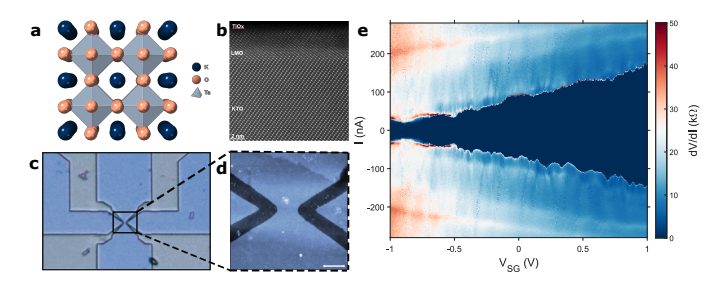
Researchers fabricate nanoscale constrictions within a superconducting potassium tantalate oxide heterostructure, enabling electrostatic control of superconductivity using side gates. Transport measurements demonstrate modulation of the critical current, the Berezinskii-Kosterlitz-Thouless transition temperature, and a regular Coulomb blockade pattern, all achieved with voltages below one volt.
The manipulation of superconductivity at the nanoscale presents significant challenges in materials science, particularly in achieving precise control over electron behaviour within complex oxide systems. Researchers are now demonstrating a method for fabricating and electrostatically controlling quantum phases within potassium tantalate (KTaO₃)-based heterostructures, offering a pathway towards scalable nanoelectronic devices and fundamental investigations into emergent phenomena. Jordan T. McCourt, Ethan G. Arnault, Merve Baksi, Divine P. Kumah, and Gleb Finkelstein from Duke University, alongside Samuel J. Poage, Salva Salmani-Rezaie, and Kaveh Ahadi from The Ohio State University, detail their findings in a recent publication titled “Electrostatic control of quantum phases in KTaO₃-based planar constrictions”. Their work focuses on creating narrow constrictions within a superconducting KTaO₃ heterostructure, allowing for individual tuning via coplanar side gates formed within the same two-dimensional electron gas (2DEG) plane, a system where electrons are confined to move in two dimensions. The high dielectric constant of KTaO₃, approximately 5000, facilitates strong electrostatic modulation of the superconducting 2DEG, enabling control of the critical current, the Berezinskii Kosterlitz Thouless (BKT) transition temperature – a characteristic of two-dimensional superconductivity – and the observation of a regular Coulomb blockade pattern with minimal applied voltage.
Researchers demonstrate a novel, scalable technique for manipulating two-dimensional electron gases (2DEGs) within a potassium tantalate oxide (KTaO3) heterostructure, offering precise control over superconductivity at the nanoscale. The fabrication process creates narrow constrictions within the 2DEG, and these are controlled using coplanar side gates, effectively acting as nanoscale ‘taps’ to regulate electron flow. KTaO3’s exceptionally high dielectric constant is central to this control, enabling substantial electrostatic modulation of the 2DEG; a dielectric constant measures a material’s ability to reduce an electric field, and a high value allows for greater control with lower voltages.
The team successfully modulates both the critical current,
The team successfully modulates both the critical current, the maximum current a superconductor can carry without losing its superconducting properties, and the Berezinskii-Kosterlitz-Thouless (BKT) transition temperature, the temperature at which a two-dimensional superconductor transitions to a normal conducting state. Applying a voltage of less than one volt induces a regular Coulomb blockade effect at these constrictions, demonstrating precise control over electron transport. The Coulomb blockade is a quantum mechanical effect where electron flow is restricted due to the energy required to add another electron to an isolated conductive region.
This level of control facilitates potential applications in several areas, including the development of single-electron devices, where the flow of individual electrons is harnessed, and highly sensitive electronic sensors. Furthermore, the technology offers a pathway towards superconducting field-effect transistors, which could significantly improve energy efficiency in electronic circuits. It provides a platform for fundamental research into two-dimensional superconductivity and the complex physics occurring at oxide interfaces. The ability to finely tune superconducting properties at this scale represents a significant advance in materials science and nanotechnology.
👉 More information🗞Electrostatic control of quantum phases in
🗞 Electrostatic control of quantum phases in KTaO3-based planar constrictions
🧠 DOI: https://doi.org/10.48550/arXiv.2506.18894