
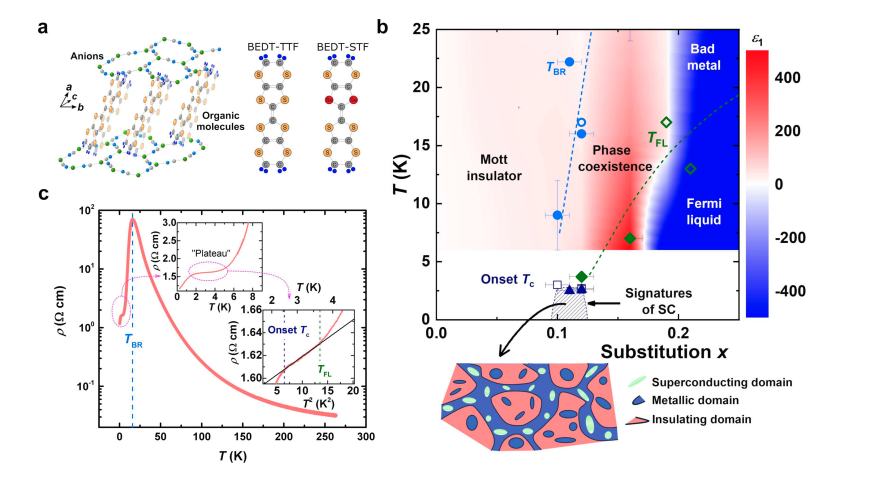
The pursuit of superconductivity, the lossless flow of electricity, often encounters unexpected obstacles, and researchers are now shedding light on why this happens in certain materials. Yuxin Wang, Vladimir Dobrosavljevic , and Eun Sang Choi, all from the National High Magnetic Field Laboratory at Florida State University, alongside colleagues including Yohei Saito and Atsushi Kawamoto, investigate this ‘failed superconductivity’ in a unique organic material exhibiting properties of a Mott spin liquid. Their work reveals that superconductivity doesn’t emerge globally in these materials, but instead forms isolated pockets within a metallic structure, ultimately undergoing a transition back to a normal metallic state under a magnetic field. This discovery offers a new perspective on a common problem in superconductivity research, potentially informing the development of future superconducting materials, even those as diverse as cuprates, by highlighting the critical role of material homogeneity and internal fluctuations.
Organic Compounds Simplify Superconductivity Search
Understanding unconventional superconductivity, where electrons flow with zero resistance, remains a significant challenge in modern physics. Researchers are now focusing on quasi-two-dimensional organic compounds to simplify the search for this elusive phenomenon, as these materials offer a comparatively simple electronic structure potentially isolating the key ingredients for superconductivity. Unlike many other unconventional superconductors, these organic compounds can be tuned between an insulating and a metallic state, allowing scientists to explore the emergence of superconductivity near this critical transition point. The team investigated these materials at extremely low temperatures and strong magnetic fields, surprisingly finding that even with characteristics suggesting superconductivity, they fail to achieve zero electrical resistance.
Instead, the data suggests a granular form of superconductivity, where tiny superconducting regions are embedded within a larger metallic matrix, implying superconductivity isn’t flowing freely throughout the material but is confined to isolated domains. This discovery provides new insight into “failed superconductivity”, observed in various materials, where superconductivity appears suppressed or incomplete. The researchers propose that interplay between intrinsic material inhomogeneity and quantum fluctuations prevents the formation of a fully connected superconducting state, offering a broader understanding of challenges in achieving and controlling superconductivity in more complex materials.
Percolation Maps Reveal Suppressed Superconductivity
Researchers investigated a material exhibiting characteristics between a conventional metal and a superconductor, focusing on why complete superconductivity fails to emerge despite evidence of superconducting fluctuations. Their approach centered on understanding the material’s internal structure and its impact on electricity flow, moving beyond simply observing the lack of superconductivity to pinpointing the underlying mechanisms. The team employed a technique based on percolation theory, borrowed from the study of fluid flow through porous materials, to analyze the distribution of superconducting regions within the sample. By modeling the material as a mixture of superconducting and normal-conducting domains, they could extract information about the properties of the superconducting regions and their interactions. Through careful analysis of measured resistance, the researchers determined the proportion of superconducting material and its electrical resistance, effectively isolating the superconducting contribution. This allowed them to observe a significant drop in resistance within the superconducting domains as temperature decreased, characteristic of true superconductivity, and identify a critical magnetic field suggesting a quantum phase transition.
Coexisting Domains Limit Organic Superconductivity
Researchers have gained new insights into unconventional superconductivity by studying unique organic materials, offering a simplified system for investigation due to their single band of electrons and tunable insulating/metallic states. The team focused on materials where superconductivity emerges within a mixed state, discovering that complete superconductivity does not develop as temperature decreases. Instead of a fully superconducting state, experiments reveal small superconducting regions embedded within a larger metallic network. These superconducting domains undergo a transition back to a metallic state when exposed to increasing magnetic fields, demonstrating a quantum phase transition, and exhibit fluctuations in electrical conductivity, suggesting a complex interplay between inhomogeneity and quantum fluctuations. This discovery sheds light on “failed superconductivity”, observed in complex copper oxides, where superconductivity is suppressed despite favorable conditions. The research demonstrates that intrinsic disorder and quantum fluctuations can hinder the development of a complete superconducting state, offering a new perspective on the mechanisms governing unconventional superconductivity.
Inhomogeneous Material Limits Superconducting Domain Growth
This research investigates the emergence of superconductivity in a specific organic material, revealing a scenario where complete superconductivity fails to develop despite the presence of superconducting fluctuations. The team found that superconductivity appears as isolated domains embedded within a metallic matrix, rather than forming a continuous, zero-resistance state. Through careful measurements of electrical resistance and magnetic susceptibility, they demonstrate a transition from a superconducting to a metallic state induced by a magnetic field, indicating a quantum superconductor-to-metal transition. The results suggest that this “failed superconductivity” arises from the material’s inherent inhomogeneity, specifically the coexistence of superconducting and metallic regions, rather than fundamental limitations of the superconducting state itself. Surprisingly, even in relatively large samples, the researchers observed universal conductance fluctuations at high magnetic fields, supporting the picture of mesoscopic phase segregation, offering a new perspective on the behaviour of “anomalous metals”.
👉 More information
🗞 Failed superconductivity in a Mott spin liquid material
🧠 DOI: https://doi.org/10.48550/arXiv.2507.10832