

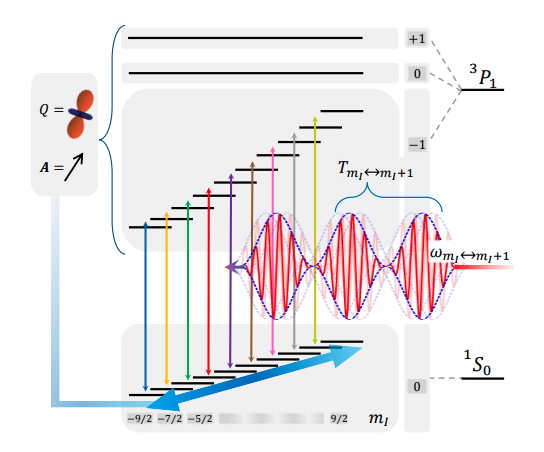
The pursuit of robust and scalable quantum computation increasingly focuses on utilising multi-level quantum systems, known as ‘qudits’, to enhance information density and processing capabilities. Recent research demonstrates precise control over these qudits within strontium atoms, leveraging a technique called optical nuclear electric resonance (ONER). This method leverages the interaction between light and the nucleus of the atom to manipulate its quantum state, providing a pathway to high-fidelity operations with an accuracy exceeding 99.9% even in the presence of environmental noise. Johannes K. Krondorfer, Matthias Diez, and Andreas W. Hauser, from the Institute of Experimental Physics at Graz University of Technology, alongside affiliations at the University of Graz, detail their findings in a study titled “Single Qudit Control in Sr via Optical Nuclear Electric Resonance”, establishing ONER as a promising avenue for advanced quantum information processing.
Researchers are actively refining optical nuclear electric resonance (ONER) as a method for achieving purely optical control over atomic qubits, extending capabilities beyond single-qubit operations to encompass multi-state control within hyperfine ground-state manifolds. This innovative approach establishes a robust platform for high-dimensional quantum information processing, consistently exceeding 99.9% fidelity in spin manipulations and paving the way for more complex quantum systems. The technique demonstrates control over strontium and cesium qubits, manipulating multiple hyperfine ground-state transitions within their respective nuclear spin manifolds.
Precise computational frameworks, leveraging tools like the QuTiP library, allow scientists to accurately model atomic behaviour, account for environmental interactions, and validate experimental findings with unprecedented accuracy. Researchers model the strontium and cesium atoms as open quantum systems, acknowledging the spontaneous emission inherent in excited state decay, and employ the Born-Markov Master Equation to describe the time evolution of the system. The Born-Markov Master Equation is a mathematical framework used to describe the evolution of open quantum systems, accounting for their interaction with the environment. This approach necessitates the use of the Lindblad superoperator, which accurately represents the decay process and associated collapse operators that govern transitions between energy levels and photon emission polarizations.
Specifically, the simulation defines the system’sHamiltonian, detailing the
Specifically, the simulation defines the system’s Hamiltonian, detailing the energy and interactions of the strontium or cesium atoms, and utilises a basis set denoted by |n, mJ, mI⟩. Here, ‘n’ represents the electronic state (ground state 1S0 or excited state 3P1), ‘mJ’ signifies the total angular momentum projection, and ‘mI’ denotes the nuclear spin projection. The simulation initiates from a defined initial state and proceeds by numerically solving the Master Equation using the QuTiP Python library and its mesolve function, allowing researchers to extract the occupation of different quantum states from the simulation results to analyse the system’s behaviour. Cesium-133, with its inherent nuclear spin of I=1/2, is used to demonstrate the technique.
Results indicate that ONER achieves high-fidelity spin manipulations, consistently exceeding 99.9% fidelity, even under realistic noise conditions. This level of control is achieved through precise modelling of the system’s dynamics, including the effects of spontaneous emission which are incorporated into the Master Equation. The computational methods employed leverage the QuTiP library to numerically solve the Master Equation, enabling the precise determination of occupation probabilities across various quantum states.
Future work should focus on extending these simulations to explore more complex pulse sequences and investigate the scalability of ONER to larger systems. Investigating the impact of different noise sources and developing strategies for error mitigation would further enhance the robustness of this control mechanism. Researchers actively demonstrate the potential of ONER to advance quantum technologies, offering a promising pathway towards building more powerful and reliable quantum computers and communication networks.
👉 More information🗞Single Qudit Control in Sr via
🗞 Single Qudit Control in Sr via Optical Nuclear Electric Resonance
🧠 DOI: https://doi.org/10.48550/arXiv.2506.23143


