
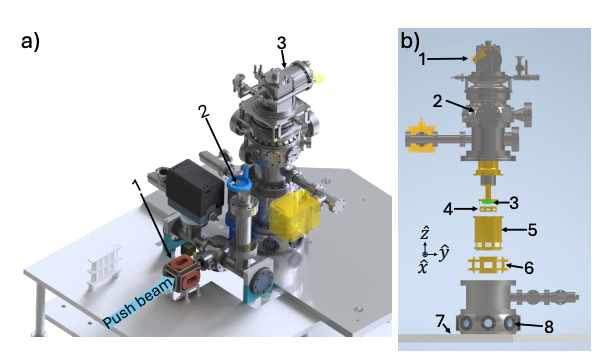
An 88Sr+ ion trap generates high-quality 408 nm photons for distributed quantum networking. The apparatus confines ion chains using a surface electrode trap and a magneto-optical trap as an atomic source. Researchers demonstrate single-photon emission from one to six ions, verified by a Hanbury Brown-Twiss measurement.
The development of robust and scalable photonic sources represents a critical challenge in the pursuit of distributed quantum computing and secure quantum communication networks. Researchers are increasingly turning to trapped ions as a promising platform for generating the single photons necessary for these applications, owing to their well-defined energy levels and long coherence times. Jianlong Lin, Mari Cieszynski, and colleagues from the University of Illinois Urbana-Champaign detail the construction and performance of an 88Sr+ ion trap apparatus specifically designed for the generation of high-quality 408 nm photons, as described in their article, “88Sr+ ion trap apparatus for generating 408 nm photons”. The instrument utilises a surface electrode trap and a two-dimensional magneto-optical trap to confine ion chains, enabling high-fidelity state preparation and readout. This is demonstrated through single-photon emission, as measured by a Hanbury Brown-Twiss experiment, with chains containing between one and six ions.
The construction and operation of a strontium-88 ion trap system represents a development in distributed quantum computing and networking. The apparatus confines chains of ions using a surface electrode trap, a technique in which ions are held in place by electric fields created by electrodes fabricated on a surface, and a two-dimensional magneto-optical trap, which utilises magnetic and laser fields to slow and capture ions. A comprehensive suite of laser systems facilitates high-fidelity state preparation and readout, essential for manipulating and measuring the quantum states of the ions.
Researchers successfully characterise the apparatus, achieving efficient ion
Researchers successfully characterise the apparatus, achieving efficient ion confinement and control. The system generates 408-nanometre light pulses via nonlinear techniques, specifically second-harmonic generation, to access the excited states of the Sr+ ions. These excited states are crucial for producing single photons, particles of light that carry quantum information. Single-photon emission is validated using a Hanbury Brown-Twiss measurement, an interferometric technique that determines the statistical nature of light. The observed anti-bunching, a reduction in the probability of detecting two photons simultaneously, confirms the emission originates from a single emitter for ion chains containing one to six ions, demonstrating a degree of control over the emission process.
The apparatus builds upon established techniques in ion trap physics and laser spectroscopy. Previous work, including Brownnutt’s (2007) doctoral thesis, which detailed Sr+ ion trapping techniques, provided a foundation for the current design. The comprehensive resource on single-photon generation and detection edited by Migdall et al. (2013) informed the development of the single-photon detection scheme. Software tools, such as the Qiskit documentation (Bourdeauducq et al., n.d.) and the OpenQL framework (Risinger et al., n.d.), provide control and analysis capabilities, facilitating future research and development in this area. These resources enable the implementation of complex quantum algorithms and the characterisation of the system’s performance.
👉 More information🗞88Sr+ ion trap apparatus for generating
🗞 88Sr+ ion trap apparatus for generating 408 nm photons
🧠 DOI: https://doi.org/10.48550/arXiv.2507.02108