

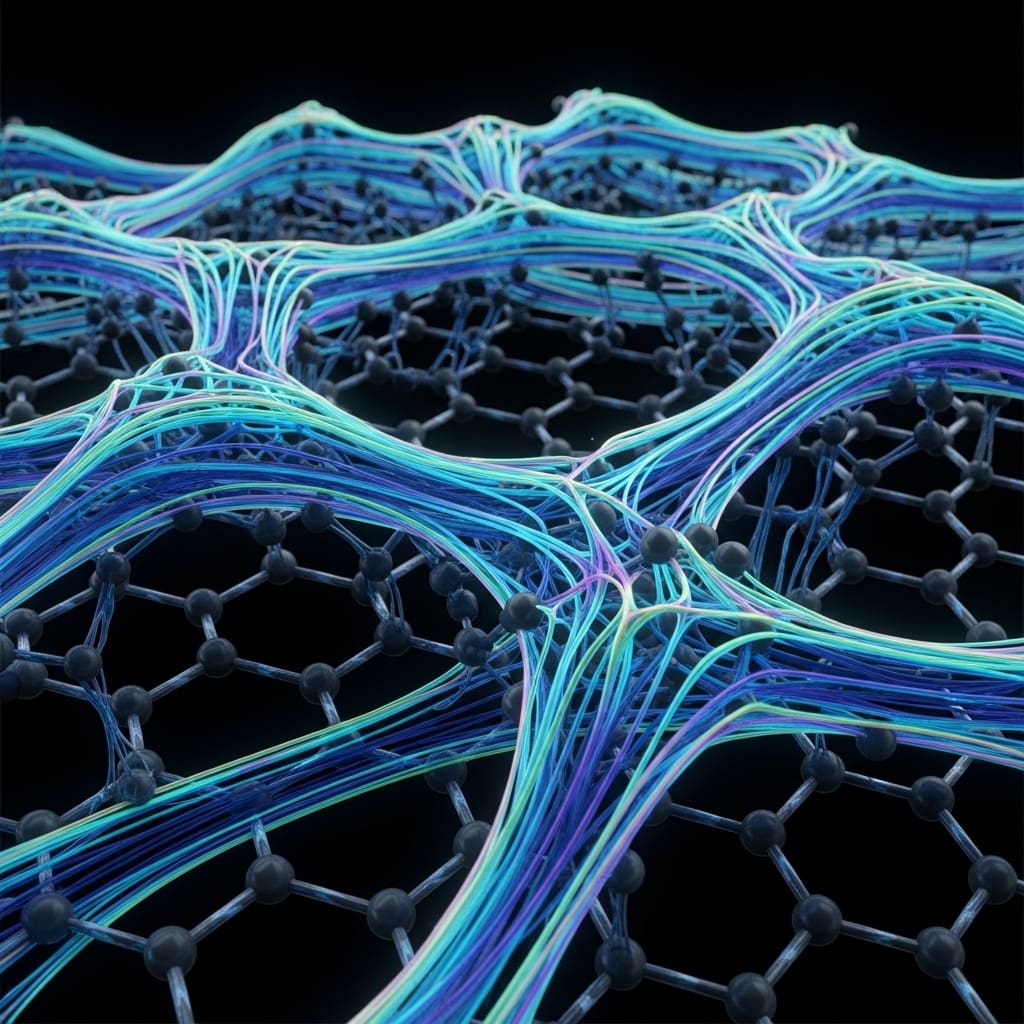
Superconductivity in graphene, a two-dimensional carbon material, is attracting considerable attention as a potential pathway to next-generation electronic devices. Tao Zhou, from South China Normal University, alongside colleagues, has investigated how applying strain to graphene impacts its superconducting properties, challenging existing theories that suggest a high density of electronic states always promotes pairing. Their research identifies a ‘kinetic blockade’ , where strain-induced polarisation actually inhibits superconductivity at certain points. Instead, the team demonstrate that superconductivity arises as robust filaments forming a unique ‘pair density wave’ state, offering a novel geometric origin for this phenomenon and opening new avenues for manipulating material properties through strain engineering.
We investigate superconductivity in strain-engineered graphene using a self-consistent Bogoliubov-de Gennes approach. Challenging the paradigm that the high density of states in flat bands universally enhances pairing, we identify a “kinetic blockade” mechanism. Strain-induced sublattice polarization segregates electronic states, rendering these singularities inert to superconductivity. Instead, superconductivity emerges as robust filaments at geometric nodes, forming a pair density wave state. This state features a sign-reversing order parameter, which is potentially detectable via impurity-induced zero-energy modes. Our findings reveal a unique geometric origin for filamentary superconductivity, offering new perspectives on strain engineering for novel superconducting phenomena.
Strain-Induced Superconductivity via Pseudomagnetic Fields Graphene’s electronic properties
This research details a theoretical exploration of how strain in graphene can induce unconventional superconductivity, focusing on a pairing mechanism related to pseudomagnetic fields and the formation of midgap states. Strain generates “pseudomagnetic fields” within the graphene lattice, mimicking the effects of a real magnetic field and leading to Landau level quantization. The combination of strain and pseudomagnetic fields creates midgap states, crucial for superconducting pairing, potentially related to Fulde-Ferrell-Larkin-Ovchinnikov (FFLO) type pairing where Cooper pairs have a finite momentum. The research builds on graphene’s 2D structure, high electron mobility, and sensitivity to external stimuli like strain.
Graphene sheets naturally exhibit ripples and corrugations, which can also contribute to the formation of midgap states and pseudomagnetic fields. The authors draw parallels to recent discoveries of superconductivity in nickelate materials, suggesting similar pairing mechanisms might be at play, and propose that impurity states could be used to probe pairing symmetry in these materials. Techniques like graphene kirigami can precisely control strain, offering a pathway to engineer and study these superconducting states. The research utilizes a combination of ab initio calculations and effective field theory to understand the electronic structure and pairing interactions in strained graphene. The superconducting state is sensitive to impurities, which can induce localized states and affect superconducting properties, providing a potential probe to understand the nature of the pairing. This proposes a novel route to achieving superconductivity in graphene through strain engineering, leveraging its unique electronic properties and drawing connections to emerging superconducting materials.
Strain Blocks Superconductivity, Creates Filaments
Scientists investigated superconductivity in graphene subjected to strain, employing a self-consistent Bogoliubov-de Gennes approach. Challenging the expectation that high density of states in flat bands always promotes pairing, the research identified a “kinetic blockade” mechanism where strain-induced sublattice polarization effectively isolates electronic states. This segregation renders the high density of states inert, preventing the formation of conventional superconductivity in these regions. Instead, superconductivity emerges as robust filaments specifically at geometric nodes, manifesting as a pair density wave.
Experiments revealed a unique spatial dissociation of the superconducting order parameter, with pairing amplitude suppressed within the high-density-of-states flat bands. Maximum pairing occurs not where the density of states is highest, but at the nodes of corrugation. This unexpected result stems from the extreme sublattice polarization induced by the strain, confining electrons to a single sublattice and hindering the necessary wavefunction overlap for coherent pairing. The flat-band regions exhibit suppressed pairing despite the high density of states, a phenomenon termed a kinetic blockade. Analysis of the electronic landscape in the normal state showed that unidirectional corrugation generates a periodic pseudo-magnetic field, resulting in flat bands at the Fermi energy.
The calculated energy band structure along the ky direction exhibited these flat bands, corresponding to zeroth pseudo-Landau levels. Spatial profiles of the zero-energy local density of states demonstrated a distinct separation of wavefunctions, with A-sublattice states localized near x = 0.33L and 0.83L, and B-sublattice states peaking at x = 0.17L and 0.67L. This valley-dependent segregation is a fundamental obstruction to pairing, as the localized states lack the necessary overlap. The study utilized a unidirectional corrugated modulation with a period of L = 500 unit cells and a corrugation ratio of r = h/L = 0.16, a value considered within experimental reach. Using an unstrained nearest-neighbor hopping of t0 as the unit of energy, the team set the pairing interaction strength to V = 1.6, the temperature to T = 10−5, the chemical potential to μ = 0, and the spectral broadening to Γ = 0.004 for their numerical calculations. This delivers a geometric origin for filamentary superconductivity, offering new perspectives on strain-tuned phases in Dirac materials and potentially paving the way for novel superconducting devices.
Strain-Induced Filaments and Pairing Blockade
This research demonstrates a novel mechanism for superconductivity in strained graphene, challenging the expectation that high density of states always promotes pairing. The authors identified a ‘kinetic blockade’ arising from strain-induced sublattice polarization, which inhibits superconductivity in flat bands. Instead, superconductivity manifests as robust filaments at geometric nodes, forming a pair density wave characterised by a sign-reversing order parameter. The significance of this work lies in revealing a geometric origin for filamentary superconductivity, distinct from the twistronics paradigm. This suggests a broader principle where non-uniform strain acts as a ‘phase filter’, spatially separating regions conducive to pairing from those where it is suppressed, naturally leading to textured superconductivity. Future research directions include exploring the impact of varying strain configurations and investigating the potential for manipulating these filamentary superconducting states for technological applications, as well as extending the theoretical framework to other Dirac materials.
👉 More information
🗞 Kinetic Blockade and Filamentary Pair Density Waves in Strain-Engineered Graphene
🧠 ArXiv: https://arxiv.org/abs/2601.08586


