

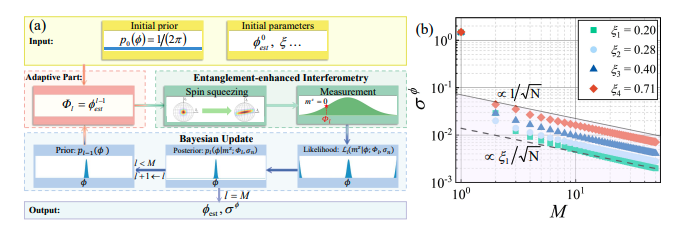
Quantum sensing promises increasingly precise measurements of physical quantities, but achieving optimal performance requires overcoming fundamental limitations, and researchers continually seek ways to push beyond these boundaries. Jinye Wei, Jungeng Zhou, and Yi Shen, along with colleagues from Shenzhen University, now demonstrate a new approach to quantum sensing that leverages the unique properties of ‘spin-squeezed’ states to enhance precision. The team develops an adaptive Bayesian estimation protocol that actively maintains measurements at the optimal point, and uses Bayesian inference to sequentially estimate phase with remarkable accuracy, even in noisy environments. This method represents a significant step forward because it delivers robust, high-precision measurements with spin-squeezed states, and holds considerable promise for applications ranging from advanced gravimeters to next-generation atomic clocks.
Spin-squeezed states represent a valuable entanglement resource capable of surpassing the standard quantum limit, but achieving optimal measurement precision with these states remains a significant challenge. Scientists have now developed an adaptive Bayesian quantum estimation protocol that achieves optimal measurement precision with spin-squeezed states, even under noisy conditions. This protocol functions by continuously adjusting measurements to maintain optimal performance and utilizing Bayesian inference to sequentially estimate phase, resulting in robust and highly precise measurements.
Quantum Precision via Atomic Measurements
This body of work represents a comprehensive investigation into quantum metrology, precision measurement, and related technologies, including atomic clocks and atom interferometry. Researchers are actively exploring techniques to enhance measurement precision beyond classical limits by harnessing quantum phenomena like entanglement and squeezing. A significant focus lies on developing atomic clocks with ever-increasing precision and stability, pushing the boundaries of timekeeping accuracy. Atom interferometry is also a key area of research, with applications ranging from gravity measurements and inertial sensing to fundamental tests of physics, both on the ground and in space.
These investigations emphasize the generation and utilization of entangled states and squeezed states of light or matter to improve measurement sensitivity. Trapped ions and neutral atoms are frequently employed as qubits for quantum sensing and metrology, with researchers exploring various interactions to enhance performance. Cavity quantum electrodynamics is also utilized to enhance light-matter interactions and generate squeezed states for sensing applications. There is growing interest in deploying quantum sensors in space for gravity mapping, fundamental physics tests, and navigation. Furthermore, machine learning techniques are increasingly being applied to optimize quantum sensing protocols and analyze data.
Potential areas of focus based on this research include the development of next-generation atomic clocks with unprecedented precision, the creation of high-resolution gravity maps using space-based quantum sensors, and the development of more accurate and robust inertial navigation systems. Quantum sensors are also being used to test fundamental physics theories and improve imaging systems. Combining different types of qubits and utilizing machine learning algorithms to optimize quantum sensing protocols are also promising avenues of research. Rydberg atom-based quantum sensors, leveraging strong atomic interactions, are also under investigation. This research paints a picture of a vibrant and rapidly evolving field dedicated to pushing the boundaries of precision measurement and sensing.
Adaptive Bayesian Estimation Boosts Phase Precision
Scientists have developed an adaptive Bayesian estimation protocol that achieves optimal measurement precision when using spin-squeezed states, even in the presence of noise. The protocol operates by maintaining measurements near the optimal point and employing Bayesian inference to sequentially estimate phase, resulting in robust, high-precision measurement capabilities. The team explicitly incorporated phase and depolarization noises into the Bayesian likelihood function to more accurately model realistic experimental conditions and enhance estimation accuracy. Statistical analysis reveals that precision decreases predictably with increasing depolarization noise, while phase noise significantly distorts the likelihood function if not properly accounted for.
The researchers addressed this distortion by reshaping the uncertainty to maintain a stable likelihood function, even under strong phase noise, thereby reducing estimation errors and fluctuations. The method’s effectiveness is quantified by demonstrating a precision scaling consistent with quantum projection noise, and an order of magnitude improvement over conventional approaches when subjected to realistic noise conditions. In gravimetry experiments using cold rubidium atoms, the protocol achieves a precision scaling with interrogation time and maintains a broad dynamic range, allowing for accurate measurements across a wide spectrum of gravitational accelerations. This advancement offers significant potential for applications in areas such as gravimeters, atomic clocks, and atomic gyroscopes, enabling more sensitive and accurate measurements than previously possible.
Adaptive Bayesian Estimation Boosts Spin-Squeezed Precision
This research presents an adaptive Bayesian estimation protocol that enhances the precision of measurements using spin-squeezed states, even in the presence of noise. The protocol operates by dynamically maintaining measurements at optimal points and employing Bayesian inference to sequentially estimate phase, resulting in robust and high-precision results. By incorporating phase noise directly into the estimation process, the method achieves improved accuracy compared to conventional fitting techniques, demonstrating its potential for applications such as gravimeters and atomic clocks. The team’s approach integrates adaptive locking to optimal working points, noise-resilient estimation via a reshaped likelihood function, and correlated interferometry to facilitate Bayesian iteration.
This combination delivers superior sensitivity and robustness without sacrificing dynamic range, establishing a comprehensive framework for quantum-enhanced metrology. While the study demonstrates significant improvements, the authors acknowledge that the performance of the protocol is dependent on accurate characterisation of the noise present in the system. Future work could focus on refining the noise characterisation techniques and exploring the application of this protocol to more complex sensing scenarios. The authors also suggest that this framework could be extended to other quantum sensing platforms, potentially broadening the impact of this research.
🗞 Practical robust Bayesian spin-squeezing-enhanced quantum sensing under noises
🧠 ArXiv: https://arxiv.org/abs/2509.08316


