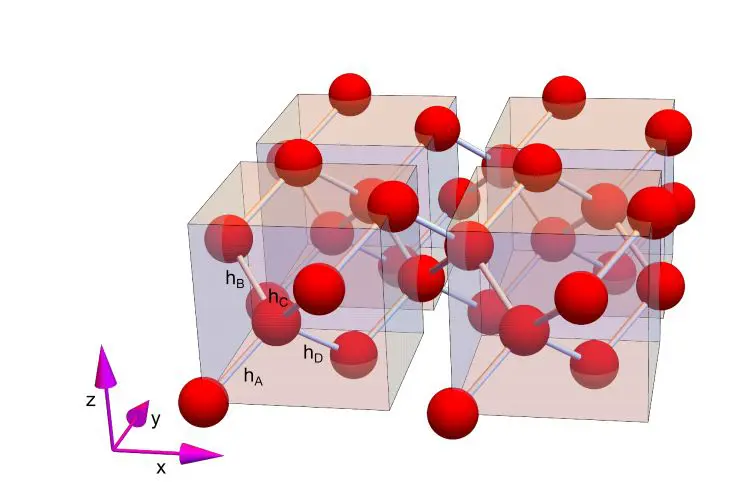
Tin, a seemingly ordinary metal, exhibits surprising topological properties according to new research led by Jan Skolimowski of the International Research Centre Magtop, Nguyen Minh Nguyen from The Chinese University of Hong Kong, Shenzhen, and Giuseppe Cuono of the Consiglio Nazionale delle Ricerche. The team demonstrates that cubic tin possesses a rare ‘dual topology’, meaning it simultaneously hosts two distinct topological invariants, a characteristic previously observed in only a few materials. Through detailed modelling, they reveal a complex interplay between strain and layer thickness, predicting the emergence of a non-trivial spin Hall state under specific compressive conditions in multi-layered structures. Importantly, the researchers discover a wealth of unique edge states, localized at surfaces and hinges, that exist regardless of the material’s topological phase, offering potential avenues for novel electronic devices and a deeper understanding of topological phenomena.
Scientists have formulated a tight-binding model for cubic tin, based on density functional theory calculations, to investigate its topological properties and electronic structure. The model accounts for the effect of in-plane strain by allowing for a variable bond angle, enabling researchers to explore how strain influences the material’s behaviour. Calculations reveal the presence of a topological invariant and a non-zero mirror Chern number in bulk tin, classifying it as a rare material exhibiting dual topology.
Topological Insulators and Semimetals Foundations
A comprehensive review of existing research highlights the foundational concepts and ongoing investigations within the field of topological materials. Early work by Fu and Kane established the theoretical framework for topological insulators with inversion symmetry, forming a cornerstone of the field. Subsequent experiments demonstrated the realization of topological crystalline insulators, such as lead tin selenide and tin telluride, revealing how crystal symmetry protects the topological surface states. Researchers have also explored materials exhibiting completely flat bands and localized states, potentially leading to unconventional superconductivity.
Investigations into Dirac and Weyl semimetals, including platinum telluride and platinum selenide, have focused on characterizing Type-II materials with tilted Dirac or Weyl cones, exhibiting distinct properties from conventional semimetals. A significant body of work addresses the robustness and fragility of topological edge states, examining the effects of disorder, interactions, and symmetry breaking. Researchers have explored mechanisms leading to edge reconstruction and loss of topological protection, while also investigating the role of spin-orbit coupling in creating and protecting these states. Further studies have examined how electron-electron interactions can modify edge state properties and potentially lead to new phases of matter. Computational methods, including density functional theory, play a crucial role in predicting and understanding the properties of topological materials, utilizing databases of calculated material properties and refining models, such as tight-binding methods, to accurately describe electronic structure.
Strain-Induced Dual Topology in Cubic Tin
Scientists have calculated a topological phase diagram for multilayer tin as a function of strain and layer number. They discovered that a non-trivial spin Hall state emerges only under compressive strain in structures with more than five layers. Surprisingly, both trivial and non-trivial phases exhibit a variety of edge states localized at different surfaces, side surfaces, top/bottom surfaces, and hinges, with energies falling within the bulk band gap. These states originate from a minimal model supporting chiral symmetry and multiple one-dimensional winding numbers that vary depending on direction within the Brillouin zone. Measurements confirm a band inversion between key energy levels, a characteristic of the material’s topological nature. The team’s tight-binding model achieves a high degree of accuracy, with parameters refined by fitting the band structure at key points and renormalizing hopping parameters to match experimental observations, accurately capturing the low-energy band structure of tin and confirming the absence of band crossing at the Fermi level.
Compressive Strain Induces Dual Topological Phases
This research establishes that multilayer tin can exhibit a quantum spin Hall phase under compressive strain, dependent on the number of layers present. Calculations reveal that a non-trivial spin Hall state emerges only with compressive strain in structures exceeding five layers in thickness. Interestingly, the investigation uncovered a variety of edge states within the energy gap, appearing in both trivial and non-trivial phases, and localizing on side surfaces, top/bottom surfaces, or hinges of the material. The microscopic origin of these states was traced to a model supporting chiral symmetry and multiple one-dimensional winding numbers. While rigorous higher-order topological states were not observed, the team suggests these states may be linked to the mirror Chern number, similar to observations in other materials. Future research could explore similar physics in van der Waals materials, with platinum selenide and platinum telluride identified as promising candidates for hosting the quantum spin Hall phase, contributing to a growing understanding of topological materials and potentially guiding the development of novel electronic devices.
🗞 Dual topology and edge-reconstruction in -Sn
🧠 ArXiv: https://arxiv.org/abs/2511.23289