

Bound entanglement, a subtle yet potentially powerful form of quantum correlation, presents a significant challenge to physicists seeking to fully harness quantum mechanics. Jonathan Louvet, François Damanet, and Thierry Bastin, all from the University of Liège, tackle this problem by exploring symmetric random induced states, where this weak form of entanglement arises naturally under specific conditions. Their work demonstrates that bound entanglement emerges with a very high probability when using optimal parameters, and reveals that different methods for creating these states yield distinct types of entanglement. This research provides a versatile approach to generating a wide range of random bound entangled states, bypassing the need for complex calculations and opening new avenues for exploring its potential applications in quantum technologies.
This research addresses this difficulty by utilizing symmetric random induced states, where bound entanglement naturally arises when considering only a portion of the system. The team investigates these states to determine the extent of bound entanglement present and to develop reliable methods for its detection. Specifically, the work characterizes the entanglement properties of symmetric random induced states and establishes criteria for identifying bound entanglement within these systems. This approach provides a pathway towards constructing and verifying bound entanglement in a more accessible manner, potentially facilitating its use in quantum information processing applications.
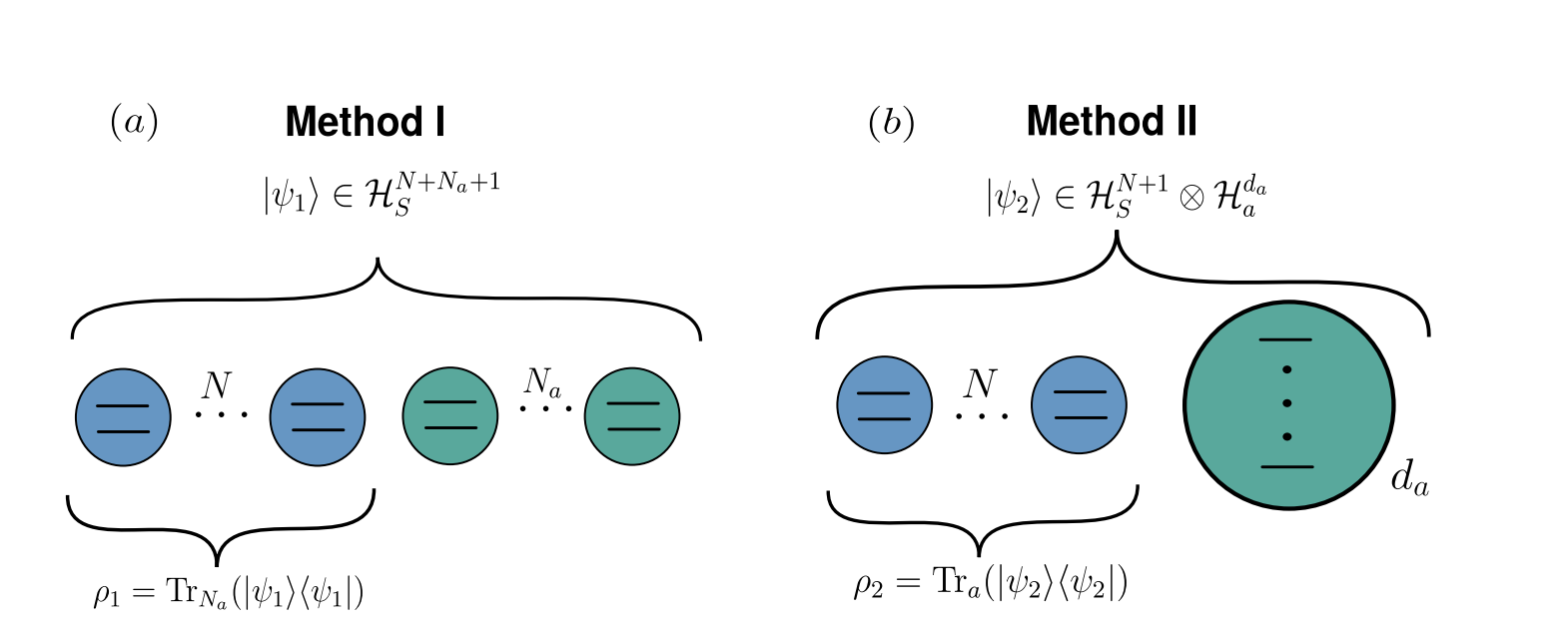
The investigation focuses on the probability of finding positive-partial-transpose (PPT) bound entanglement in symmetric random induced states when selecting appropriate parameters. This is achieved through two methods: partial tracing of symmetric multiqubit pure states and tracing out a qudit ancilla. For systems with more than three qubits, the results demonstrate that bound entanglement naturally emerges under optimal parameters, occurring with a probability very close to one. The team shows that these two methods generate different varieties of PPT bound entangled states and identifies the contexts in which each method offers distinct advantages. These methods provide a versatile toolkit for generating large families of random states.
Bound Entanglement and Quantum State Separability
Entanglement is a fundamental quantum phenomenon where particles become linked, even when separated, and is a key resource for quantum technologies. Quantum states are either separable or entangled. The positive partial transpose (PPT) criterion tests for separability; if a state fails this test, it must be entangled. Bound entanglement is a particularly subtle form of entanglement that, unlike other types, cannot be distilled into a higher rate of entanglement using local operations and classical communication. This limits its usefulness for some quantum protocols, but it remains a fascinating area of study.
This research delves into the properties of bound entangled states, focusing on their construction and characterization. The document explores various methods for creating bound entangled states, including using permutation operators, combining different entangled states, exploiting mathematical structures, and investigating random induced states. It also focuses on identifying and classifying bound entangled states using criteria like the PPT criterion and range criterion, and analyzing their relationship to unextendible product bases. The research utilizes mathematical tools such as density matrices, partial transpose, convex analysis, and random matrix theory. Specific classes of states, including Bell diagonal states, symmetric states, and random induced states, are also investigated, along with the implications for quantum communication and computation. Numerical simulations and analysis are used to verify the theoretical results, and bound entanglement is contrasted with other forms of entanglement.
This research is important for several reasons. It deepens our understanding of the different types of entanglement and their properties, contributing to the development of quantum information theory, the foundation for quantum technologies. Understanding the limitations of bound entanglement is crucial for designing efficient quantum communication and computation protocols. While not directly useful for distillation, bound entanglement can still play a role in other quantum protocols, potentially impacting quantum cryptography and leading to the development of new criteria for identifying entangled states. The study also contributes to mathematical physics, potentially leading to new mathematical tools and techniques.
Key takeaways from this research include the understanding that bound entanglement is a subtle form of entanglement that cannot be distilled, that characterizing it requires sophisticated mathematical tools, and that understanding its properties is crucial for designing efficient quantum information protocols. This work represents a significant contribution to the field of quantum information theory, providing a deep and detailed analysis of bound entanglement and having important implications for the development of quantum technologies.
Bound Entanglement From Random Induced States
This work demonstrates that symmetric random induced states offer an effective means of generating bound entangled states, even in systems with a limited number of qubits. By investigating two distinct methods, partial tracing of multiqubit states and tracing out a qudit ancilla, researchers consistently achieved high probabilities of generating these states as system size increased. The results reveal that these methods produce different types of bound entangled states, with the first method offering greater variety for theoretical exploration and the second providing increased robustness and a wider operational range, potentially benefiting experimental implementations. The team also identified specific patterns in the distribution of bound entanglement, including a predictable relationship between the number of qubits and the probability of generating these states, and a sequential emergence of entanglement across different subsets of the system. Furthermore, analysis of Hilbert-Schmidt distances confirms the diversity of states generated using this approach, highlighting its versatility as a resource for entanglement studies. While acknowledging that further research is needed to fully explore the operational utility of these states in quantum technologies, this work establishes symmetric random induced states as a flexible and powerful framework for both theoretical analysis and potential experimental realization of bound entanglement.
🗞 Bound entanglement in symmetric random induced states
🧠 ArXiv: https://arxiv.org/abs/2510.23480


