

The quest for robust and scalable single-photon sources underpins many emerging quantum technologies, and achieving this often requires complex interactions between light and matter. Zi-Qi Zeng, Jian Wang, and Xiu-Bin Liu, alongside colleagues including Xu-Jie Wang and Li Liu, have now demonstrated a new approach to generating these crucial particles of light. The team successfully creates superposition states, where a photon exists in multiple states simultaneously, using a technique called resonance fluorescence from a single quantum dot. By manipulating these superpositions and employing a standard optical setup, they observe a clear violation of a fundamental principle of physics, the Bell inequality, paving the way for simpler and more practical solid-state photon sources for future quantum networks.
Creating Vacuum-One-Photon Qubit Superpositions
This research details a significant advance in generating quantum light by creating a unique superposition of states with either no photons or exactly one photon. Scientists are developing these “vacuum-one-photon” qubits as building blocks for future quantum technologies, addressing a key challenge: controlling the number of photons emitted from a quantum source. The team successfully generated and characterized these vacuum-one-photon entangled states using a quantum dot, achieving improved control over photon number and enhancing entanglement quality. Entanglement is created by encoding information in the arrival time of the photons, a technique known as time-bin entanglement, well-suited for quantum communication.
The researchers demonstrate the potential for scaling up these systems to create more complex, multi-photon entangled states essential for advanced quantum applications. They leveraged the Purcell effect, which enhances light emission within a resonant cavity, to improve the efficiency and quality of the light source. Crucially, the team demonstrated a violation of the Bell inequality, proving that the generated entanglement is genuinely non-classical and cannot be explained by classical physics. This achievement represents a significant step towards realizing practical quantum communication and computing systems, paving the way for more advanced quantum technologies.
Entanglement from Single Quantum Dot Resonance Fluorescence
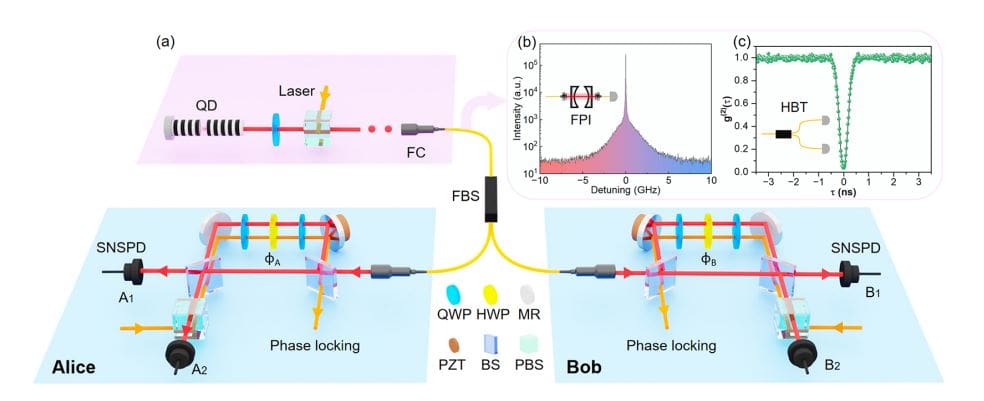
This research demonstrates a new approach to generating entangled photons, crucial for advancements in quantum technologies. Scientists achieved the creation of time-bin entanglement directly from the natural fluorescence emitted by a single quantum dot, simplifying previous methods that required complex multi-photon generation. The team measured a clear violation of the Clauser-Horn-Shimony-Holt Bell inequality, providing direct evidence of genuine entanglement between spatially separated locations and confirming the quantum nature of the generated photon pairs. The experimental setup utilizes a self-assembled quantum dot coupled to a micropillar cavity, driven by a continuous wave laser.
Under low excitation conditions, the device emits a stream of single photons exhibiting anti-bunched photon statistics, meaning photons are emitted one at a time. This emission is then split and directed into independent time-bin analyzers, which measure the arrival time of the photons. By carefully controlling the phase of these analyzers, the team generated and measured time-entangled states, resembling a superposition of vacuum and single photon states. Detailed experiments revealed a clear periodic dependence on the phase, confirming the entanglement and allowing for precise measurement of its properties. The experimental results closely matched theoretical simulations, validating the approach and demonstrating the high fidelity of the generated entangled states.
Scalable Entanglement from Single Quantum Dots
This research demonstrates a new method for generating time-bin entanglement using the natural fluorescence emitted by a single quantum dot. By exploiting vacuum-one-photon superposition states created through resonant excitation, the team successfully violated the Clauser-Horn-Shimony-Holt Bell inequality using a Franson-type interferometer, confirming the generation of entangled photons. This approach simplifies previous entanglement generation techniques by removing the need for complex multi-photon generation or signal processing, while also offering low power consumption and stable transmission. The findings establish a scalable pathway towards practical, solid-state photon sources for quantum technologies. The high brightness of this source allows for extending time-bin entanglement across multiple spatial modes, opening possibilities for more complex nonlocal tests and the creation of genuinely multipartite entangled states. Researchers suggest that by replacing the current beam splitter with a more complex optical component, it may be possible to distribute entanglement among a larger number of modes, bringing high-dimensional quantum networks closer to realization.
👉 More information
🗞 Bell Inequality Violation with Vacuum-One-Photon Number Superposition States
🧠 ArXiv: https://arxiv.org/abs/2511.15413

