The behaviour of quantum systems as they evolve over time remains a fundamental question in physics, and understanding how these systems relax to equilibrium is particularly challenging. Researchers led by J. O. Austin-Harris, P. Sigdel, and C. Binegar, alongside colleagues including S. E. Begg, T. Bilitewski, and Y. Liu, now present a significant advance in controlling and observing these dynamics using ultracold gases. Their work establishes a new method for tracking the evolution of quantum states, allowing them to define a clear indicator of change and infer interactions between particles from a single measurement. Crucially, the team demonstrates experimental access to unusual “non-ergodic” behaviour, where systems retain a memory of their initial state even while seemingly relaxing towards equilibrium, opening new avenues for exploring the complex interplay between memory and thermalisation in quantum systems.
Observation of phase memory and dynamical phase transitions in spinor gases J. O. Austin-Harris, P. Sigdel, C. Binegar, S.
Spinor Bose-Einstein Condensate Dynamics Characterization
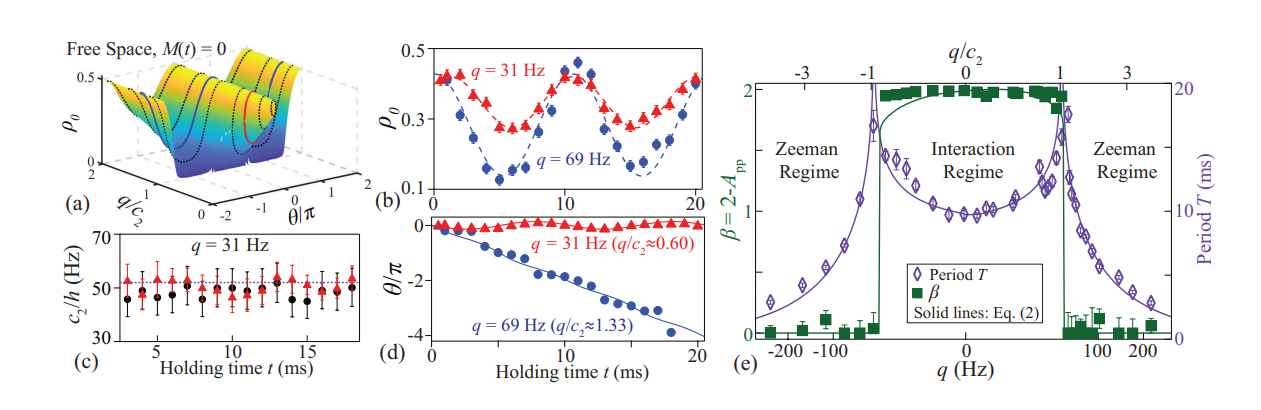
Scientists engineered a novel experimental platform using ultracold spinor gases to investigate many-body quantum dynamics, establishing a toolkit for precise control and characterisation of nonequilibrium phenomena. The study harnessed F=1 spinor Bose-Einstein condensates, containing up to 105 sodium atoms trapped within a crossed optical dipole trap, as the foundation for their investigations into complex quantum behaviours. Each experimental cycle began with preparation of a desired initial state using a resonant radio-frequency pulse, setting the stage for manipulation of the system’s quantum properties. The team developed a method to extract the evolution of spinor phases from observed spin population dynamics, defining an order parameter that sharply identifies dynamical phase transitions across a wide range of conditions.
This innovative approach overcomes limitations of previous studies reliant solely on spin population measurements, which often obscured crucial connections to underlying spinor physics and required comparison to theoretical predictions. The newly defined order parameter provides a more rigorous method for directly obtaining the dynamical phase diagram and characterizing these transitions, even in scenarios lacking established theoretical predictions. Furthermore, scientists pioneered a technique for inferring spin-dependent interactions from a single experimental time trace, a significant advancement over the standard approach that necessitated mapping a cross section of the phase diagram. This streamlined method holds immediate applications for systems experiencing complex time-dependent interactions, offering a more efficient pathway to understanding their behaviour.
The research also demonstrates control over non-ergodic relaxation dynamics, where states within the nominally thermal region of the energy spectrum retain memory of the initial state, achieved through precise manipulation of spinor phases. Specifically, the team observed memory of two relative spinor phases, demonstrating that these states can exhibit non-thermal values at late times. Together, this work establishes experimental control over spinor phases as a powerful tool for probing and controlling nonequilibrium dynamics, opening new avenues for research in quantum many-body physics.
Spinor BEC Dynamics and Ergodicity Breaking
This research details a comprehensive investigation into the dynamics of spinor Bose-Einstein condensates, focusing on their response to various external influences. The experimental system centres on spin-1 BECs, which exhibit richer physics than simpler scalar BECs due to their internal spin degree of freedom. Key areas of exploration include quantum phase transitions, non-equilibrium dynamics, ergodicity breaking, quantum many-body scars, and the application of Floquet engineering and high-frequency drives. The research also examines thermalization and the breakdown of ergodicity, investigating conditions where the system fails to reach equilibrium.
The team employs techniques such as microwave dressing, moving optical lattices, and periodic drives to induce and control these dynamics, carefully monitoring the system’s behaviour through observation techniques commonly used in cold atom physics. The theoretical framework relies heavily on Floquet theory, a powerful tool for analysing systems under periodic driving. This allows for an effective description of the dynamics using a time-independent Hamiltonian, calculated through the Floquet-Magnus expansion. The theoretical calculations are performed in the interaction frame to simplify the analysis and derive an effective Hamiltonian that captures the essential physics of the driven system.
The team uses thermal micro-canonical expectation values to describe the system’s behaviour, mapping phase diagrams and studying antiferromagnetic condensates in optical lattices. They investigate quench dynamics and observe evidence for ergodicity breaking and the presence of quantum many-body scars, as well as dynamical phase transitions induced by the driving forces. This detailed work provides a foundation for understanding complex quantum many-body physics, thermalization, and ergodicity in ultracold atomic gases.
Spinor Gas Dynamics and Non-Ergodic Relaxation
Scientists have achieved significant advances in the control and characterisation of quantum dynamics using ultracold spinor gases. This work establishes a robust toolkit for precisely manipulating and observing the behaviour of these gases, allowing researchers to extract detailed information about their evolution over time. A key accomplishment is the development of a method to infer spin-dependent interactions from a single experimental measurement, a substantial improvement over previous techniques that required extensive data collection. This new approach offers a streamlined way to study complex systems experiencing time-dependent interactions.
Furthermore, the team demonstrated experimental access to and control over non-ergodic relaxation dynamics, a phenomenon where states retain memory of their initial conditions even as they approach thermal equilibrium. By manipulating the internal phases of the spinor gases, scientists induced these non-ergodic behaviours, opening new avenues for investigating the fundamental principles governing thermalization. The researchers acknowledge that the observed dynamics are sensitive to the initial conditions, and further investigation is needed to fully understand the range of behaviours possible. Future work will likely extend these techniques to more complex protocols, such as those involving moving lattices, and explore potential applications in quantum computation and sensing, including enhanced quantum sensing near critical points and state preparation for quantum metrology. This research matures quantum simulation capabilities in spinor Bose condensates, leveraging full phase control for increasingly sophisticated experiments.
🗞 Observation of phase memory and dynamical phase transitions in spinor gases
🧠 ArXiv: https://arxiv.org/abs/2511.03720