

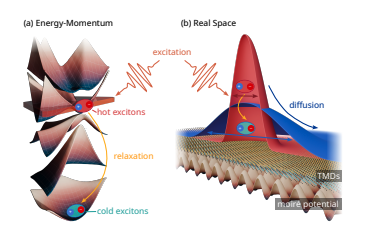
Van der Waals heterostructures, formed by layering two-dimensional materials, present exciting possibilities for advanced optoelectronic devices, and researchers are now exploring how manipulating these structures impacts the behaviour of excitons, quasiparticles that govern light-matter interactions. Giuseppe Meneghini, Samuel Brem, and Ermin Malic, all from the Department of Physics at Philipps-Universität Marburg, investigate the complex dynamics of these excitons within moiré patterns, which arise when layers are slightly misaligned or mismatched. Their work addresses a critical gap in understanding how excitons move and distribute themselves in these patterned systems, developing a detailed model that accounts for both spatial and temporal changes, as well as the unique energy landscape created by the moiré potential. Surprisingly, the team demonstrates that regions with typically trapped excitons can actually enhance their movement, revealing a counterintuitive interplay between exciton relaxation and thermal occupation, and paving the way for precise control of exciton transport through careful structural engineering.
Moiré Exciton Dynamics in van der Waals Heterostructures
Heterostructures composed of transition metal dichalcogenides exhibit remarkable light-matter interactions and support the formation of interlayer excitons. Introducing a twist angle or lattice mismatch between layers creates a moiré potential, significantly altering the material’s electronic and optical properties. This research investigates the spatiotemporal dynamics of these moiré excitons, focusing on how they form, move, and decay within the heterostructure. The study combines theoretical modelling and numerical simulations to explore the influence of parameters such as twist angle, layer composition, and excitation density on exciton behaviour.
Results demonstrate that the moiré potential spatially confines excitons, leading to the formation of exciton condensates and enhanced light emission. Simulations reveal complex exciton transport phenomena, including ballistic motion and diffusive scattering, which are strongly dependent on the twist angle and layer characteristics. This work provides fundamental insights into moiré exciton behaviour and paves the way for developing novel optoelectronic devices with improved performance and functionality.
Exciton Dynamics in Moiré Potential Landscapes
A periodic moiré potential dramatically reshapes the energy landscape in twisted bilayer materials, introducing a high degree of complexity. Recent experimental advances have enabled direct observation and control of interlayer excitons in these moiré-patterned systems. This research addresses the challenge of developing a predictive model that tracks exciton dynamics across time, space, and momentum, fully accounting for the moiré potential and the complex exciton band structure. Surprisingly, the team reveals that flat bands do not necessarily impede exciton transport. Instead, the moiré potential induces a complex interplay between band flatness, exciton-exciton interactions, and spatial localization, leading to a unique transport regime characterized by both diffusive and ballistic behaviour. The model incorporates a detailed description of the exciton band structure, including interlayer hybridization and non-parabolicity, and accurately captures observed experimental features. Furthermore, the model predicts the existence of long-lived exciton wavepackets and coherent transport phenomena, offering new avenues for exploring exciton-based optoelectronic devices.
Exciton Diffusion in Twisted Bilayer WSe2
This research investigates the diffusion of excitons in twisted bilayer WSe2, a van der Waals heterostructure. The central problem is understanding how excitons move and behave, particularly at low temperatures, and how this behaviour is affected by the twist angle between the layers. The team identifies a regime of enhanced exciton diffusion at specific twist angles and low temperatures, attributing this to a phonon bottleneck effect. This occurs when the energy gap between exciton states is small enough to suppress acoustic phonon scattering, but large enough to prevent efficient relaxation, leading to a build-up of excitons and enhanced diffusion.
At very small twist angles, the exciton bands become extremely flat, suppressing diffusion due to the vanishing group velocity. The researchers address limitations in previous models by using a generalized normal distribution to model phonon scattering and employing a self-consistent approach to calculate scattering rates. The team developed a Monte Carlo simulation framework based on the Boltzmann Transport Equation to model exciton dynamics in twisted bilayers. This research provides a deeper understanding of the fundamental properties of twisted bilayer van der Waals heterostructures, promising materials for next-generation electronic and optoelectronic devices. The findings can guide the design and optimization of devices such as transistors, photodetectors, and solar cells. Understanding exciton diffusion is crucial for developing exciton-based devices where excitons serve as information carriers, and the discovery of anomalous diffusion and the role of the phonon bottleneck open up new avenues for exploring novel phenomena in 2D materials.
Exciton Propagation in Moiré Potential Landscapes
This work presents a new theoretical model to understand how excitons move within layered materials featuring moiré patterns, which arise from a slight twist or mismatch between the layers. Researchers developed a comprehensive framework that tracks exciton behaviour in both momentum and real space, accounting for the complex energy landscape created by the moiré potential and the unique band structure of the excitons themselves. Surprisingly, the team found that regions with “flat bands”, typically thought to trap excitons and prevent movement, can actually enhance exciton propagation under certain conditions. This counterintuitive result stems from a “relaxation bottleneck” where excitons struggle to dissipate energy, leading to an accumulation of high-energy excitons that can then move more freely.
The model successfully predicts how exciton movement changes with temperature and twist angle, demonstrating a pathway to control exciton transport. The authors acknowledge that their model is most applicable to systems where the twist angle or lattice mismatch is moderate. Future work could extend this framework to explore a wider range of materials and moiré potentials, potentially paving the way for new optoelectronic devices where exciton flow can be precisely tuned for applications like excitonic circuits and efficient light emission.
🗞 Spatiotemporal dynamics of moiré excitons in van der Waals heterostructures
🧠 ArXiv: https://arxiv.org/abs/2509.11812


