

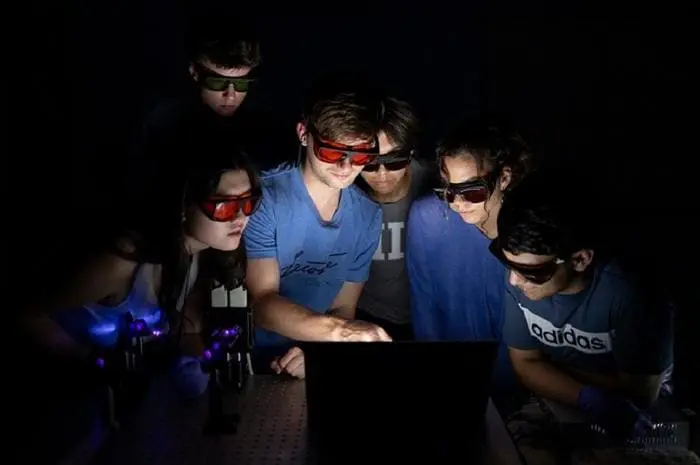
As the world of quantum physics undergoes a profound transformation, driven by the exponential potential of quantum technologies to revolutionize computing, telecommunications, cybersecurity, and biomedicine, the need for innovative educational tools has become increasingly pressing. In response to this challenge, a team of researchers from the University of Barcelona’s Faculty of Physics has developed a novel experimental system designed to introduce students to the complex concepts of quantum physics, including quantum entanglement and superposition.
This versatile and cost-effective equipment, already operational in the university’s Advanced Quantum Laboratory, enables students to directly measure quantum entanglement and perform full two-photon state tomography, providing a unique opportunity for hands-on exploration of the probabilistic nature of quantum mechanics. By facilitating a deeper understanding of these fundamental principles, this innovation has the potential to inspire a new generation of scientists and engineers to pursue careers in quantum science and technology, ultimately driving progress in these rapidly evolving fields.
Introduction to Quantum Physics Education
The field of quantum physics is undergoing a significant transformation, with potential applications in computing, telecommunications, cybersecurity, and biomedicine. As a result, there is a growing interest among students to learn about quantum concepts, such as entanglement and superposition. However, understanding these non-intuitive ideas can be challenging. To address this issue, a team from the University of Barcelona’s Faculty of Physics has developed new experimental equipment that enables students to explore complex quantum physics concepts in a more accessible way.
The equipment, designed by professors Bruno Juliá, Martí Duocastella, and José M. Gómez, is based on the master’s final project of Raúl Lahoz and allows for the study of phenomena unique to quantum mechanics, such as entangled systems. This innovation has been implemented in the Advanced Quantum Laboratory of the UB’s Faculty of Physics and can also be used in less specialized centers. The system enables students to perform direct measurements of quantum entanglement, which is essential for characterizing quantum entangled systems and understanding Bell’s inequalities.
The development of this equipment is particularly relevant in 2025, declared the International Year of Quantum Science and Technology by UNESCO. As the world of quantum physics continues to evolve, it is crucial to provide students with hands-on experience and experimental demonstrations to complement theoretical knowledge. The University of Barcelona’s initiative aims to make quantum technologies more accessible to students, allowing them to explore the innovative potential of quantum science and its applications in various fields.
Quantum Entanglement and Bell Inequalities
Quantum entanglement is a fundamental concept in quantum mechanics, where two or more particles become correlated in such a way that the state of one particle cannot be described independently of the others. This phenomenon has been experimentally proven by scientists such as John S. Bell, Alain Aspect, John F. Clauser, and Anton Zeilinger, who demonstrated the violation of Bell’s inequalities using entangled photons. The study of Bell inequalities is essential for understanding quantum entanglement and the probabilistic nature of quantum mechanics.
The equipment designed by the University of Barcelona team allows students to study Bell inequalities and perform full two-photon state tomography. With a simple operation, it can prepare different quantum entangled states, enabling students to make direct measurements of quantum entanglement. The system uses detectors assembled to optical fibers, which simplifies the experiment and increases the efficiency of detection. This innovation enables students to gain hands-on experience with advanced instrumentation, facilitating their understanding of complex quantum concepts.
The results obtained using this equipment demonstrate successful manipulation of the quantum state of photons and the achievement of high-fidelity entangled states and significant violations of Bell inequalities. These findings are crucial for characterizing quantum entangled systems and understanding the principles of quantum mechanics. By providing students with direct access to these experiments, the University of Barcelona’s initiative aims to enhance their comprehension of quantum concepts and prepare them for future research and applications in this field.
Experimental Setup and Methodology
The experimental setup designed by the University of Barcelona team consists of a simple and efficient system that enables students to perform measurements of quantum entanglement. The equipment uses detectors assembled to optical fibers, which facilitates the alignment of the system and increases the efficiency of detection. This innovation allows for a complete measurement of Bell inequalities to be performed during a practical laboratory session, typically lasting between one and two hours.
The methodology employed in this study involves an experimental approach, where students are encouraged to participate in hands-on experiments to gain a deeper understanding of quantum concepts. The equipment is designed to be user-friendly, allowing students to prepare different quantum entangled states and perform measurements with ease. The results obtained using this equipment demonstrate the effectiveness of this approach, with students achieving high-fidelity entangled states and significant violations of Bell inequalities.
The study has received funding from both the Spanish Ministry of Science, Innovation and Universities and the European Union’s Next Generation EU funds. The research has been published in the journal EPJ Quantum Technology, providing a valuable resource for educators and researchers in the field of quantum physics. By sharing their findings and methodology, the University of Barcelona team aims to contribute to the development of quantum education and inspire future generations of researchers and scientists.
Applications and Future Perspectives
The development of this equipment has significant implications for quantum education and research. By providing students with hands-on experience and experimental demonstrations, the University of Barcelona’s initiative aims to enhance their comprehension of complex quantum concepts and prepare them for future applications in this field. The equipment can be used in various educational settings, from bachelor’s to master’s degree courses, and has already received positive feedback from students.
The study of quantum entanglement and Bell inequalities has far-reaching implications for the development of quantum technologies, including quantum computing, quantum cryptography, and quantum communication. By understanding these fundamental concepts, researchers can develop new technologies that exploit the unique properties of quantum systems. The University of Barcelona’s initiative contributes to this effort by providing students with a deeper understanding of quantum mechanics and its applications.
As the field of quantum physics continues to evolve, it is essential to provide students with the necessary tools and resources to explore its potential. The development of this equipment is an important step in this direction, enabling students to gain hands-on experience with advanced instrumentation and facilitating their understanding of complex quantum concepts. By inspiring future generations of researchers and scientists, the University of Barcelona’s initiative aims to contribute to the advancement of quantum education and research, ultimately leading to innovative applications and breakthroughs in this field.
External Link: Click Here For More


