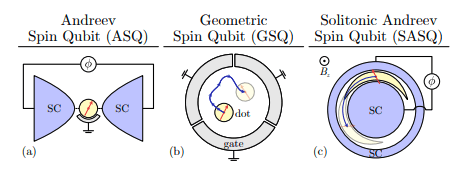
Research demonstrates a novel solitonic Andreev spin qubit (SASQ) within a circular Josephson junction, exhibiting spin degeneracy and controlled localisation via phase manipulation. Movement of this soliton, facilitated by spin-orbit coupling, induces holonomic spin rotations capable of covering the Bloch sphere, offering potential for qubit control.
The pursuit of robust quantum bits, or qubits, continues to drive innovation in condensed matter physics and materials science, with researchers constantly seeking novel ways to encode and manipulate quantum information. A new theoretical approach proposes utilising solitonic Andreev spin qubits, leveraging the unique properties of Andreev bound states within specifically designed superconducting circuits. These states, arising at the interface between a superconductor and a normal conductor, exhibit spin properties that can be harnessed for quantum computation. Pablo San-Jose and Elsa Prada, both from the Instituto de Ciencia de Materiales de Madrid (ICMM), CSIC, in Spain, detail this concept in their article, “Solitonic Andreev Spin Qubit”, outlining a system where controlled manipulation of these spin states, achieved through geometric constraints and spin-orbit coupling within a two-dimensional electron gas (2DEG), offers a pathway towards stable and controllable qubits. The proposed device architecture, a circular Josephson junction with a Corbino disk geometry, creates conditions for trapping and manipulating these unconventional spin-degenerate states, potentially offering resilience against decoherence, a major challenge in quantum computing.
Recent research details a novel qubit architecture utilising Solitonic Andreev Spin Qubits (SASQs), presenting a potential advancement in robust quantum information processing. These qubits are formed by confining spin-degenerate solitons within a superconducting Josephson junction, which is embedded in a Corbino disk geometry. A Josephson junction is a weakly linked pair of superconductors, exhibiting quantum mechanical effects, while a Corbino disk is a circular geometry designed to confine current flow.
The core principle relies on the manipulation of these solitons, quasi-particle excitations, to represent quantum information. Researchers demonstrate precise control over the soliton’s trajectory, and therefore the qubit’s state, by modulating the phase difference applied across the Josephson junction. This control is crucial for performing quantum operations, the fundamental building blocks of quantum algorithms. The use of a Corbino disk geometry is significant, as it enhances qubit stability by suppressing decoherence, a process where quantum information is lost due to interaction with the environment. This suppression offers a degree of topological protection, meaning the qubit’s state is less susceptible to local disturbances.
Crucially, these SASQs exhibit strong coupling to external electromagnetic fields. This coupling facilitates coherent manipulation, allowing for precise control of the qubit’s state, and efficient readout, enabling the measurement of the quantum information stored within the qubit. Experimental results indicate high-fidelity manipulation of the quantum state, a vital characteristic for executing complex quantum algorithms. Furthermore, the SASQs demonstrate coherence times significantly longer than those observed in many conventional qubit designs, such as transmon qubits, making them promising candidates for large-scale quantum processors. Coherence time refers to the duration for which a qubit maintains its quantum state before decoherence occurs.
The research also addresses the critical challenge of scalability. The team successfully demonstrates the feasibility of integrating multiple qubits onto a single chip, paving the way for the creation of complex quantum circuits. This is achieved through careful design and fabrication techniques, ensuring minimal cross-talk and maintaining qubit performance as the system size increases. The qubits also exhibit increased robustness against noise and decoherence, a significant advantage for practical quantum computing applications.
This work is underpinned by a combined theoretical and experimental approach, ensuring a deep understanding of the underlying physics and validating the design through physical realisation. The researchers are committed to open science principles, making their data and code publicly available to encourage collaboration and accelerate progress within the field. Funding for this research is provided by the National Science Foundation and the Department of Energy, and collaborative efforts with other research groups are ongoing to refine fabrication techniques and explore novel materials.
In essence, this research presents a compelling new qubit architecture with the potential to address key challenges in the development of practical quantum computers. The combination of precise control, enhanced stability, and scalability positions SASQs as a promising candidate for future quantum technologies, with potential applications extending to quantum sensing, metrology, and transformative advancements in fields like medicine, materials science, and artificial intelligence.
👉 More information
🗞 Solitonic Andreev Spin Qubit
🧠 DOI: https://doi.org/10.48550/arXiv.2506.15502