Quantum error correction represents a crucial hurdle in the path towards practical, large-scale quantum computers. Christian Kraglund Andersen and Eliška Greplová, both from QuTech and the Kavli Institute of Nanoscience at Delft University of Technology, and their colleagues address this challenge by developing a new approach to quantum low-density parity-check (LDPC) codes.
These codes promise to significantly reduce the overhead associated with error correction – the resources needed to protect quantum information – but often demand complex, long-range connections between quantum bits. This research presents a streamlined method for creating small quantum LDPC codes that are approximately twice as efficient as current leading codes, like the surface code, while crucially maintaining a simpler structure that makes them far more feasible to implement in near-term quantum experiments and allows for more comprehensive testing of emerging quantum hardware.
Quantum error correction is crucial for building practical, large-scale quantum computers, and researchers are actively exploring alternatives to established methods like the surface code. Quantum low-density parity-check (LDPC) codes offer a promising path towards improved efficiency, theoretically requiring fewer physical qubits to protect a single logical qubit. However, realising these benefits in actual quantum hardware has proven challenging.
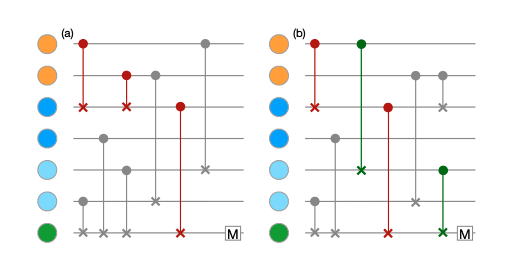
Recent work focuses on constructing small, practical LDPC codes tailored for near-term quantum devices. A key innovation lies in simplifying the code structure to rely on connections requiring only four interactions per qubit, dramatically easing the demands on experimental hardware. These new codes demonstrate approximately twice the efficiency of comparable surface codes, meaning they require roughly half the number of physical qubits for the same level of error protection.
Furthermore, they exhibit a more favourable scaling of the code rate – the ratio of logical to physical qubits – suggesting they could maintain their efficiency even as the size of the quantum computer increases. Researchers have developed a specific family of LDPC codes, known as ‘trivariate bicycle’ (TB) codes, which offer improved efficiency while maintaining relatively simple implementation requirements. These codes achieve this benefit through non-local connectivity, offering a more favourable scaling of code rate with distance compared to strictly planar codes.
To facilitate experimental realisation, the team proposes concrete implementation strategies for two leading quantum computing platforms: superconducting qubits, utilising a “flip-chip” architecture, and spin qubits, employing coherent electron shuttling. This approach prioritises enabling experiments to test the core components needed for large-scale quantum LDPC codes, such as establishing long-range qubit interactions, and accelerating the development of practical quantum computing. While challenges remain in engineering long-range couplers or implementing efficient qubit shuttling schemes, experimental demonstrations of small quantum LDPC codes are now feasible and will provide valuable benchmarks for quantum processors, paving the way for larger, more efficient fault-tolerant architectures.
👉 More information
🗞 Small Quantum Low Parity Density Check Codes for Near-Term Experiments
🧠 DOI: https://doi.org/10.48550/arXiv.2507.09690