
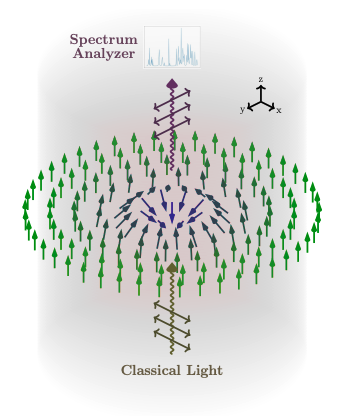
Researchers demonstrate optical detection of quantum behaviour in magnetic skyrmions, nanoscale spin textures with potential for data storage. Brillouin light scattering reveals asymmetry in the scattering spectrum, confirming energy level quantisation and providing a method to control these effects with temperature and laser power.
The pursuit of stable, nanoscale magnetic structures represents a significant area of materials science, with potential applications ranging from high-density data storage to novel spintronic devices. Recent research focuses on skyrmions, topologically protected spin textures exhibiting particle-like behaviour, as promising candidates for these technologies. Identifying and characterising the quantum behaviour of these structures, however, remains a considerable experimental challenge. Now, Sanchar Sharma, Christina Psaroudaki, and colleagues at Laboratoire de Physique de l’École Normale Supérieure, ENS, Université PSL, CNRS, Sorbonne Université, Université de Paris, detail a method utilising Brillouin light scattering (BLS) – a technique analysing interactions between light and magnetic excitations – to detect quantum effects within skyrmions. Their work, entitled “Optical signatures of quantum skyrmions”, proposes that asymmetry in the BLS spectrum serves as a robust indicator of energy level quantisation, offering a pathway towards optical detection of non-classical behaviour in these nanoscale magnetic textures.
Magnets present an increasingly viable platform for quantum information processing, and researchers now demonstrate a method for directly probing the non-classical behaviour of topologically protected nanoscale spin textures, specifically skyrmions. These swirling, magnetic textures, often described as ‘magnetic vortices’, hold promise for data storage and quantum computing due to their stability and small size. This study establishes a protocol for optically detecting energy level quantization within skyrmions, a crucial step towards realising their potential in quantum technologies and moving beyond theoretical predictions to provide experimental evidence of their quantum behaviour. Researchers predict that classical skyrmions generate symmetric sidebands in the Brillouin light scattering (BLS) spectrum, a phenomenon where light scatters and creates additional frequencies, but quantum skyrmions exhibit a distinct asymmetry in these sidebands originating from vacuum fluctuations inherent in their rotational motion.
The core of the approach involves utilising the BLS spectrum to detect these asymmetries. Calculations employing a master equation, a mathematical model describing the time evolution of a quantum system, confirm that this sideband asymmetry functions as a robust indicator of energy level quantization and establishes a concrete experimental protocol for detecting non-classical features in spin textures. This control represents a significant advancement, enabling precise optical control over the skyrmion’s quantum properties and paving the way for exploring the potential of skyrmions as qubits, the fundamental building blocks of quantum computers. A qubit, unlike a classical bit which represents 0 or 1, can exist in a superposition of both states simultaneously, enabling vastly more complex calculations.
The findings establish a robust link between optical measurements and the quantum properties of skyrmions, offering a promising route towards developing novel quantum computing architectures and quantum information storage devices. Future research will focus on experimentally verifying these findings and exploring the potential of skyrmions for building practical quantum devices. This includes investigating methods for manipulating and controlling multiple skyrmions, and scaling up the system to create more complex quantum circuits.
👉 More information
🗞 Optical signatures of quantum skyrmions
🧠 DOI: https://doi.org/10.48550/arXiv.2506.16877