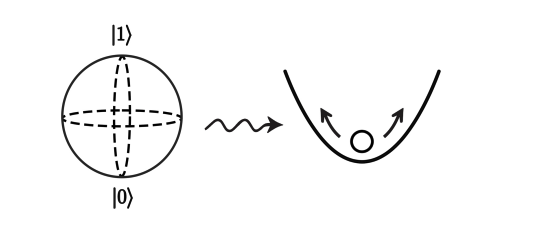
The interplay between the classical and quantum worlds remains a fundamental question in physics, and new research explores how a simple quantum system impacts a classical mechanical oscillator. Felipe Sobrero from Centro Brasileiro de Pesquisas Físicas, along with Luca Abrahão and Thiago Guerreiro from Pontifícia Universidade Católica do Rio de Janeiro, and Pedro V. Paraguassú, demonstrate that a quantum bit, or qubit, exerts both predictable and random forces on the oscillator, forces that are uniquely shaped by the qubit’s initial state. This research reveals that these forces leave distinct, measurable signatures on the oscillator’s behaviour, suggesting a novel method for determining the qubit’s state through classical noise analysis. The findings open exciting possibilities for advancements in areas such as mesoscopic optomechanical experiments and even small-scale tests probing the foundations of gravity.
Influence manifests as deterministic and stochastic forces, highly dependent on its initial quantum state, imprinting unique measurable quantum-induced signatures onto the oscillator’s response. The present results suggest a pathway to quantum state reconstruction through classical noise spectroscopy, with potential applications to mesoscopic optomechanical experiments, quantum metrology, and tabletop tests of the quantum nature of gravity. Mesoscopic mechanical oscillators, such as trapped nanoparticles and nanomechanical resonators, present ideal platforms to explore fundamental physics, the quantum-classical boundary, and the interface between these realms.
Quantum Influence Functional Derivation and Construction
This work details the derivation of a mathematical tool, the influence functional, which describes how a quantum system, a qubit, affects a classical system represented by its motion. The goal is to understand the interplay between these two realms and to model the quantum system’s influence on the classical one. The research employs a technique common in the study of open quantum systems and quantum Brownian motion to achieve this. The team calculated how the combined quantum-classical system evolves over time, focusing on the changes in the quantum state due to interaction with the classical motion.
This involved defining an interaction between the qubit and the classical system and using a mathematical technique to simplify the calculations. The Baker-Campbell-Hausdorff formula, a crucial tool for manipulating exponential functions, was employed to approximate the system’s evolution. The authors then used this simplified expression to calculate the influence functional, which describes the quantum system’s impact on the classical system’s dynamics. This involved analyzing how the qubit’s initial state affects the classical motion and performing algebraic manipulations to arrive at a final expression.
The resulting functional provides a detailed description of the quantum-classical interaction. The research utilizes key concepts from both quantum and classical mechanics, including Pauli operators, qubit states, and classical coordinates. The influence functional, a central concept in open quantum systems, allows for the construction of an effective action that incorporates quantum effects into the classical system’s dynamics. In summary, the work provides a detailed mathematical derivation of the influence functional, offering a powerful tool for understanding quantum-classical interactions.
Qubit State Controls Mechanical Oscillator Motion
Scientists have demonstrated a remarkable connection between a classical mechanical oscillator and a single qubit, revealing how the qubit’s quantum state directly influences the oscillator’s motion. The research establishes that a qubit induces both deterministic and stochastic forces on the oscillator, with these forces being highly dependent on the qubit’s initial quantum state, effectively imprinting quantum information onto the classical system. This interaction allows for the transduction of information from the qubit’s state onto the motion of the mechanical oscillator, a phenomenon analogous to quantum-induced stochastic graviton noise predicted in quantum gravity. The team employed the Feynman-Vernon influence functional method, a powerful technique for analyzing open quantum systems, to derive the effective action of the oscillator under the influence of the qubit.
This approach allowed them to directly extract the quantum-induced classical dynamics and investigate how the qubit causes decoherence in the mechanical oscillator. Results demonstrate that even a single qubit generates detectable forces, opening possibilities for novel sensing techniques and tabletop experiments designed to probe the foundations of gravity. Furthermore, the research highlights the potential for quantum state reconstruction through classical noise spectroscopy, offering a pathway to determine the qubit’s state by analyzing the noise it induces in the oscillator. This discovery has significant implications for mesoscopic optomechanical systems, quantum metrology, and the development of experiments seeking to detect gravitational-induced entanglement. The findings suggest a new avenue for exploring the quantum-classical boundary and investigating the interplay between quantum theory and gravity, potentially leading to advancements in both fundamental physics and technological applications.
Qubit Control and Classical Motion Transduction
This work investigates the dynamics of a mechanical oscillator coupled to a single qubit, revealing that the qubit exerts both deterministic and stochastic forces on the oscillator. The magnitude of these forces, ranging from zepto- to atto-Newtons, depends on the qubit’s initial state and imprints measurable signatures onto the oscillator’s motion. The findings demonstrate a pathway for reconstructing the qubit’s state by observing the classical behaviour of the oscillator, effectively transducing quantum information into a classical signal. Furthermore, the research establishes that the qubit performs work on the mechanical oscillator, which has implications for understanding quantum thermodynamics and the behaviour of mesoscopic engines.
The authors acknowledge that their analysis currently focuses on a simplified model with a single qubit and an initially separable state. Future research directions include extending the analysis to systems with multiple qubits and investigating the effects of collective entanglement, as well as exploring different interaction Hamiltonians. Promising experimental platforms for applying these findings include levitated nanoparticles coupled to trapped ions and nanomechanical resonators linked to solid-state two-level systems, potentially leading to new approaches for testing the quantum nature of gravity.
🗞 Response of a classical mesoscopic oscillator to a two-level quantum system
🧠 ArXiv: https://arxiv.org/abs/2509.04216