

Kagome lattices, materials arranged in a distinctive woven pattern, are attracting considerable attention from physicists seeking to understand complex electronic behaviour and the emergence of charge density waves (CDWs). These CDWs, which represent a periodic modulation of electron density, offer a platform to explore novel physical mechanisms, and theoretical models have predicted their occurrence in certain kagome compounds. Now, Dechao Cheng from Chongqing University, Nour Maraytta from the Karlsruhe Institute of Technology, Xiuhua Chen from the University of Science and Technology of China, and colleagues successfully grew single crystals of Ti_{0. 85}Fe6Ge6 using a sophisticated vapour transport method, anticipating the emergence of kagome CDW behaviour. While the material exhibits antiferromagnetic properties and metallic conductivity, surprisingly, the team observed no evidence of a charge density wave. Detailed analysis, including density functional theory calculations, reveals that the unique bonding characteristics within Ti_{0. 85}Fe6Ge6, specifically strong titanium-germanium bonds and germanium dimers, prevent the atomic “rattling” necessary for CDW formation, and the results highlight the importance of both atomic size and chemical bonding in determining whether these intriguing waves will appear in kagome lattices.
Kagome materials, characterized by their unique two-dimensional Kagome lattice structure, represent a fascinating area of condensed matter physics, offering a platform to explore complex quantum phenomena and uncover the mechanisms behind charge density wave (CDW) formation. Researchers are actively investigating these materials, developing chemical models to predict and understand their behaviour, particularly in compounds like FeGe, LiFe6Ge6, and various rare-earth-based RCr6Ge6 compounds.
Kagome Lattices and Electronic Property Exploration
The Kagome lattice, a network of corner-sharing triangles, is predicted to host unusual electronic properties, including Dirac and Van Hove singularities, which lead to distinctive electronic behaviour. The lattice geometry can also create flat bands, enhancing electron interactions and fostering correlated electronic states. A prominent feature observed in many Kagome materials is the formation of charge density waves, periodic modulations of electron density, and scientists are investigating their origin, behaviour, and interplay with other electronic properties. Some materials exhibit topological electronic states, characterized by protected surface states and unusual transport properties, while others display complex magnetic behaviour, including anisotropic magnetism and spin reorientation transitions.
Investigations into materials like FeGe have focused on understanding the CDW formation mechanism and its relationship to magnetism and electronic transport. LiFe6Ge6 is of particular interest because it can exhibit multiple CDW phases and different crystal structures, allowing researchers to control and encode different CDW states. Extensive studies of RCr6Ge6 compounds, where R represents a rare earth element, explore the interplay between magnetism, topology, and CDWs, with the rare earth element allowing for tuning of the magnetic properties. Research also extends to materials like MgFe6Ge6 and LuGe, exploring their magnetic, electronic, and structural properties.
Significant findings include the discovery that LiFe6Ge6 can exhibit multiple CDW phases and polymorphs, offering possibilities for designing materials with tailored electronic properties. Understanding the interplay of CDWs, magnetism, and topology is a central theme, crucial for developing a complete picture of their electronic behaviour. The observation of sublinear resistivity in some Kagome materials suggests the presence of unusual scattering mechanisms, and researchers are investigating the role of Van Hove singularities in determining electronic transport properties. Furthermore, studies are exploring how twisting Kagome layers can affect electronic properties and potentially induce new phases, emphasizing the importance of understanding the orbital origins of magnetism in these materials.
The research utilizes a variety of experimental and theoretical techniques, including X-ray diffraction to determine crystal structure, magnetization measurements to study magnetic properties, electrical resistivity and specific heat measurements to investigate electronic transport and density of states, and angle-resolved photoemission spectroscopy to directly map the electronic band structure. Density functional theory calculations provide theoretical modelling of electronic structure and properties, while Mössbauer spectroscopy studies the local magnetic environment of specific elements. This research has the potential to lead to the discovery of new materials with exotic electronic properties, with applications in high-performance electronics, spintronics, quantum computing, and energy storage.
High-Quality TiFeGe Crystals Exhibit Antiferromagnetism
Scientists successfully synthesized high-quality Ti0. 85Fe6Ge6 single crystals using a chemical vapor transport method, previously unapplied to this family of materials. Single-crystal and powder X-ray diffraction confirmed the hexagonal crystal structure, establishing a foundation for detailed physical property investigations. Magnetization measurements revealed an antiferromagnetic transition at 488 K, with the easy axis of magnetization aligned along the crystallographic c-direction. Electrical transport measurements demonstrated metallic behaviour, indicating that electron-type carriers dominate conductivity, and a negligible negative magnetoresistance was observed across all measured temperatures.
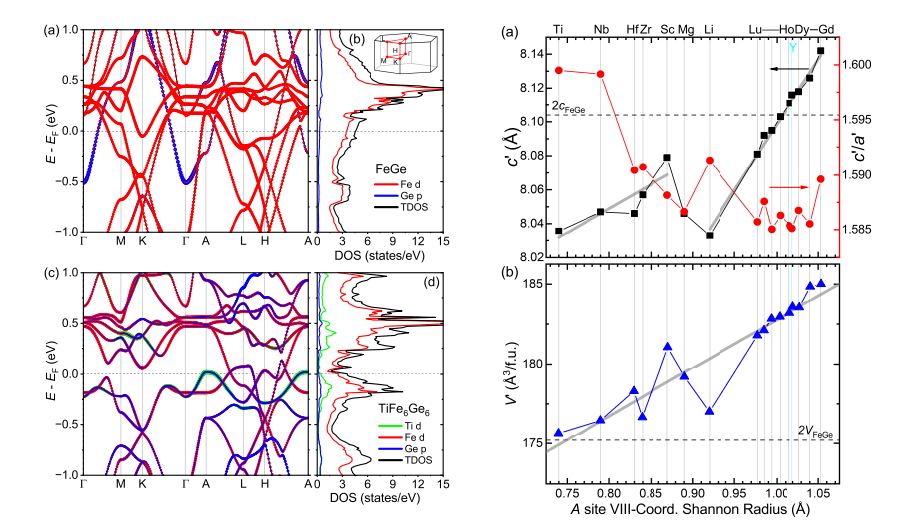
Despite expectations based on the rattling chain model, no evidence of charge density wave ordering was detected down to 2 K. Density functional theory calculations revealed a markedly different electronic structure than predicted, showing a shift of the density of states away from the Fermi level, resulting in an indirect gap within the Brillouin zone. This gap opening, coupled with structural investigations, suggests that strong covalent bonds between titanium and germanium, along with the formation of solid germanium dimers, prevent the atomic motion necessary for CDW formation. Furthermore, the presence of an antibonding state involving iron at the Fermi level enhances spin polarization and reduces electronic density. These results demonstrate that both the ionic radius of the filler atom and specific chemical bonding characteristics are crucial factors governing CDW formation in these Kagome compounds, offering new insights for discovering novel materials exhibiting this intriguing quantum phenomenon.
Suppressed Charge Density Waves in TiFeGe Alloy
Researchers successfully grew single crystals of Ti0. 85Fe6Ge6, a material predicted to exhibit charge density wave behaviour within its Kagome lattice structure. Magnetization measurements confirmed the material is an easy-axis antiferromagnet, establishing magnetic ordering at 488 K, and transport measurements revealed metallic conductivity dominated by electron-type carriers. Despite these characteristics, the team observed no evidence of a CDW in their structural, magnetization, or transport investigations. Density functional theory calculations revealed a key distinction between this material and related compounds: a shift in the density of electronic states away from the Fermi level.
This, combined with structural investigations, suggests that strong covalent bonding within Ti0. 85Fe6Ge6 prevents the atomic rattling necessary for CDW formation. The research highlights the crucial role of both ionic radius and bonding characteristics in determining the emergence of CDWs in Kagome materials, offering supplementary insights to existing models. The authors acknowledge that the specific composition of Ti0. 85Fe6Ge6 represents a local energetic minimum, potentially complementing other compositions that do exhibit CDW phases, and future work could explore the impact of varying the titanium content to better understand the relationship between composition, bonding, and the emergence of CDWs in these complex materials.
👉 More information
🗞 Single crystal growth, structural and physical properties, and absence of a charge density wave in Ti_{0.85}Fe6Ge6
🧠 ArXiv: https://arxiv.org/abs/2509.20142


