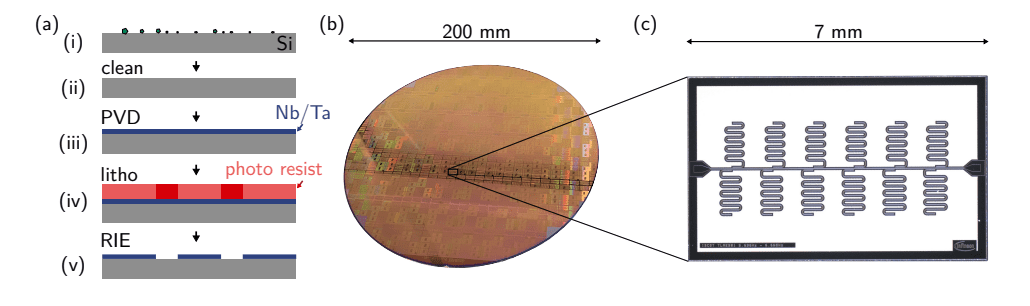
The pursuit of universal quantum computers requires the manufacture of vast numbers of high-quality, uniform quantum components on a single chip, and researchers are increasingly looking to established semiconductor fabrication techniques to meet this challenge. Now, N. Arlt, K. Houska, and J. Braumüller, along with colleagues from Technical University of Munich and Infineon Technologies AG, demonstrate a significant step forward by fabricating superconducting resonators within a fully operational, industry-scale semiconductor facility. This work establishes a crucial baseline for process quality, achieving exceptionally high performance, measured by Q-factors exceeding those needed for single-photon experiments, in both Niobium and Tantalum microwave resonators. Importantly, the team also successfully integrates Niobium air bridges into the fabrication process, maintaining the resonators’ high quality and paving the way for more complex quantum circuits manufactured with industrial precision.
Universal quantum computers promise to solve computational problems beyond the reach of today’s machines. Realising this potential requires manufacturing a vast number of high-quality quantum components, known as physical qubits, on a single chip. Researchers are now leveraging the precision and control of semiconductor fabrication facilities, used for making conventional computer chips, to build these quantum circuits. This approach offers the benefits of established industrial processes, ensuring uniformity and repeatability in manufacturing.
Niobium and Tantalum Superconducting Resonator Fabrication
This research focuses on fabricating and characterising superconducting resonators, key components for quantum technologies, using both niobium and tantalum. These resonators, designed to store microwave energy, require exceptionally high quality factors, a measure of how efficiently they retain energy without loss. The team also developed methods for creating air bridges, tiny suspended conductors, to further enhance performance by minimising energy loss and unwanted electrical effects. A central goal is to understand and mitigate the factors that limit resonator performance. The fabrication process involves depositing thin films of niobium and tantalum using a technique called sputtering, followed by precise patterning using reactive ion etching and lift-off processes.
Air bridges are created through a multi-step process involving dielectric deposition and etching. Researchers used silicon and sapphire as substrates, carefully considering how the choice of material impacts performance. They also explored the use of niobium nitride as an adhesion layer to improve film properties. The quality of the deposited films, surface roughness, and the presence of defects are all critical factors influencing performance. To characterise the resonators, researchers employed a range of techniques.
Microwave measurements determine the resonant frequency and quality factor, while X-ray diffraction analyses the crystal structure of the deposited films. Atomic force microscopy characterises surface roughness, and scanning and transmission electron microscopy provide detailed images of the fabricated structures. Key findings highlight the importance of high-quality materials with minimal defects and impurities. Controlling the interfaces between the metal films and the substrate is also crucial, with buffer layers like niobium nitride improving performance. Air bridges effectively reduce unwanted electrical effects and enhance quality factors.
However, microscopic defects, known as two-level systems, represent a significant source of energy loss, particularly at lower temperatures. This research demonstrates the potential for scaling up quantum circuit fabrication by utilising existing semiconductor manufacturing infrastructure. The findings contribute to the development of more powerful and reliable quantum computers and improved quantum sensors. Future research will focus on mitigating the impact of two-level systems, exploring alternative superconducting materials, and developing techniques for integrating superconducting circuits in three dimensions. Ensuring compatibility with the extremely low temperatures required for superconducting operation remains a key consideration.
Scalable Quantum Resonators Fabricated with Industry Tools
Researchers have made significant progress in fabricating quantum components using standard semiconductor manufacturing techniques, paving the way for more scalable quantum computers. The team successfully created high-quality microwave resonators, essential building blocks for quantum circuits, within a commercial fabrication facility. These resonators, made from materials like niobium and tantalum, exhibited exceptionally high performance, with quality factors exceeding typical levels. The fabrication process involved careful control of material properties and the incorporation of air bridges to further enhance performance.
Measurements revealed that the quality of the materials and the precision of the manufacturing process were critical to achieving high quality factors. A post-processing step involving a buffered oxide etch significantly improved resonator performance, boosting quality factors by over 50% in some cases. Detailed analysis revealed that resonator performance is limited by microscopic defects within the materials, specifically two-level systems. These defects act as sources of energy loss, impacting the coherence of quantum information. The team modelled this loss mechanism and found that the observed behaviour closely matched theoretical predictions, confirming the dominance of two-level systems as a limiting factor.
Interestingly, tantalum films deposited directly on silicon exhibited significantly higher losses compared to those with a niobium seed layer, highlighting the importance of material selection and interface control. The researchers also demonstrated that the resonators’ performance is strongly dependent on the number of photons within them, a characteristic signature of two-level system-induced loss. By carefully analysing this dependence, they were able to quantify the impact of two-level systems and identify strategies for minimising their effect. These findings represent a crucial step towards building more robust and scalable quantum circuits, bringing the promise of practical quantum computing closer to reality.
This research demonstrates the successful fabrication of high-quality superconducting quantum circuits using a standard 200 mm semiconductor production line. Researchers achieved high internal quality factors, exceeding one million, using both niobium and tantalum-based resonators. Importantly, the process also incorporated niobium air bridges without compromising resonator quality, a crucial step towards more complex circuit designs. These results establish the viability of leveraging established semiconductor manufacturing techniques for building quantum hardware. By utilising existing industrial processes, the team has shown a path towards improved process control, stability, and scalability in quantum circuit fabrication. While acknowledging that increasing circuit density can lead to increased energy loss, future work will focus on integrating Josephson junctions to create larger circuits and exploring multi-layer technologies to mitigate these losses, ultimately testing the reproducibility and parameter control of the fabrication process.
👉 More information
🗞 High- superconducting resonators fabricated in an industry-scale semiconductor-fabrication facility
🧠 ArXiv: https://arxiv.org/abs/2508.09577