
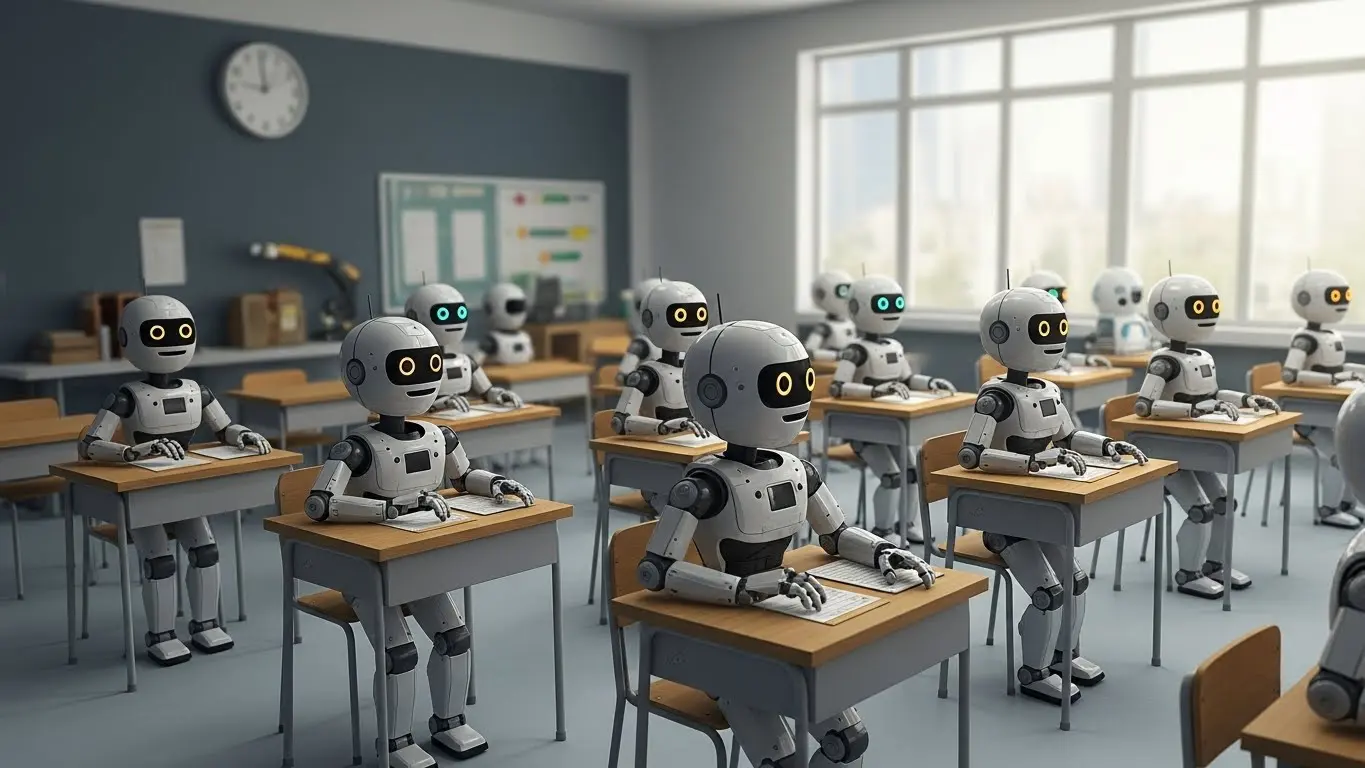
At its core, self-supervised learning leverages the inherent structure within data itself to create learning signals, allowing AI to discover patterns and representations without explicit human guidance. This is a departure from traditional supervised learning, where algorithms are trained on meticulously labeled examples, and unsupervised learning, which seeks patterns without any guidance but often struggles with meaningful representation.
The foundation of this revolution lies in the concept of pretext tasks. These are artificially constructed tasks designed to force the AI to understand underlying data characteristics. For example, an algorithm might be tasked with predicting a missing portion of an image, rotating a distorted image back to its original orientation, or predicting the next word in a sentence. While these tasks aren’t the ultimate goal, solving them requires the AI to develop a robust understanding of the data’s structure, creating valuable internal representations. This is akin to a child learning about shapes and colors by playing with building blocks, the blocks themselves aren’t the end product, but the process of manipulating them builds foundational knowledge. This approach, championed by researchers like Geoffrey Hinton at the University of Toronto, a pioneer in deep learning, is dramatically expanding the scope of what AI can achieve.
Unveiling Hidden Structures in Data
The power of self-supervised learning stems from its ability to exploit the inherent redundancy and structure within data. Consider the vast amount of unlabeled text available online. Traditional language models required humans to label sentences with grammatical structures or semantic meanings. Self-supervised learning, however, can learn from the raw text itself. By masking certain words and training the AI to predict them, a technique known as masked language modeling, the algorithm learns contextual relationships and builds a rich understanding of language. This is the principle behind models like BERT (Bidirectional Encoder Representations from Transformers), developed at Google by Jacob Devlin and his team, which has achieved state-of-the-art results in numerous natural language processing tasks. BERT’s success demonstrates that AI can acquire sophisticated language skills simply by observing and predicting patterns in text, without explicit human labeling.
This principle extends far beyond text. In computer vision, researchers are employing similar techniques to learn from unlabeled images and videos. One common approach involves predicting the relative position of image patches, forcing the AI to understand spatial relationships and object boundaries. Another technique involves predicting future frames in a video, requiring the algorithm to learn about object motion and scene dynamics. Yoshua Bengio, a professor at the University of Montreal and a leading figure in deep learning, has been instrumental in developing these techniques, emphasizing the importance of learning disentangled representations, isolating individual factors of variation within data. This allows the AI to generalize better and adapt to new situations.
From Pretext to Practicality: Transfer Learning
The true potential of self-supervised learning is unlocked through transfer learning. Once an AI has been pre-trained on a large unlabeled dataset using a pretext task, the learned representations can be transferred to a downstream task with limited labeled data. This significantly reduces the need for expensive data annotation and accelerates the development of AI applications. Imagine training a self-driving car. Collecting and labeling millions of images of traffic signs, pedestrians, and other vehicles is a monumental task. However, if the car’s vision system has already been pre-trained on a massive dataset of unlabeled images using self-supervised learning, it will require far less labeled data to learn the specific tasks required for autonomous driving.
This transfer learning capability is particularly valuable in domains where labeled data is scarce or expensive to obtain, such as medical imaging and scientific research. For example, researchers at Stanford University, led by Fei-Fei Li, a renowned computer vision expert, are using self-supervised learning to analyze medical images and identify potential diseases with limited labeled data. By pre-training on large datasets of unlabeled medical scans, the AI can learn to recognize subtle patterns and anomalies that might be missed by human observers. This has the potential to revolutionize healthcare by enabling earlier and more accurate diagnoses.
The Challenge of Representation Quality
Despite its promise, self-supervised learning is not without its challenges. A critical issue is ensuring the quality of the learned representations. While an AI might excel at solving the pretext task, the resulting representations may not be optimal for downstream tasks. This is because the pretext task is often an artificial construct and may not capture the true underlying structure of the data. For example, an AI trained to predict missing image patches might learn to focus on low-level features like edges and textures, rather than high-level semantic concepts like objects and scenes.
To address this, researchers are exploring more sophisticated pretext tasks that encourage the AI to learn more meaningful representations. Contrastive learning, pioneered by Simonyan and Zisserman at the University of Oxford, is one such approach. It involves training the AI to distinguish between similar and dissimilar examples, forcing it to learn representations that capture the essential characteristics of each instance. Another promising direction is masked autoencoders, where large portions of the input are masked and the AI is tasked with reconstructing the original input. This forces the AI to learn a compressed and informative representation of the data.
Beyond Images and Text: Expanding the Scope
The applications of self-supervised learning extend far beyond images and text. Researchers are applying these techniques to a wide range of data modalities, including audio, video, and even sensor data. In the field of robotics, self-supervised learning is enabling robots to learn from their own interactions with the environment. By observing the consequences of their actions, robots can learn to predict the outcomes of future actions and improve their performance over time. This is particularly important for tasks that are difficult to program explicitly, such as grasping objects or navigating complex environments.
Furthermore, self-supervised learning is proving valuable in scientific discovery. Researchers at DeepMind, led by Demis Hassabis, have used self-supervised learning to predict protein structures with unprecedented accuracy. By training an AI on a massive database of protein sequences, the algorithm learned to predict the 3D structure of proteins, a long-standing challenge in biology. This breakthrough has the potential to accelerate drug discovery and our understanding of fundamental biological processes.
The Future of AI: Towards Autonomous Agents
The long-term vision of self-supervised learning is to create truly autonomous agents that can learn and adapt to new environments without human intervention. This requires developing AI systems that can not only learn from unlabeled data but also actively explore and interact with the world to gather new information. Active learning, where the AI strategically selects which data points to label, is one promising approach. Another direction is reinforcement learning, where the AI learns by trial and error, receiving rewards for achieving desired goals.
Yann LeCun, a professor at New York University and a leading figure in convolutional neural networks, advocates for a future where AI systems can learn in a continuous and lifelong manner. He envisions AI agents that can accumulate knowledge over time, building upon their existing understanding to solve increasingly complex problems. This requires developing AI architectures that are capable of storing and retrieving information efficiently, as well as learning to reason and generalize from limited data. The journey towards truly autonomous intelligence is still in its early stages, but self-supervised learning is undoubtedly a crucial step in the right direction.
Addressing Bias and Ethical Considerations
As self-supervised learning becomes more prevalent, it’s crucial to address potential biases in the data and ensure ethical considerations are prioritized. Unlabeled datasets, while abundant, can still reflect societal biases present in the data collection process. If an AI is trained on biased data, it may perpetuate and amplify those biases in its predictions. For example, an AI trained on images predominantly featuring certain demographics may perform poorly on images featuring other demographics.
Researchers are actively developing techniques to mitigate bias in self-supervised learning, such as data augmentation and adversarial training. However, it’s also important to recognize that bias is a complex issue that requires a multi-faceted approach, including careful data curation, algorithmic fairness metrics, and ongoing monitoring. Furthermore, the increasing autonomy of AI systems raises ethical concerns about accountability and transparency. It’s essential to develop mechanisms for understanding and controlling the behavior of AI agents, ensuring they align with human values and societal norms.
The Convergence of Learning Paradigms
The future of AI is likely to involve a convergence of different learning paradigms. Self-supervised learning will not replace supervised and unsupervised learning entirely, but rather complement them. Supervised learning will continue to be valuable for tasks where labeled data is readily available, while unsupervised learning will remain useful for exploratory data analysis and anomaly detection. Self-supervised learning will serve as a powerful pre-training technique, enabling AI systems to learn from vast amounts of unlabeled data and then fine-tune their performance on specific tasks with limited labeled data. This hybrid approach will unlock the full potential of AI, enabling it to solve complex problems and improve our lives in countless ways. The ongoing research, driven by pioneers like Hinton, Bengio, LeCun, and Li, promises a future where AI is not just intelligent, but also adaptable, resourceful, and aligned with human values.