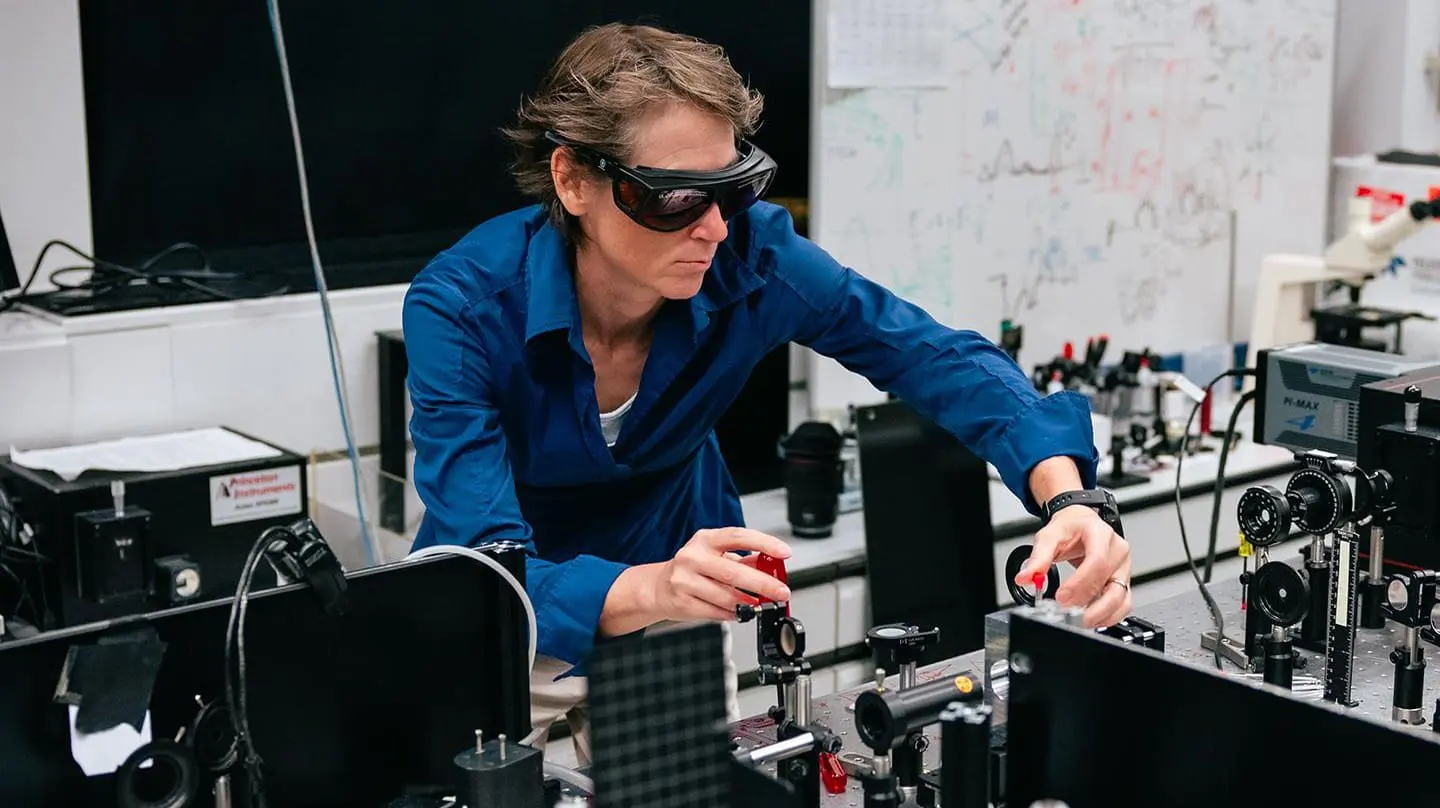
Researchers at EPFL have developed a new spectroscopy method that reveals the quantum secrets of water, allowing them to measure electronic and nuclear quantum effects that were previously only accessible through theoretical simulations. Led by Professor Sylvie Roke, the team used correlated vibrational spectroscopy (CVS) to observe molecules participating in hydrogen bonds in liquid water.
This breakthrough enables scientists to distinguish between interacting and non-interacting molecules, providing a deeper understanding of the dynamic interactions that give water its unique properties. PhD student Eksha Chaudhary was also involved in the research. The method has “transformative” potential to characterize interactions in any material and has been published in Science.
Unveiling Water’s Quantum Secrets: A New Spectroscopy Method
Water is essential for life, but the dynamic interactions between H2O molecules, known as hydrogen bonds, remain poorly understood. Hydrogen bonds result from the sharing of electronic charge between hydrogen and oxygen atoms in adjacent water molecules, creating a complex three-dimensional network that gives liquid water its unique properties. However, the quantum phenomena at the heart of these networks have been accessible only through theoretical simulations until now.
Researchers led by Professor Sylvie Roke at EPFL’s Laboratory for Fundamental BioPhotonics have developed a novel method called correlated vibrational spectroscopy (CVS), which enables them to measure how water molecules behave when participating in hydrogen bond networks. This approach allows scientists to distinguish between participating (interacting) molecules and randomly distributed, non-H-bonded (non-interacting) molecules, a feat that was previously impossible.
The Power of Correlated Vibrational Spectroscopy
CVS works by illuminating liquid water with femtosecond laser pulses in the near-infrared spectrum. These ultra-short bursts of light create tiny charge oscillations and atomic displacements in the water, which trigger visible light emission. This emitted light appears in a scattering pattern that contains key information about the spatial organization of the molecules. In contrast, the color of the photons contains information about atomic displacements within and between molecules.
By changing the detector position and recording spectra using certain combinations of polarized light, the researchers can create separate spectra for non-interacting and interacting molecules. This allows them to quantify directly the electronic and nuclear quantum effects of hydrogen bond networks, providing a powerful tool for characterizing interactions in any material.
Probing Hydrogen Bond Networks with CVS
The team conducted experiments aimed at using CVS to tease apart the electronic and nuclear quantum effects of hydrogen bond networks. For example, they changed the pH of water by adding hydroxide ions (making it more basic) or protons (more acidic). By doing so, they were able to quantify exactly how much extra charge hydroxide ions donate to hydrogen bond networks (8%) and how much charge protons accept from it (4%). These values were corroborated with the aid of advanced simulations conducted by collaborators in France, Italy, and the UK.
The researchers emphasize that CVS can be applied to any material, and several new characterization experiments are already underway. The ability to quantify directly hydrogen bonding strength is a powerful method that can be used to clarify molecular-level details of any solution, containing electrolytes, sugars, amino acids, DNA, or proteins.
A New Era in Materials Characterization
The development of CVS marks a significant breakthrough in the field of materials characterization. This novel spectroscopy method has the potential to deliver a wealth of information on liquids, systems, and processes that were previously inaccessible. As CVS is not limited to water, it can be applied to a wide range of materials, providing new insights into their properties and behavior.
The implications of this research are far-reaching, with potential applications in fields such as chemistry, biology, and materials science. The ability to quantify the strength of hydrogen bonds and other intermolecular interactions will enable researchers to design new materials with tailored properties, leading to breakthroughs in fields such as energy storage, catalysis, and biomedicine.
External Link: Click Here For More