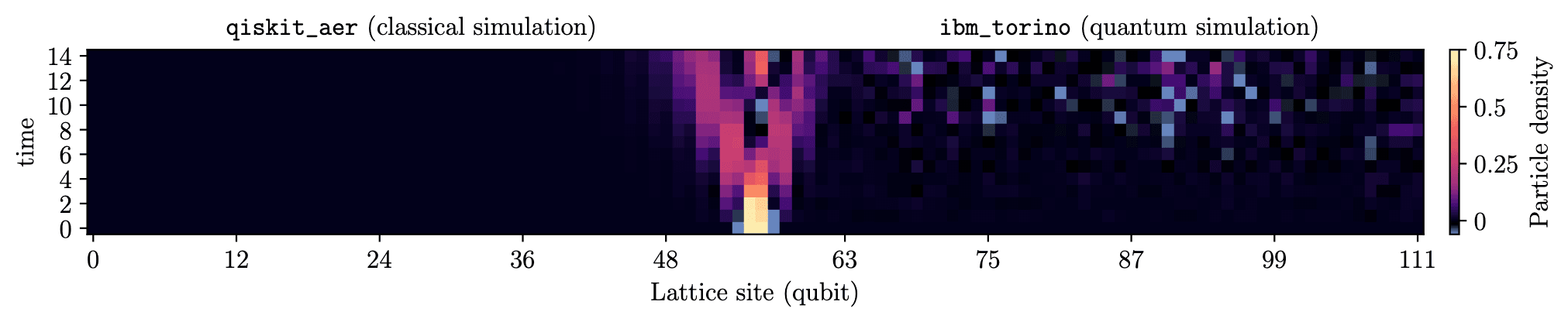
Researchers from IBM Quantum have achieved a major breakthrough in quantum simulation technology. They successfully performed a complex quantum simulation with 13,858 CNOTs and a CNOT depth of 370. This feat was made possible by leveraging Qiskit Runtime’s built-in error mitigation ways and custom layers of error correction. The team was led by experts in quantum physics. They used IBM Quantum hardware to run roughly 154 million “shots” of their circuits. This demonstrates the power of utility-scale quantum computing.
This achievement brings us closer to simulating complex physics processes that are currently impossible with classical computers. The next step for the research group is to simulate collisions between two particle beams. This step could demonstrate quantum computational advantage. IBM and the research team remain committed to achieving full quantum error correction, which would unlock even more powerful simulations.
The research team has successfully demonstrated the power of quantum simulation using 112 qubits on the IBM Quantum Heron processor, ibm_torino. By leveraging the Qiskit software stack, they were able to run circuits that are impossible to simulate with brute force classical methods. This is a significant milestone in the development of quantum computing.
One of the most impressive aspects of this experiment is the team’s ability to mitigate errors caused by noise in the surrounding environment. Quantum hardware is notoriously prone to errors, and developing robust error correction techniques is an active area of research. In the absence of full-fledged quantum error correction, the team relied on quantum error suppression methods and post-processing techniques to analyze the noisy outputs and deduce estimates of the noise-free results.
The Qiskit Runtime primitives played a crucial role
The Qiskit Runtime primitives played a crucial role in this experiment, particularly the Sampler primitive, which calculates probabilities or quasi-probabilities of bitstrings being output by quantum circuits. This not only simplified the process of collecting outputs but also improved their fidelity by automatically inserting error suppression techniques like dynamical decoupling and applying quantum readout error mitigation.
The team’s use of Qiskit execution modes, such as Session mode, allowed them to submit circuits to quantum hardware in efficient multi-job workloads. This enabled them to run many variants of their circuits, totaling roughly 154 million “shots” on quantum hardware. The correlated noise between runs facilitated their error mitigation methods.
The results are nothing short of remarkable. By leveraging the Qiskit software stack and built-in error handling capabilities, the team was able to perform a quantum simulation with an impressive 13,858 CNOTs and a CNOT depth of 370. This is a testament to the power of quantum simulation technology and its potential to unlock new insights into complex physics processes.
Looking ahead, the research group is already working on simulating collisions between two particle beams, which could demonstrate quantum computational advantage. If successful, this would be a groundbreaking achievement, as no classical computing method can accurately simulate these collisions at high energies using simplified physics theories like the Schwinger model.
The prospect of achieving full quantum error correction
The prospect of achieving full quantum error correction is still an open challenge, but IBM and the research team are actively working towards it. The ability to perform error correction in quantum computations would make quantum computers even more powerful, enabling rich, three-dimensional simulations of incredibly complex physics processes.
As we move forward, it’s clear that quantum simulation technology has the potential to revolutionize our understanding of fundamental particles and unlock new secrets of the universe. I’m excited to see where this research will take us in the years to come!
External Link: Click Here For More