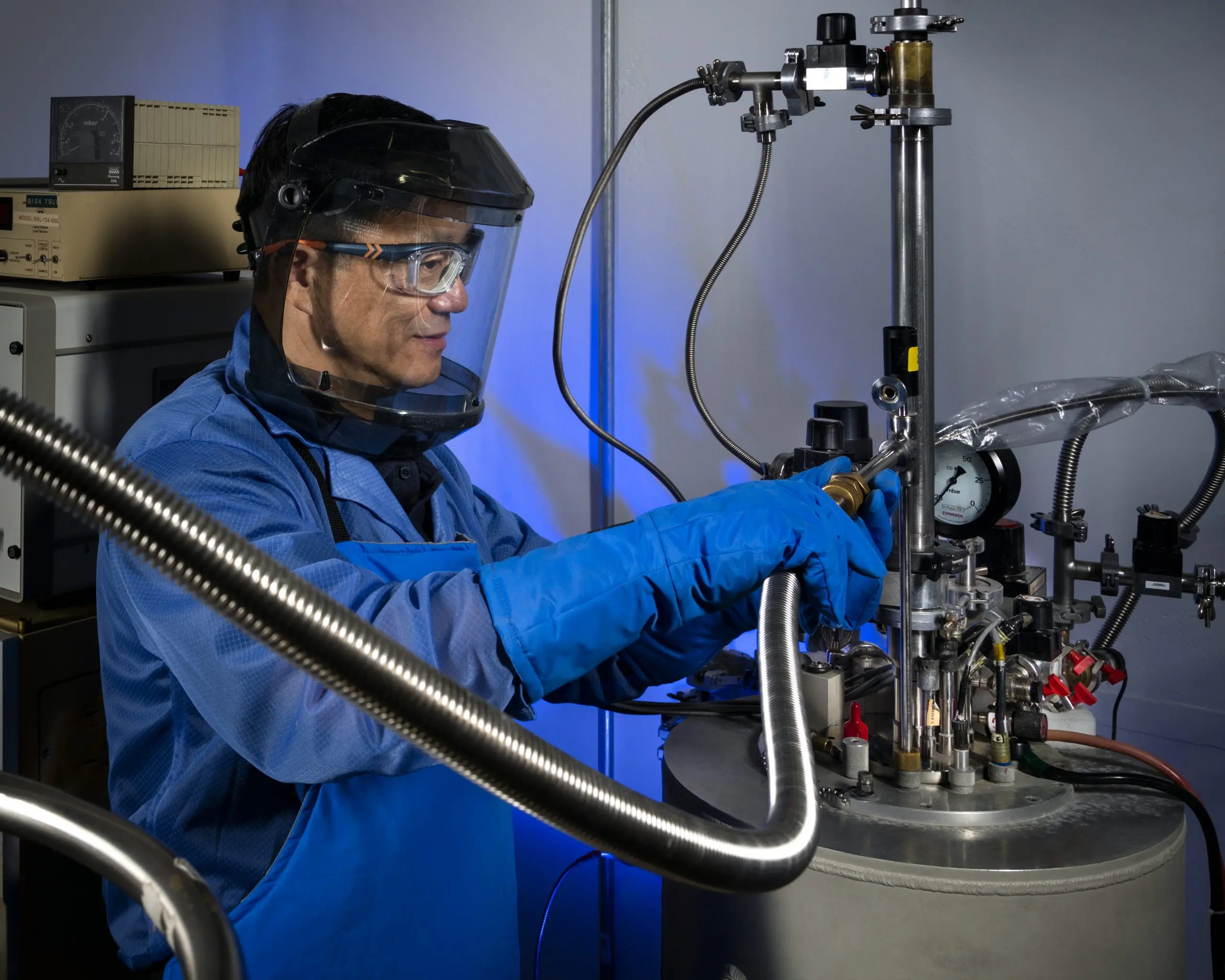
Wei Pan, a researcher at Sandia National Laboratories, has been elected a fellow of the American Physical Society for his pioneering research on quantum phenomena. His work focuses on the behavior of electrons in two-dimensional systems, including the discovery of unconventional fractional quantum Hall states and innovative experiments exploring topological superconductivity and Majorana particles. Pan’s research has important implications for fault-tolerant quantum computing and could lead to the development of more robust quantum computers.
He joined Sandia in 2003 after earning his Ph.D. and has worked at the Labs’ Albuquerque and Livermore locations. The American Physical Society has recognized Pan’s contributions to the field, naming him among their prestigious roster of fellows. His work is supported by Sandia National Laboratories, a multimission laboratory operated by National Technology and Engineering Solutions of Sandia LLC, a wholly owned subsidiary of Honeywell International Inc., for the U.S. Department of Energy’s National Nuclear Security Administration.
Introduction to Quantum Research and the American Physical Society
The field of quantum physics has been rapidly advancing in recent years, with researchers making groundbreaking discoveries that have the potential to revolutionize our understanding of the universe. One such researcher is Wei Pan, who has been elected a fellow of the American Physical Society (APS) for his outstanding contributions to the field. The APS is a prestigious organization that recognizes and promotes excellence in physics research, and being named a fellow is a significant honor. Pan’s research focuses on quantum phenomena, including the fractional quantum Hall effect, excitonic insulator phase, Majorana particles, topological superconductivity, and Leggett modes in Dirac semimetals.
The fractional quantum Hall effect is a complex phenomenon that arises from the collective motion of electrons in a two-dimensional system. This effect has important implications for fault-tolerant quantum computing, as it provides a robust and stable platform for quantum information processing. Pan’s work on this topic has led to the discovery of several unconventional fractional quantum Hall states, which have expanded our understanding of this phenomenon. His research has also explored the excitonic insulator phase in InAs/GaSb, which is a promising material system for studying quantum phenomena.
Pan’s election as an APS fellow is a testament to his dedication and expertise in the field of quantum physics. His work has been recognized by his peers, and he has made significant contributions to our understanding of quantum systems. The APS fellowship is a prestigious award that recognizes researchers who have made outstanding contributions to the field of physics. Pan’s achievement is a reflection of his hard work and commitment to advancing our knowledge of the quantum world.
The study of quantum phenomena is a complex and challenging field, requiring a deep understanding of theoretical concepts and experimental techniques. Researchers like Pan are pushing the boundaries of our knowledge, exploring new materials and systems that can exhibit quantum behavior. The discovery of new quantum states and phases has the potential to revolutionize our understanding of the universe, with applications in fields such as quantum computing, materials science, and condensed matter physics.
Quantum Phenomena and Topological Protection
Quantum phenomena are a class of physical effects that arise from the behavior of particles at the atomic and subatomic level. These effects are often counterintuitive and can lead to novel properties and behaviors that are not seen in classical systems. One of the key features of quantum systems is topological protection, which refers to the robustness of certain quantum states against environmental perturbations. This means that even if the system is subjected to external noise or interference, the quantum state remains stable and unchanged.
Topological protection is a critical concept in quantum physics, as it provides a way to protect quantum information from decoherence and errors. Decoherence is the loss of quantum coherence due to interactions with the environment, which can cause quantum states to decay and lose their quantum properties. Topological protection offers a way to mitigate this effect, by creating quantum states that are robust against environmental perturbations. This has important implications for quantum computing, as it provides a way to build more stable and reliable quantum computers.
Pan’s research has focused on exploring topological protection in various quantum systems, including the fractional quantum Hall effect and topological superconductivity. His work has shown that these systems can exhibit robust quantum behavior, even in the presence of external noise and interference. This has important implications for the development of quantum technologies, such as quantum computing and quantum simulation.
The study of topological protection is an active area of research, with scientists exploring new materials and systems that can exhibit this phenomenon. The discovery of new topological phases and states has the potential to revolutionize our understanding of quantum physics, with applications in fields such as quantum computing, materials science, and condensed matter physics.
Experimental Techniques and Materials Science
The study of quantum phenomena requires a range of experimental techniques and materials science expertise. Researchers like Pan use advanced instrumentation and techniques to probe the behavior of quantum systems, including spectroscopy, microscopy, and transport measurements. These techniques allow scientists to study the properties of quantum systems in detail, including their electronic structure, magnetic properties, and optical response.
Materials science plays a critical role in the study of quantum phenomena, as the properties of the material system can have a significant impact on the behavior of the quantum state. Researchers are actively exploring new materials and systems that can exhibit quantum behavior, including topological insulators, superconductors, and nanomaterials. These materials offer a range of possibilities for studying quantum phenomena, from the fractional quantum Hall effect to topological superconductivity.
Pan’s research has focused on the study of InAs/GaSb, which is a promising material system for studying quantum phenomena. This material exhibits a range of interesting properties, including a high mobility and a large spin-orbit coupling. These properties make it an ideal system for studying the fractional quantum Hall effect and other quantum phenomena.
The development of new materials and experimental techniques is critical to advancing our understanding of quantum physics. Researchers are continually pushing the boundaries of what is possible, exploring new systems and techniques that can provide insights into the behavior of quantum systems.
Career Development and Advice for Aspiring Researchers
For aspiring researchers, Pan’s advice is simple: “Follow your own interest. This can propel you longer and deeper in your research journey.” This advice reflects the importance of passion and motivation in scientific research, as well as the need to stay focused and driven in the face of challenges and setbacks.
Pan’s own career is a testament to the power of following one’s interests and passions. His work on quantum phenomena has taken him from his early days as a researcher to his current position as an APS fellow. Throughout his career, he has remained committed to advancing our understanding of the quantum world, and his contributions have had a significant impact on the field.
For those interested in pursuing a career in scientific research, Pan’s advice is to stay focused and motivated, even in the face of challenges and setbacks. It is also important to seek out opportunities for collaboration and mentorship, as these can provide valuable insights and guidance throughout one’s career.
The study of quantum physics is a complex and challenging field, requiring a deep understanding of theoretical concepts and experimental techniques. However, for those who are passionate about advancing our knowledge of the universe, it can be a highly rewarding and fulfilling career. Researchers like Pan are pushing the boundaries of what is possible, exploring new systems and techniques that can provide insights into the behavior of quantum systems.
External Link: Click Here For More