

Research utilising Rydberg atom arrays demonstrates an emergent double supersolid phase, exhibiting coexisting superfluids and crystalline order. Monte Carlo simulations reveal a tunable phase diagram, including double superfluidity and an antiferromagnetic insulator, with crystalline order unexpectedly enhanced by increased thermal activity.
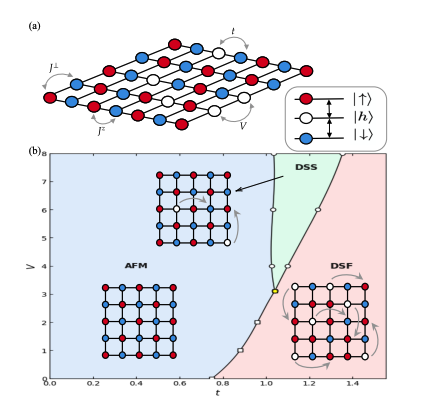
The pursuit of exotic states of matter continues to yield surprising results, particularly within systems exhibiting both crystalline order and superfluidity, known as supersolids. Recent advances in manipulating Rydberg atoms – atoms with highly excited electrons – using optical tweezers now provide a novel platform to investigate these complex phenomena. Researchers at Fudan University and Westlake University, including Kuangjie Chen, Yang Qi, Zheng Yan, and Xiaopeng Li, detail their investigation into a bosonic t-J-V model, a theoretical framework describing interacting particles on a lattice, realised using these Rydberg atom arrays. Their work, entitled ‘Double Supersolid Phase in a Bosonic t-J-V Model with Rydberg Atoms’, utilises large-scale Monte Carlo simulations to reveal an emergent double supersolid (DSS) phase, characterised by the coexistence of two superfluids and crystalline order, and demonstrates how tuning interactions within the system can lead to unconventional thermal behaviour.
Recent advances in quantum simulation utilise tunable systems to investigate complex many-body physics, and researchers now demonstrate a novel platform employing Rydberg atom arrays to realise and explore the bosonic t-J model. This innovative approach permits precise control over interactions and access to exotic quantum phases, including a newly discovered double supersolid (DSS) phase exhibiting coexisting superfluidity and crystalline order. Through large-scale Monte Carlo simulations and detailed analysis of key observables, scientists map a rich phase diagram and uncover unconventional behaviour within the DSS regime, establishing a viable pathway for exploring complex quantum phenomena and developing advanced quantum technologies.
Researchers meticulously construct a system of interacting bosons
Researchers meticulously construct a system of interacting bosons on a lattice, utilising Rydberg atoms to engineer strong interactions and tunable parameters. Rydberg atoms, created by exciting atoms to very high energy levels, exhibit exaggerated interactions, making them ideal for simulating strongly correlated quantum systems. They systematically vary the tunneling strength (t), which governs the movement of bosons between lattice sites, and the repulsive interaction strength (V) to explore the system’s behaviour across a wide range of conditions, revealing a transition between a double superfluid phase, the DSS phase, and an antiferromagnetic insulating state.
The study highlights an unconventional thermal enhancement of crystalline order within the DSS regime, challenging conventional understanding of phase transitions and prompting further investigation into the mechanisms driving this behaviour. Increasing the temperature unexpectedly strengthens the crystalline arrangement, a counterintuitive finding that demands a deeper exploration of the interplay between thermal fluctuations and crystalline order. Typically, increased thermal energy disrupts crystalline structures, but this system exhibits the opposite effect.
Detailed analysis of superfluid density, hole density, and hole-hole correlations provides compelling evidence supporting these observations and solidifies the understanding of the underlying physics. Measurements of superfluid density, a measure of frictionless flow, for both holes and spin components confirm a loss of superfluidity at phase transitions, indicating a change in the collective behaviour of particles as they transition between different phases. Finite-size scaling techniques extrapolate results to larger system sizes, improving the accuracy of the analysis and providing confidence in the observed phenomena. This technique mitigates the effects of boundary conditions inherent in simulations of finite systems.
Hole density measurements demonstrate a decrease in hole
Hole density measurements demonstrate a decrease in hole concentration as tunneling strength increases, indicating boson filling of the lattice and a transition towards a pure spin-1/2 model. Holes represent the absence of a boson, and their behaviour is crucial in understanding the system’s properties. Hole-hole correlation measurements reveal strong repulsion between holes at short distances, suggesting a relatively uniform distribution of holes throughout the system, even within the different phases observed. The effective Hamiltonian, incorporating interaction strengths for spin components, provides a theoretical framework for understanding these observed behaviours, accurately capturing the interplay between tunneling, repulsive interactions, and spin alignment. The Hamiltonian, a mathematical expression describing the total energy of the system, allows for predictive modelling of its behaviour.
Expanding upon these findings, future research could investigate the dynamics of holes and spins within these phases, and their response to external drives, providing valuable insights into the system’s behaviour. Ultimately, this work establishes a promising avenue for exploring novel quantum phenomena and developing advanced quantum technologies, paving the way for future advancements in quantum simulation and materials science.
🗞 Double Supersolid Phase in a Bosonic t-J-V Model with Rydberg Atoms
🧠 DOI: https://doi.org/10.48550/arXiv.2506.16820


