Rotating black holes may serve as natural sources of squeezed gravitons, according to new research led by Pangiotis Dorlisa from the National Technical University of Athens, along with Nick E. Mavromatosa from both the National Technical University of Athens and King’s College London, and Sarben Sarkar from King’s College London. The team demonstrates that axion fields, hypothetical particles arising from diverse theoretical origins, surrounding these black holes generate pairs of gravitons in a squeezed state through a process called superradiance. This research is significant because it proposes a novel astrophysical mechanism for creating squeezed states of gravity, potentially offering a pathway to probe quantum gravity effects and test fundamental physics. The findings reveal that standard gravitational effects dominate the production of squeezing, vastly outweighing contributions from more exotic quantum anomalies, and suggest that sufficiently long-lived axion clouds around black holes could produce measurable levels of gravitational squeezing.
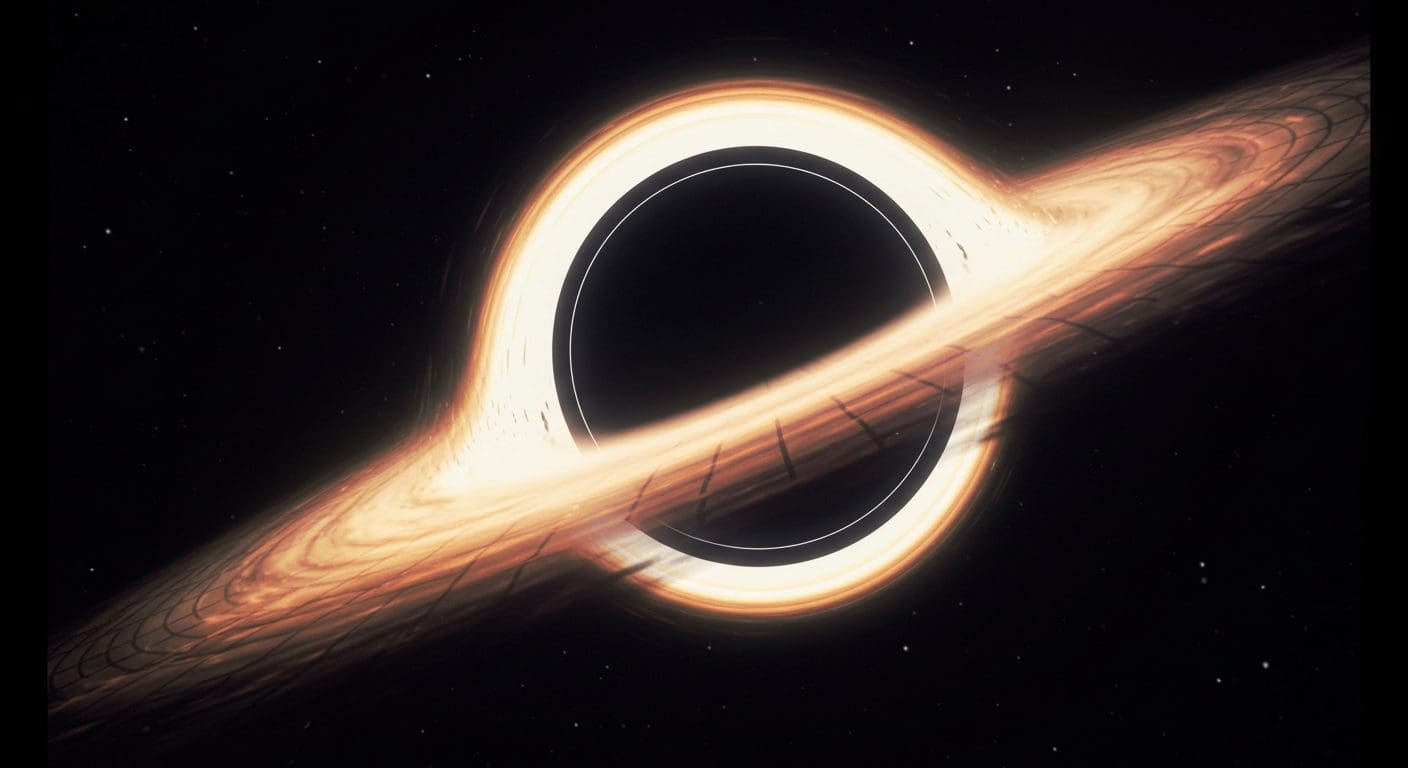
In multi-dimensional spacetimes, rotating black holes, specifically Kerr-type black holes, represent a novel astrophysical source of squeezed graviton states, originating from superradiant axionic clouds. These axions, regardless of their origin, can arise from various theoretical frameworks, including models incorporating Kalb-Ramond fields, compactifications within string theory, and geometries featuring a totally antisymmetric component of torsion in Einstein-Cartan theory. These axion fields interact with chiral gauge fields and gravitational Chern-Simons anomalies present in effective gravitational actions. When these axions gain mass in the presence of a rotating black hole, they undergo superradiance, leading to the creation of entangled pairs of gravitons.
Quantum Gravity, Waves, and Information Sources
This extensive list comprises citations related to quantum gravity, quantum information, gravitational wave detection, and related fields, revealing a strong focus on several key themes and research areas. A significant portion of the citations address theoretical aspects of quantum gravity, including modifications to general relativity, the search for quantum gravity effects, and the interplay between quantum mechanics and gravity. There is a strong emphasis on gravitational wave detection and the potential for using quantum technologies to enhance detectors, including experiments similar to LIGO and Virgo, squeezing techniques, and quantum noise reduction. A large number of citations relate to quantum information theory, quantum communication, quantum entanglement, and the application of these concepts to gravitational wave detection and other areas of physics, including references to quantum key distribution, squeezed states, continuous variable quantum information, and quantum metrology.
A recurring theme is the use of squeezed states of light, or other fields, to reduce quantum noise in detectors, a crucial technique for improving detector sensitivity. The role of entanglement and other quantum correlations in enhancing measurements and potentially probing fundamental physics is also explored. Some citations suggest investigations into alternative theories of gravity beyond general relativity, while the use of quantum techniques to improve the precision of measurements is a central theme. A significant portion of the work focuses on continuous variable quantum information, which uses continuous degrees of freedom, like the amplitude and phase of light, rather than discrete qubits.
This bibliography clearly demonstrates a highly interdisciplinary research program, bringing together concepts and techniques from quantum physics, general relativity, optics, and information theory. Many of the citations point to research aimed at developing practical applications, particularly in the context of gravitational wave detection, and the list includes many recent publications from the 2010s and 2020s, indicating an active and ongoing research effort, with preprints from 2024 and 2025 confirming this. The overarching goal appears to be leveraging quantum technologies to overcome the limitations of classical detectors and push the boundaries of what is measurable in the universe. The list is remarkably comprehensive, covering a wide range of relevant topics and techniques. In summary, this bibliography represents a significant body of work at the forefront of research in quantum gravity, gravitational wave detection, and quantum technologies, highlighting the growing synergy between these fields and the potential for groundbreaking discoveries in the years to come.
Axion Clouds Generate Squeezed Graviton States
Researchers have discovered a novel mechanism for generating squeezed states of gravitons, ripples in the fabric of spacetime, around rotating black holes. This process is driven by the interaction of black holes with surrounding clouds of axions, hypothetical particles that could also constitute dark matter. Regardless of their precise origin, the axions become superradiantly amplified around the black hole, leading to the production of entangled pairs of gravitons. This entanglement manifests as squeezing, a quantum phenomenon where the uncertainty in one property of the gravitons is reduced at the expense of increased uncertainty in another.
The research demonstrates that the squeezing effect stemming from general relativity significantly dominates over any contribution from more exotic gravitational anomalies. Calculations reveal that the generated squeezing is strong enough to be potentially measurable, offering a unique window into the quantum nature of gravity and the properties of axions. The team employed a mathematical approach, similar to techniques used in optics to analyze squeezed light, to model the behavior of these squeezed graviton states. Interestingly, the polarization of the emitted gravitons exhibits a strong preference for opposite states, meaning that if one graviton in a pair has a specific polarization, the other is likely to have the perpendicular polarization.
This characteristic, similar to the entanglement observed in photons, suggests a strong correlation between the two particles. The magnitude of this effect is surprisingly robust, even when accounting for the complex interplay between the black hole’s spin, the axion cloud, and the emitted gravitons. The team found that the number of axions in the cloud, combined with the black hole’s properties, effectively balances out a natural suppression of the squeezing effect. This suggests that even relatively small black holes could generate measurable levels of squeezed gravitons. The research opens up the possibility of using observations of these squeezed states to probe the existence of axions and to test the fundamental predictions of general relativity in the strong-gravity regime near black holes.
Axion Clouds Generate Squeezed Graviton States
The research presents a novel mechanism for generating squeezed graviton states around rotating black holes, stemming from the presence of axionic clouds. These axions, originating from diverse theoretical sources including string theory and modified gravity theories like Einstein-Cartan, interact with the black hole’s rotation to produce pairs of gravitons in a squeezed state, a quantum state with reduced uncertainty in one property at the expense of increased uncertainty in another. The team demonstrated, through a mathematical framework analogous to optics, that the squeezing effect arising from conventional general relativity significantly dominates over contributions from more exotic gravitational anomaly terms. This dominance of general relativistic effects leads to a potentially observable production of squeezed gravitons, particularly if the axionic cloud persists for a sufficient duration.
The findings suggest a potential pathway for detecting these squeezed states using future gravitational wave interferometers, offering a new avenue for probing quantum gravity effects. While the research acknowledges the complexity of modelling real astrophysical scenarios, it provides a theoretical foundation for understanding how squeezed gravitons might be generated and detected in the vicinity of rotating black holes. Future work could focus on refining.
👉 More information
🗞 Squeezed gravitons from superradiant axion fields around rotating black holes
🧠 ArXiv: https://arxiv.org/abs/2507.23475