

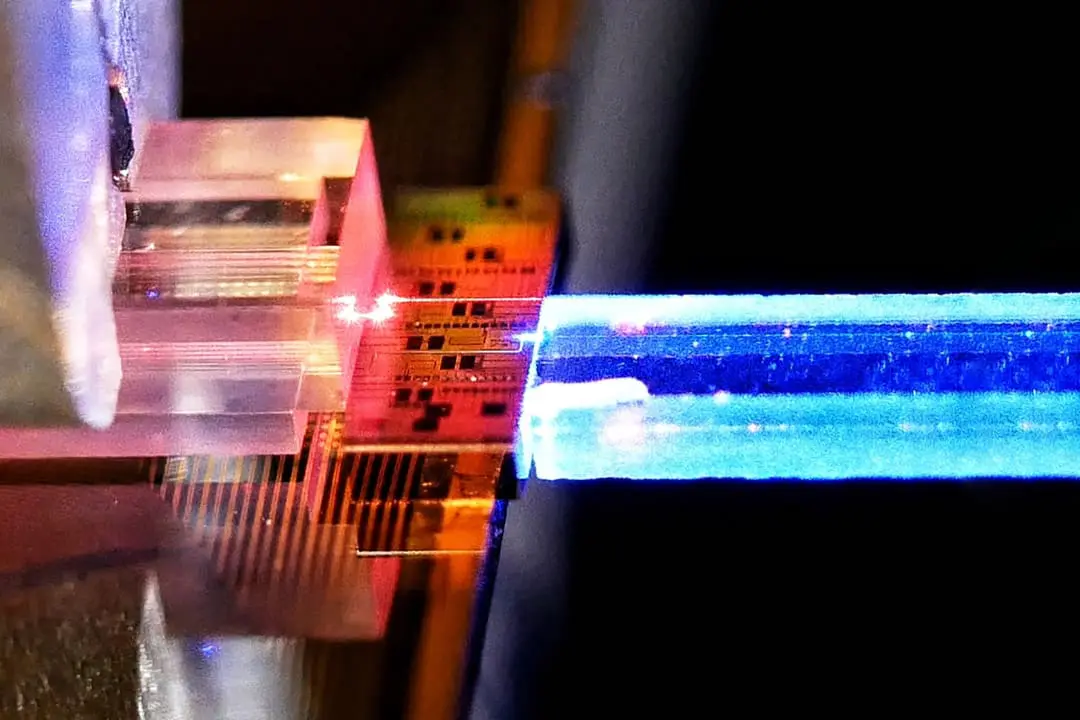
Rochester Institute of Technology (RIT) and the University of Rochester have collaborated to develop the Rochester Quantum Network (RoQNET), an experimental quantum communications network designed to enhance secure information transmission. Utilizing single photons over fiber-optic lines, RoQNET spans approximately 11 miles at room temperature, leveraging optical wavelengths for its operations. Due to their compatibility with existing telecommunications infrastructure, the network employs photons as qubits, offering a practical approach to long-distance quantum communication. Future plans include expanding RoQNET to connect with other research facilities across New York state, aiming to advance secure communications and distributed computing capabilities.
Rochester Institute of Technology (RIT) and the University of Rochester have teamed up to create the Rochester Quantum Network (RoQNET), an innovative quantum communications network designed to enhance secure information transmission. This collaboration leverages single photons transmitted over fiber-optic lines, covering a distance of approximately 11 miles at room temperature using optical wavelengths.
The network’s foundation lies in using photons as qubits, chosen for their suitability in long-distance communication and compatibility with existing telecommunications infrastructure. RoQNET is a test bed for exploring distributed quantum entanglement, a critical component for advancing quantum communication technologies.
Plans to Expand RoQNET Across New York State
The Rochester Quantum Network (RoQNET) employs single photons as qubits for secure communication over fiber-optic lines, leveraging their unique quantum properties. This approach ensures that any attempt to intercept or measure the photons disrupts their quantum state, making eavesdropping detectable. The network’s use of integrated photonic chips allows for precise control over photon states, enhancing security by enabling efficient generation and detection of quantum signals.
RoQNET’s design incorporates solid-state memory nodes, which securely store quantum information during transmission. These nodes facilitate controlled storage and retrieval of photons, ensuring data integrity without compromising security. Operating at room temperature is a significant advantage, as it eliminates the need for complex cooling systems typically required in other quantum networks, making RoQNET more practical for real-world applications.
The network’s expansion plans aim to connect with other research facilities across New York state, enhancing scalability and robustness. This growth will facilitate larger-scale secure communication systems, demonstrating the potential of quantum networks in diverse settings beyond laboratory environments. By integrating advanced protocols and addressing challenges such as error correction without compromising security, RoQNET paves the way for a more reliable and widespread quantum internet.
The practical implications of RoQNET’s work extend to improving secure communication methods, offering real-world applications in fields like data transmission and potentially leading to advancements in quantum key distribution (QKD). These developments could enhance the efficiency and speed of secure communication systems, contributing to a more robust and scalable quantum infrastructure.
More information
External Link: Click Here For More


