
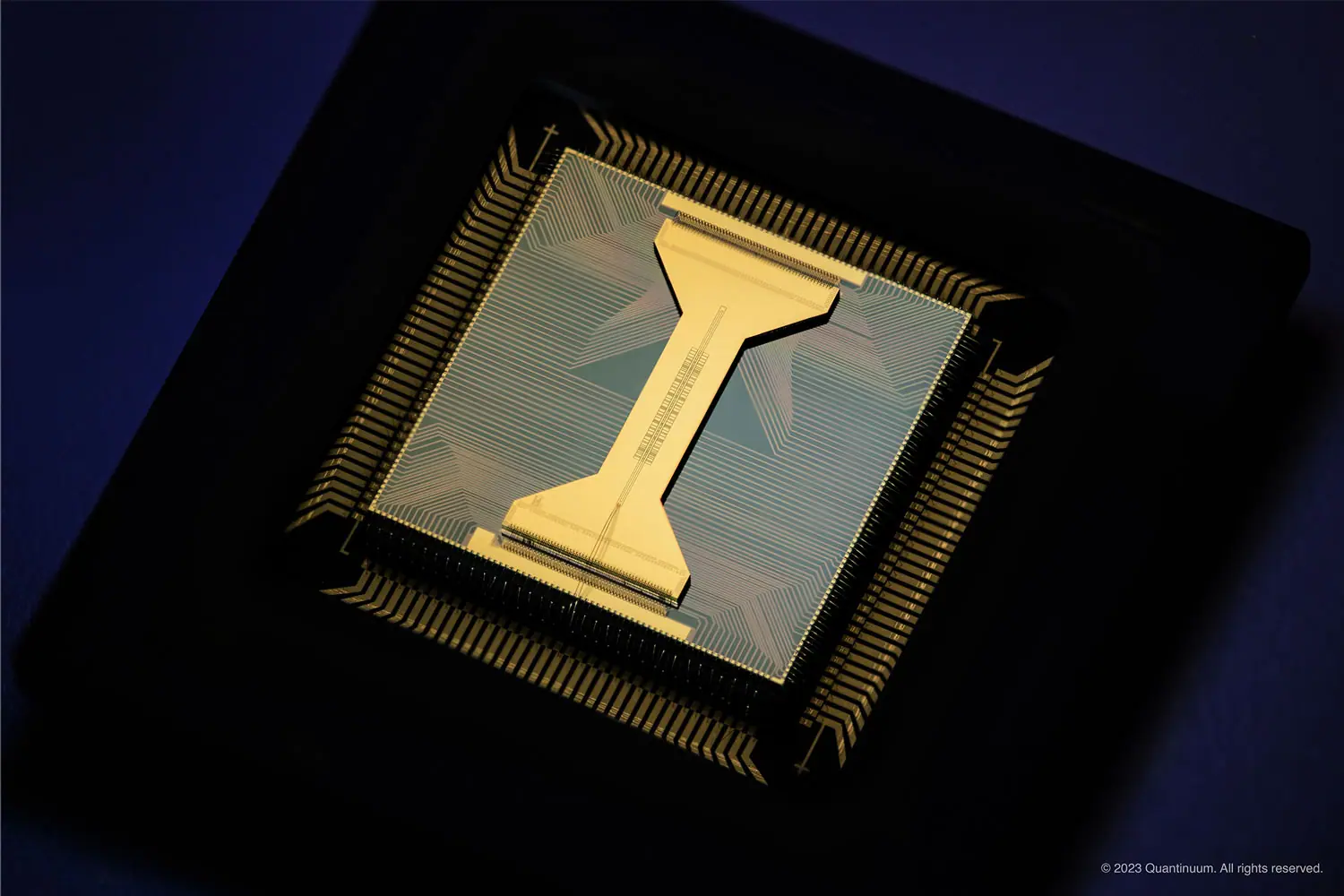
Quantinuum, the world’s largest integrated quantum computing company, will provide Japan’s largest research institution, RIKEN, with access to its high-performing H1-Series ion-trap quantum computing technology. The technology will be installed at RIKEN’s campus in Wako, Saitama, as part of a project to build a quantum-HPC hybrid platform. The project, which also involves SoftBank, University of Tokyo, and Osaka University, aims to develop software tools and applications to integrate quantum computers and supercomputers. The goal is to demonstrate the benefits of such hybrid platforms for future post-5G services. The project is commissioned by Japan’s Ministry of Economy, Trade and Industry.
RIKEN Chooses Quantinuum’s System Model H1 for Hybrid Quantum-Supercomputing Platform
RIKEN, Japan’s largest comprehensive research institution, has selected Quantinuum’s System Model H1 for its large-scale hybrid quantum-supercomputing platform. The agreement will provide RIKEN and its collaborators, including SoftBank, the University of Tokyo, and Osaka University, with on-premise access to Quantinuum’s ion-trap quantum computer. The hardware will be installed at RIKEN’s campus in Wako, Saitama.
Quantum-HPC Hybrid Platform Project
The deployment of Quantinuum’s System Model H1 is part of RIKEN’s project to build a quantum-HPC hybrid platform. This platform will consist of high-performance computing systems, such as the supercomputer Fugaku and quantum computers. The integrated hardware platform will support a large-scale software research program. Researchers at RIKEN, along with collaborators from SoftBank, University of Tokyo, and Osaka University, will develop the software tools and applications required to integrate quantum computers and supercomputers most effectively.
Future Post-5G Era Services
The project’s goal is to demonstrate the advantages of hybrid computational platforms for deployment as services in the future post-5G era. The New Energy and Industrial Technology Development Organization (NEDO), a national research and development agency under Japan’s Ministry of Economy, Trade and Industry, has commissioned this project.
Quantinuum’s Role and Expectations
Dr. Rajeeb Hazra, CEO of Quantinuum, expressed his honor at being selected to be part of this advanced project in Japan. He highlighted Quantinuum’s track record in quantum computing and expressed hope that their technical and operational expertise would contribute to achieving the project’s objectives. He also expressed excitement that this engagement would allow researchers in RIKEN and other Japanese institutions to benefit from their H-Series quantum computer’s full power and capability.
RIKEN’s Commitment to Quantum-HPC Hybrid Computing
Dr. Mitsuhisa Sato, Deputy Director at RIKEN Center for Computational Science / Director, Quantum HPC Collaborative Platform Division, stated that advanced quantum computers are now moving into the practical stage. From the HPC’s perspective, quantum computers are devices that accelerate scientific applications conventionally executed on supercomputers and enable computations that cannot yet be solved by supercomputers. RIKEN is committed to developing system software for quantum-HPC hybrid computing, leveraging its comprehensive scientific research capabilities and experience in the development and operation of cutting-edge supercomputers, such as Fugaku.
RIKEN, a National Research and Development Agency, is Japan’s largest comprehensive research institution renowned for high-quality research in a diverse range of scientific disciplines. Founded in 1917, initially as a private research foundation, RIKEN has grown rapidly in size and scope, today encompassing a network of world-class research centers and institutes across Japan.
“We are honored to be selected to be part of this ambitious, advanced project in Japan,” said Dr. Rajeeb Hazra, CEO of Quantinuum. “Quantinuum has a track record as a commercial leader in quantum computing, and we hope to bring our technical and operational know-how and contribute to achieving the project’s objectives. Our H-Series quantum computer is uniquely poised to enable ground-breaking developments by researchers around the world. We are excited that this engagement will allow researchers in RIKEN and other Japanese institutions to benefit from our H-Series quantum computer’s full power and capability.”
“Advanced quantum computers of NISQ are now moving into the practical stage as the number of qubits is increasing and the fidelity is improved. From the HPC’s point of view, quantum computers are devices that accelerate scientific applications conventionally executed on supercomputers and enable computations that cannot yet be solved by supercomputers. RIKEN is committed to developing system software for quantum-HPC hybrid computing, by leveraging its comprehensive scientific research capabilities and experience in the development and operation of cutting-edge supercomputers, such as Fugaku,” said Dr. Mitsuhisa Sato, Deputy Director, RIKEN Center for Computational Science / Director, Quantum HPC Collaborative Platform Division.
Summary
Japan’s largest research institution, RIKEN, is collaborating with SoftBank, University of Tokyo, and Osaka University to develop a large-scale hybrid platform that integrates quantum computers and supercomputers. The goal of this project is to demonstrate the benefits of such hybrid computational platforms for future deployment in the post-5G era.
- RIKEN, Japan’s largest research institution, has partnered with Quantinuum, a leading quantum computing company, to develop a large-scale hybrid quantum-supercomputing platform.
- The project involves the integration of Quantinuum’s System Model H1 Ion-trap Quantum Computer into RIKEN’s existing high-performance computing systems, including the supercomputer Fugaku.
- The collaboration also includes SoftBank, University of Tokyo, and Osaka University, who will assist in developing the necessary software tools and applications.
- The aim is to demonstrate the benefits of hybrid computational platforms for future deployment in the post-5G era.
- The project is commissioned by the New Energy and Industrial Technology Development Organization (NEDO), a national research and development agency under Japan’s Ministry of Economy, Trade and Industry.
- Dr. Rajeeb Hazra, CEO of Quantinuum, and Dr. Mitsuhisa Sato, Deputy Director at RIKEN, expressed their excitement and commitment towards the project.