

Rigetti Computing has announced its collaboration with Amazon Web Services (AWS) to provide customers access to Rigetti’s Quantum Processing Units (QPUs).
Rigetti’s QPUs are based on superconducting qubit technology, a universal, gate-model machine that can be applied in chemical simulation, combinatorial optimization, and machine learning. The company’s quantum processors, like the Ankaa™-series chips, offer fast gate times and program execution rates, making them suitable for simulating complex biochemical mechanisms and optimizing global logistics management.
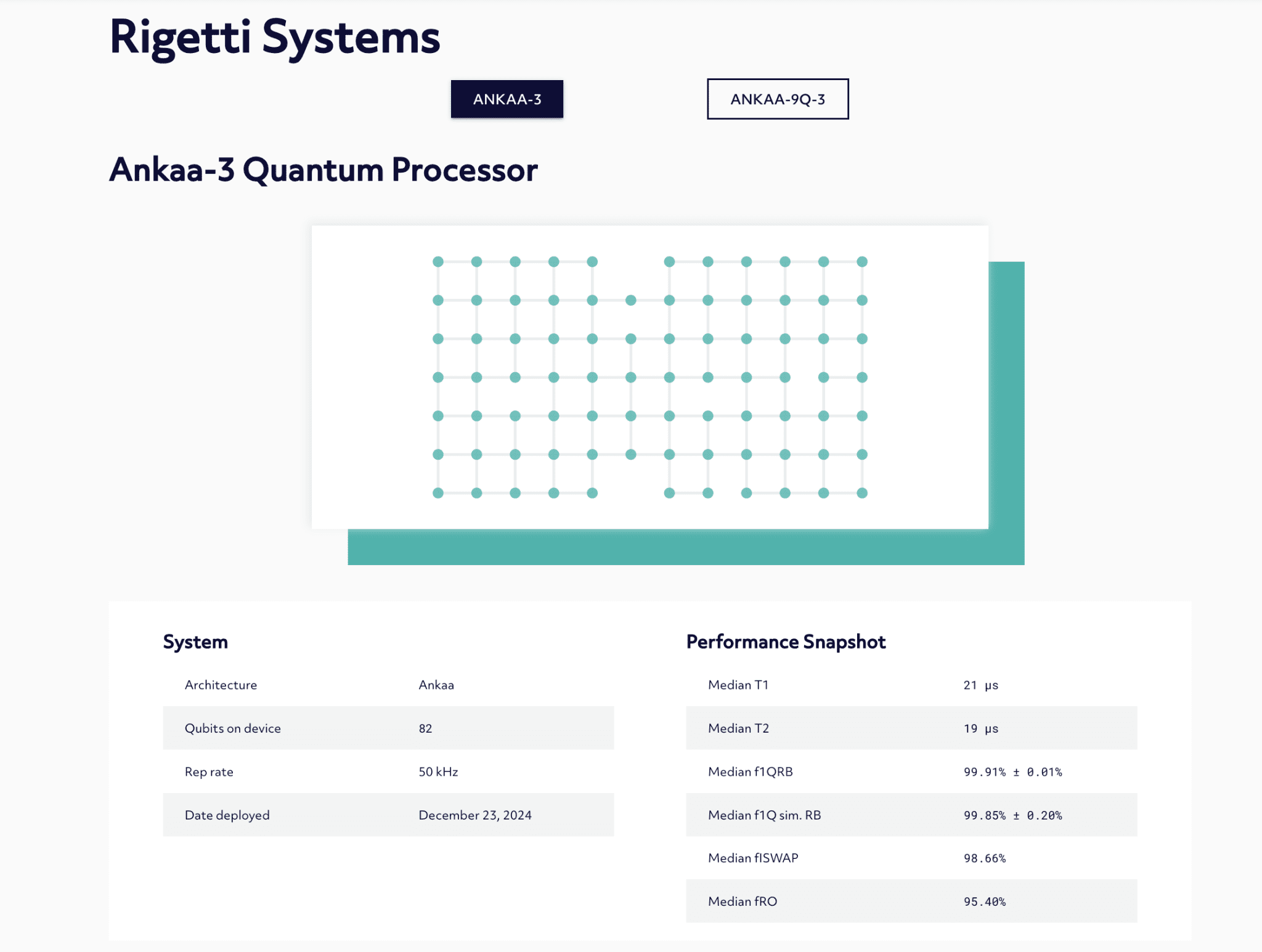
The Ankaa chip, at its core, consists of three principal subsystems: a compiler tool chain, a low-latency hardware controller, and superconducting qubits. These components work together to execute user programs efficiently. Rigetti’s quantum chips boast enhanced readout capabilities, faster processing times, and fast gate times for multiple entangling gate families.
The Ankaa chip topology is square with 4-fold connectivity, allowing developers to optimize programs for performance and minimize circuit depth. The two-qubit entangling gate mechanism, typically ISWAP, is actuated by electrical frequency modulation control, ensuring precise interactions between qubits.
Based in California, with offices in Australia and the UK, Rigetti Computing is a leading player in the field of quantum computing. The company specializes in building and deploying integrated quantum systems using superconducting qubit technology. These systems enable organizations across various sectors, including finance, insurance, pharmaceuticals, defense, and energy, to augment their computational workflows with quantum processors.
Its universal, gate-model superconducting quantum processors are at
Its universal, gate-model superconducting quantum processors are at the heart of Rigetti’s offerings. These machines, based on tunable superconducting qubits, have potential applications in areas such as chemical simulation, combinatorial optimization, and machine learning. The efficiency with which coherent superconducting qubits can simulate and understand the behavior of biochemical mechanisms makes them ideal for studying complex processes like photosynthesis and protein folding. Moreover, quantum computers can navigate exponentially more state space to find optimal solutions in areas like global logistics management.
Rigetti’s Ankaa™-series chips are characterized by a tileable, tunable-coupler-based architecture that is scalable to large qubit counts. Due to parametric resonance and fast DC pulse-based logic gates, the chips offer fast gate times and program execution rates. Performance metrics for current Rigetti systems can be found on their QPU page.
The Ankaa processor boasts enhanced readout capabilities, contributing to better overall circuit fidelities. Other improvements include a speedup in quantum processing and fast gate times for multiple entangling gate families. The square topology of the Ankaa chip, with 4-fold connectivity, features both ISWAP entangling gates, allowing developers to optimize programs for performance and minimize circuit depth.
Rigetti’s two-qubit entangling gate mechanism (typically ISWAP) is
Rigetti’s two-qubit entangling gate mechanism (typically ISWAP) is actuated by electrical frequency modulation (FM) control. The frequency of one qubit is flipped into resonance with a nearest-neighbor qubit for a precisely defined duration. To minimize cross-talk between qubits and estimate the effect of decoherence on an algorithm, the lifetimes of the qubits should be compared to the gate duration multiplied by the circuit depth of the algorithm.
This partnership enables end users to develop quantum algorithms using Rigetti’s state-of-the-art quantum hardware by providing AWS customers access to Rigetti’s QPUs. This collaboration is expected to drive application and research progress in the quantum computing industry more widely and allowing more people to access a variety of hardware on the cloud.
External Link: Click Here For More


