Researchers from various institutions have proposed a real-time adaptive protocol to measure decoherence timescales in quantum systems. Decoherence timescales, which determine the survival time of quantum coherence, are crucial for the performance of quantum technologies. The new protocol estimates these timescales using information from preceding experiments, reducing the time required to reach a given uncertainty by up to an order of magnitude compared to the standard method. Despite promising results, further research is needed to address methodological questions and optimize the protocol for practical applications.
What is the Importance of Decoherence Timescales in Quantum Systems?
Quantum coherence, the ability of a quantum system to maintain a superposition of states, is a critical aspect of quantum technologies. The time over which quantum coherence survives, known as the decoherence timescale, is a key performance indicator for quantum bits (qubits), the fundamental units of quantum information. Decoherence timescales determine the storage time for quantum memories and quantum repeaters, which are crucial for quantum communication networks.
Decoherence timescales also play a significant role in quantum sensing. On one hand, decoherence sets the ultimate performance limit of the sensors. On the other hand, decoherence itself can be the quantity measured by a quantum sensor as it provides information about the environment. For instance, in relaxometry, the rate at which a polarized quantum sensor reaches the thermal equilibrium configuration gives information about different physical processes in the environment.
Rapid benchmarking of decoherence timescales in platforms such as superconducting qubits or silicon spin qubits is a critical validation and quality assurance step for the development of large-scale quantum computing architectures. It also has the potential to improve error-correction protocols efficiently close to fault-tolerance thresholds.
How are Decoherence Timescales Currently Measured?
Decoherence rates are typically measured by preparing the system into a known quantum state and probing it at varying time delays to determine the probability of decay from its initial state. The standard protocol for decoherence estimation involves a series of measurements with time delays set over a predetermined range reflecting the expected value of the decoherence rate and fitting of the result to a decay function.
However, this method has its limitations. As the range of time delays is determined in advance, some of the measurements will provide little information on the decoherence of the system since the time delay is either much shorter than the true decoherence rate, resulting in no decay, or much longer, resulting in complete decay.
What is the Proposed Real-Time Adaptive Protocol for Measuring Decoherence Timescales?
A team of researchers from various institutions, including the SUPA Institute of Photonics and Quantum Sciences, the Department of Materials at the University of Oxford, the Department of Physics at the University of Warwick, the Department of Engineering Science at the University of Oxford, the Department of Chemical and Biological Physics at the Weizmann Institute of Science, and the Institute of Signals, Sensors and Systems at Heriot-Watt University, have proposed a real-time adaptive protocol to measure decoherence timescales.
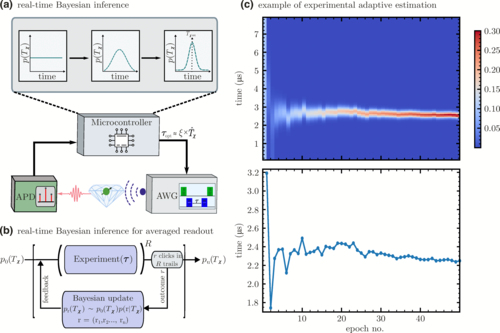
This protocol estimates the key decoherence timescales and the corresponding decay exponent of a quantum system in real time using information gained in preceding experiments. This approach reduces the time required to reach a given uncertainty by a factor up to an order of magnitude, depending on the specific experiment, compared to the standard protocol of curve fitting. A further speedup of a factor approximately 2 can be realized by performing the optimization with respect to sensitivity as opposed to variance.
How Does the Real-Time Adaptive Protocol Work?
The real-time adaptive protocol measures decoherence timescales for a single qubit, corresponding to relaxation, dephasing, and echo decay time, together with the coherence decay exponent. While the proposed algorithms are very general and can be applied to any quantum architecture, the researchers implemented their experiments on a single spin qubit associated with a nitrogen-vacancy (N.V.) center in diamond.
Adaptive techniques are central to progress across a broad range of quantum technologies. Early work in this field involved the implementation of adaptive quantum phase-estimation algorithms on photonic systems, later extended to frequency estimation with applications to static dc magnetometry with single electron spins.
What are the Implications and Future Directions of this Research?
Despite the promising results of the real-time adaptive protocol, several methodological questions still remain open. A priority concern is that adaptive protocols introduce an overhead given by the time required to compute settings on the fly for the next iteration. It is crucial to minimize this computation time since it can slow the protocol down to the point that the overhead negates the benefits of the adaptive approach.
The researchers’ work represents a significant step in measuring decoherence timescales in quantum systems. Their real-time adaptive protocol could potentially revolutionize how we measure and understand decoherence in quantum systems, paving the way for more efficient and accurate quantum technologies. However, further research is needed to address the remaining methodological questions and to optimize the protocol for practical applications.
Publication Date: 2024-02-13
Authors: Muhammad Junaid Arshad, Christiaan Bekker, Ben Haylock, Krzysztof Skrzypczak et al.
Source: Physical review applied
DOI: https://doi.org/10.1103/physrevapplied.21.024026