

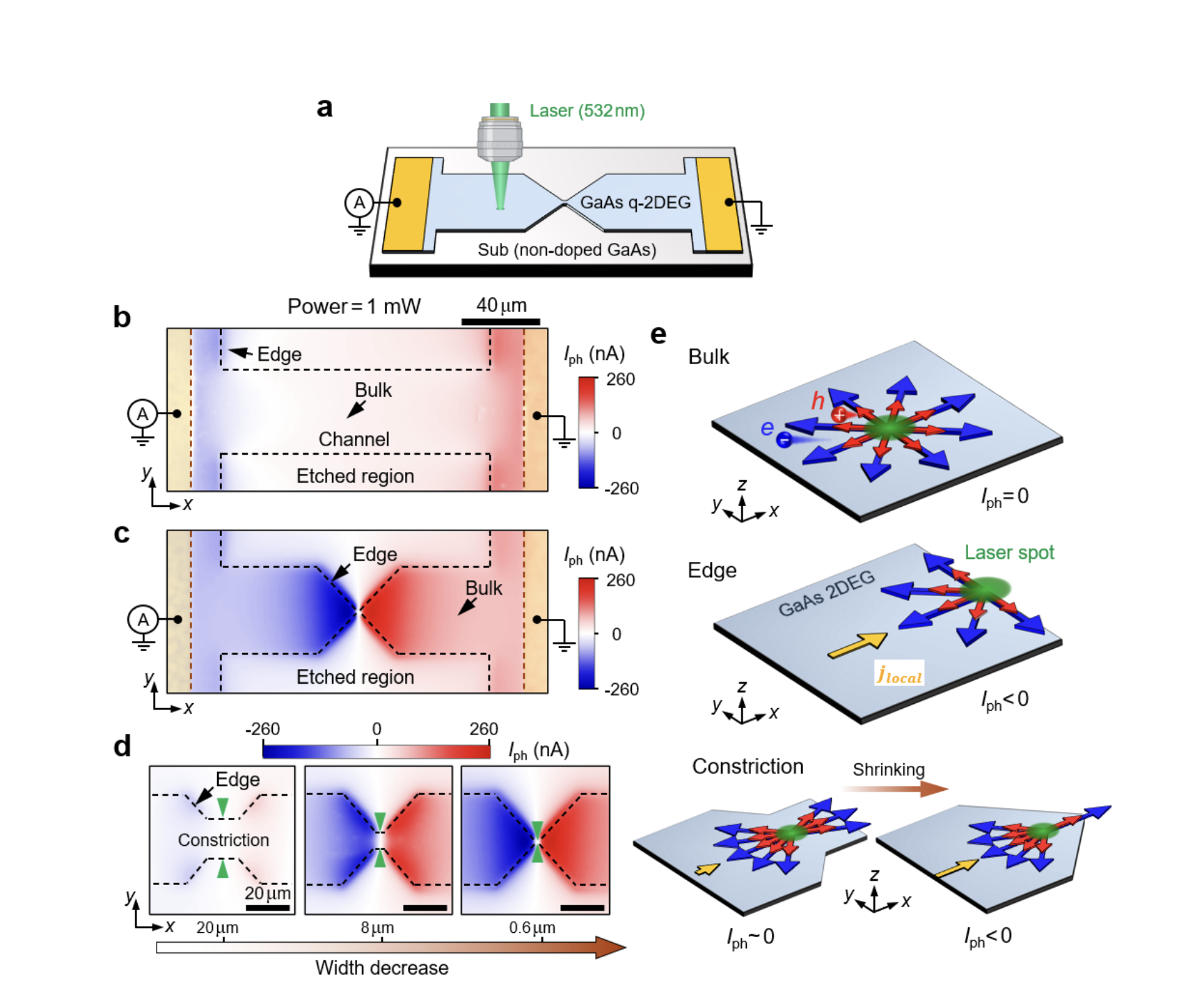
The pursuit of more efficient and versatile optoelectronic devices receives a significant boost from new research into bipolar photocurrents, where the flow of electrical current reverses depending on the light used to generate it. Xiaoguo Fang from Zhejiang University, Huanyi Xue and Feilin Chen from Westlake University, and Xuhui Mao from Fudan University, alongside their colleagues, demonstrate for the first time a bipolar Shockley-Ramo photoresponse in nanoscale devices crafted from gallium arsenide. This breakthrough overcomes a key limitation of existing technologies, which typically exhibit only a single current direction, by carefully controlling the movement of both electrons and holes within the device’s geometry. The team’s approach, which exploits the unique properties of gallium arsenide and precise nanoscale engineering, allows them to switch the current polarity simply by changing the intensity of the light, paving the way for advanced optical logic and high-contrast imaging technologies.
Constriction Width Impacts Photocarrier Polarization Dynamics
Researchers investigate how photocarrier polarization, a property of semiconductors relating to the direction of electron movement, behaves in constricted structures. They observed that the polarization can reverse direction and sought to understand why, focusing on the influence of constriction width, temperature, and the intensity of incident light. To achieve this understanding, the team combined experimental observations with detailed computer simulations. These simulations model the behavior of electrons and holes, the charge carriers in semiconductors, within the constricted structures, allowing them to explore the underlying physics driving the observed polarization effects.
The simulations employ a drift-diffusion model, which describes how charge carriers move under the influence of electric fields and concentration differences. A crucial element of this model is the inclusion of intervalley scattering, a process where excited carriers transition between different energy levels within the semiconductor material, and is represented in the simulations by a scaling factor. The model also accounts for temperature-dependent diffusion lengths, reflecting how far a carrier travels before recombining, as temperature significantly impacts carrier mobility and lifetime. The simulated polarization signal is then calculated using the Sum-Rule theorem, which connects the polarization to the local current density and a calculated weighting field.
The researchers first calculate the weighting field using finite element analysis, a computational technique for solving complex physical problems. They then simulate the current density for electrons and holes, considering temperature, light intensity, and the effects of intervalley scattering, before applying the Sum-Rule theorem to determine the polarization signal. The team validated their model by comparing the simulated polarization signal with experimental results, successfully reproducing the unusual power-dependent behavior of the polarization by adjusting the intervalley scattering factor within the simulation. They also found that the bipolar polarization response, the switching of polarization direction, only occurs in very narrow constrictions, around 0.6 micrometers.
Furthermore, the simulations accurately predicted the temperature-modulated bipolar polarization response, demonstrating the model’s ability to capture the complex interplay between temperature and polarization. This detailed computational approach provides a rigorous understanding of photocarrier polarization in constricted semiconductor structures, supporting the experimental findings and offering insights into the underlying physical mechanisms. The research builds upon established principles in semiconductor physics, diffusion in solids, photocurrent polarization, finite element analysis, intervalley scattering, and drift-diffusion modeling, offering a comprehensive analysis of this complex phenomenon.
🗞 Geometrical Tailoring of Shockley-Ramo Bipolar Photocurrent in Self-powered GaAs Nanodevices
🧠 DOI: https://doi.org/10.48550/arXiv.2507.12794


