

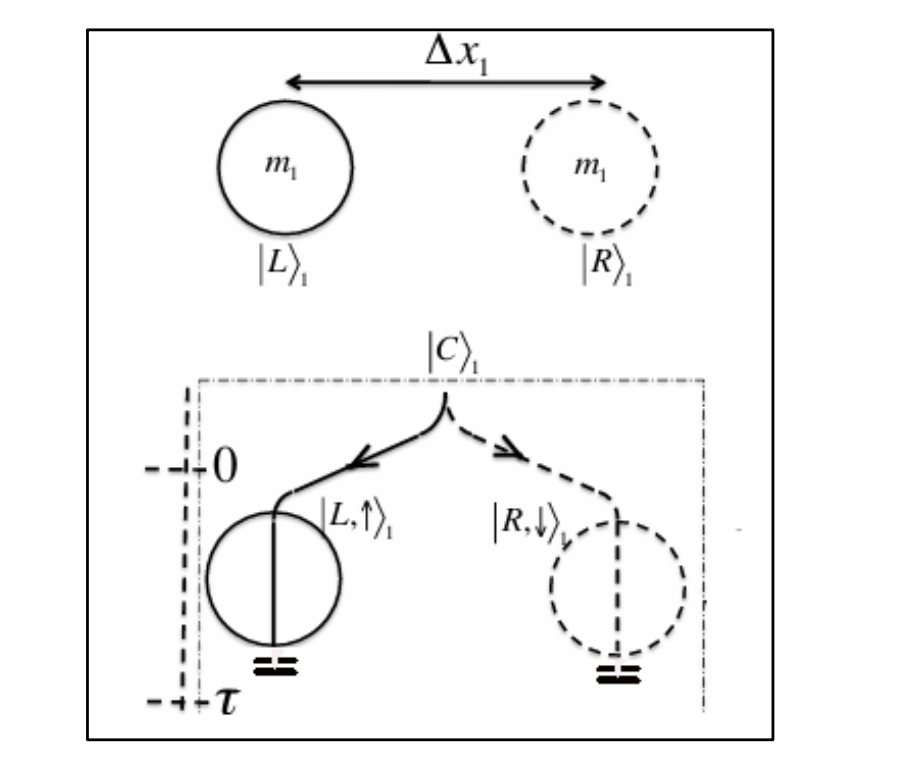
The fundamental nature of quantum measurement remains one of the most debated topics in physics, with competing interpretations struggling to explain how definite outcomes arise from probabilistic quantum states. Xing M. Wang from Einstein’s Electron and Local Branching, alongside colleagues, now proposes a novel experimental program to distinguish between leading interpretations, including the Copenhagen Interpretation and the Many-Worlds Interpretation, by directly probing the dynamics of local branching. Their approach centres on utilising Stern-Gerlach interferometers equipped with a unique dual sensing technique, combining transparent and opaque detectors, to search for subtle anomalies in closed quantum systems. Successfully observing these rare events, without violating established conservation laws, would provide compelling evidence for the Branched Hilbert Subspace Interpretation, suggesting a more nuanced, fuzzy boundary between the quantum and classical worlds and offering a promising avenue for resolving the long-standing debate over the foundations of quantum mechanics.
The second stage involves a full-loop ghost imaging system, incorporating two transparent sensors and one opaque detector, to investigate recoherence phenomena, events that would contradict both established interpretations if observed. The experimental approach involves a modified Stern-Gerlach Interferometer setup with dual sensing, combining a non-destructive transparent sensor with a projective opaque detector to observe nuanced evolution of the quantum state. The proposed experiment is divided into three stages, each designed to test specific aspects of the interpretation.
The first stage focuses on detecting conflicting outcomes between the transparent and opaque sensors, challenging the idea of instantaneous collapse or immediate branching. The second stage aims to demonstrate that a quantum state can be re-established after a local measurement, using a single full-loop system to test for this recoherence. The third stage builds on the second by introducing a second system and a test ion to generate a measurable electromagnetic phase shift. Observing no phase shift suggests the transparent sensor erased the independent evolution of the branches, potentially supporting retrocausality, while observing a phase shift demonstrates local unitary dynamics, falsifying retrocausality. Their approach centers on meticulously examining the dynamics of local branching within a closed quantum system, utilizing advanced Stern-Gerlach interferometers equipped with a unique dual-sensor technique. This technique combines transparent sensors, which non-destructively detect a particle’s presence, with projective opaque detectors that provide standard measurement outcomes. A second full-loop system, introducing an electromagnetic phase shift, then aims to differentiate between retrocausal and unitary mechanisms driving any observed recoherence. The proposed experiments are feasible with current trapped-ion technology, offering a promising path toward resolving the long-standing debate over the fundamental nature of quantum reality. Researchers aim to achieve a time window of approximately 60 nanoseconds for detecting successive sensor clicks, introducing measurement timing uncertainty that blurs the classical-quantum boundary and potentially reveals anomalous results. The core of the approach lies in examining the dynamics of local branching using Stern-Gerlach interferometers equipped with both transparent and opaque detectors. Successfully observing these anomalies, without violating any conservation laws, would offer strong evidence for the local branching framework, suggesting a fuzzy boundary between classical and quantum realms. The proposed experimental designs, building on existing trapped-ion technology and dual-layer detection methods, establish a practical framework for future investigations into the foundations of quantum measurement. While acknowledging the challenges inherent in detecting these rare events, the authors highlight the potential for these experiments to provide empirical insights into longstanding debates surrounding quantum interpretations and concepts like non-retrocausality.
👉 More information🗞Probing Local Branching Dynamics with Stern-Gerlach
🗞 Probing Local Branching Dynamics with Stern-Gerlach Interferometers and Dual Sensing
🧠 ArXiv: https://arxiv.org/abs/2508.16019


