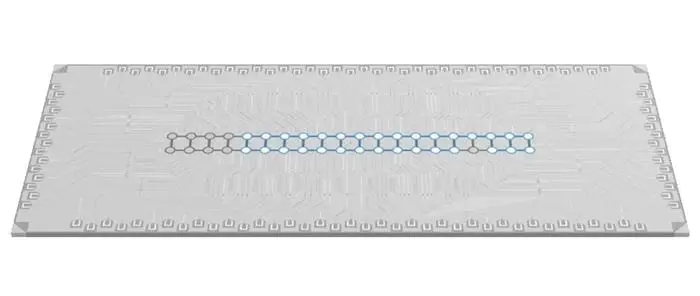
Researchers from Singapore and China have made a breakthrough in understanding quantum transport, a phenomenon that could revolutionize nanoelectronics and thermal management technologies. Using a 31-qubit superconducting quantum processor, they simulated quantum transport with unprecedented detail, allowing them to access information previously inaccessible.
The team, led by Dario Poletti from the Centre for Quantum Technologies and Professor Haohua Wang from Zhejiang University, engineered different types of transport and controlled individual qubits to study how particles flow between two groups of qubits.
Their work, published in Nature Communications, demonstrates a new paradigm for quantum transport experiments, enabling the exploration of richer transport scenarios. The researchers’ findings have significant implications for advancing our understanding of quantum systems and developing innovative technologies.
Simulating Quantum Transport with Superconducting Qubits
Researchers from Singapore and China have successfully used a 31-qubit superconducting quantum processor to study the phenomenon of quantum transport in unprecedented detail. This breakthrough could lead to significant advances in technologies such as nanoelectronics and thermal management.
Quantum transport refers to the flow of particles, magnetization, energy, or information through a quantum channel. To better understand this complex process, researchers from the Centre for Quantum Technologies (CQT) and Zhejiang University (ZJU) collaborated on an experiment that simulated quantum transport using a superconducting qubit bath.
The team’s 31-qubit quantum processor allowed them to engineer different types of transport and control individual qubits with high precision. This level of control enabled the researchers to access information that was previously inaccessible with other implementations of quantum transport.
Theoretical Foundations: Quantum Thermalization
The theoretical models used in this experiment were derived by Dario Poletti, Xiansong Xu, and Chu Guo. These models are based on concepts from quantum thermalization, which describes how systems in contact with each other tend towards equilibrium over time. In the context of quantum transport, the researchers considered two baths as a composite system that would thermalize over time, leading to steady transport.
Xiansong Xu notes that a unified picture of thermalization dynamics and nonequilibrium steady dynamics is still an open question in the field. However, the theoretical derivation and numerical verifications are not straightforward, requiring further research.
Experimental Implementation: Observing Quantum Transport
The experimental group implemented the theoretical proposal by setting up different baths and engineering various types of transport using their 31-qubit quantum processor. This level of control allowed them to study how differences in initial bath states and the number of qubits affected the scale and steadiness of the current.
The researchers prepared 60 randomly chosen distinct initial states for systems of 14, 17, and 31 qubits and measured the current after 200 nanoseconds. The distribution showed that the current converges towards the same value as the system size grows, a phenomenon known as “typicality.”
Additionally, the team evaluated the steadiness of the current by measuring temporal fluctuations, which appeared as spin flow to and fro between the baths. They observed that the fluctuations became significantly smaller compared to the main signal as the system size grew, manifesting the emergence of expected macroscopic physics.
Future Directions: Exploring Richer Transport Scenarios
The researchers hope to build on these results and continue their collaboration to explore richer transport scenarios. This could involve studying more complex systems, such as those with multiple baths or non-trivial geometries. The team’s ability to fine-tune control parameters and precisely measure tiny temporal fluctuations will be crucial in overcoming the challenges that lie ahead.
Ultimately, this research has the potential to significantly advance our understanding of quantum transport and its applications in various fields. As Dario Poletti notes, “This is a very exciting time for quantum science, and we’re just starting to scratch the surface of what’s possible.”
External Link: Click Here For More