

Researchers at the University of Chicago Pritzker School of Molecular Engineering have made a breakthrough in understanding quantum systems, paving the way for ultra-sensitive sensors that could revolutionize navigation and biological sensor technology. Led by Professor David Awschalom, the team has developed a new method to harness the spin of defects in diamonds to measure the behavior of other single electron defects. This innovation will enable the creation of even better quantum sensors with longer coherence times.
The research focuses on nitrogen vacancy (NV) centers in diamonds, which can detect nanoscale magnetic fields. However, scientists have struggled to isolate the spin of these centers from the spins of other defects in the material, which can destroy their quantum state memory. By studying the behavior of single electron defects at the atomic level, the team has gained a deeper understanding of how to engineer quantum systems and think about charge in materials.
Key individuals involved in this work include postdoctoral scholar Jonathan Marcks, graduate student Benjamin S. Soloway, and Professors Aashish Clerk and Giulia Galli. The research was supported by the U.S. Department of Energy, U.S. Department of Defense, National Science Foundation, and Argonne National Laboratory.
Measuring Defects to Better Understand Quantum Systems
Quantum defects have the potential to act as ultra-sensitive sensors that could offer new kinds of navigation or biological sensor technology. One type of these defect systems, nitrogen vacancy (NV) centers in diamonds, can measure nanoscale magnetic fields. However, scientists still do not have a full understanding of how to best isolate the quantum spin of these centers from the spins of other defects in the material, which can destroy its quantum state memory, or coherence.
Researchers at the University of Chicago Pritzker School of Molecular Engineering (PME) have devised a new way to harness the defect spin to measure the behavior of other single electron defects in diamonds. This new understanding will be used to create even better quantum sensors that can maintain long coherence times. The research team, led by postdoctoral researcher Jonathan Marcks, synthesizes these NV centers in facilities at Argonne National Laboratory using chemical vapor deposition.
Understanding Background Noise
The NV centers are highly coherent, but their spin is still sensitive to the behavior of other defect spins in the material. This is because no matter how carefully the diamond is grown, it always ends up with unintended nitrogen defects that have their own spin, causing decoherence in the system and affecting its usefulness as a sensor. The team wanted to better understand how these surrounding defects behave and couple with each other.
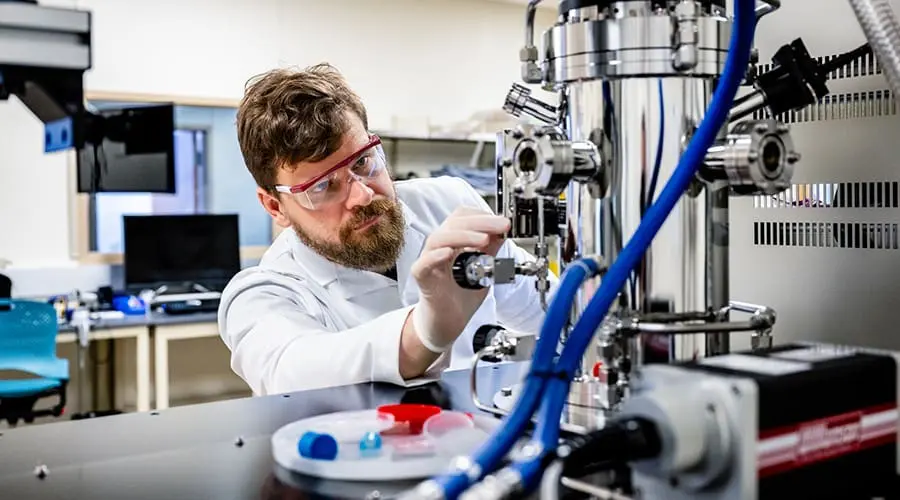
To achieve this, the researchers used a laser and a home-built microscope system to measure the NV center. The number of photons that the NV center emits depends on the NV center’s spin state. Because these centers interact with other spins, the team realized they could use the NV center as a nanoscale sensor of the nearby nitrogen electron charge, which is otherwise invisible.
Measuring Nearby Electron Charge
The process gave them the first-ever observation of coupled spin and charge dynamics within this material — right down to single defects. The researchers found that the nitrogen defects do not always have a single charge state but flip back and forth between different states. This discovery challenges previous assumptions from solid-state physics.
The team collaborated with Prof. Aashish Clerk and Prof. Giulia Galli, whose teams provided the theoretical and computational tools that allowed the researchers to better understand their observations. The combined effort of experiment, theory, and computation has given them ideas on how to create extremely clean materials for emerging quantum technologies and control some of these internal noise sources.
Implications for Quantum Sensors
The new understanding will impact both how scientists engineer quantum systems and how they think about charge in many materials. By harnessing the defect spin to measure the behavior of other single electron defects, researchers can build better quantum sensors that can maintain long coherence times. This breakthrough has significant implications for the development of emerging quantum technologies.
Ultimately, the team’s work will contribute to the creation of highly coherent nitrogen vacancy centers and the development of new quantum sensors with unprecedented sensitivity. The research was supported by the U.S. Department of Energy Office of Science National Quantum Information Science Research Centers as part of the Q-NEXT center, along with funding from the U.S. Department of Defense (AFOSR) and the National Science Foundation.
External Link: Click Here For More


