

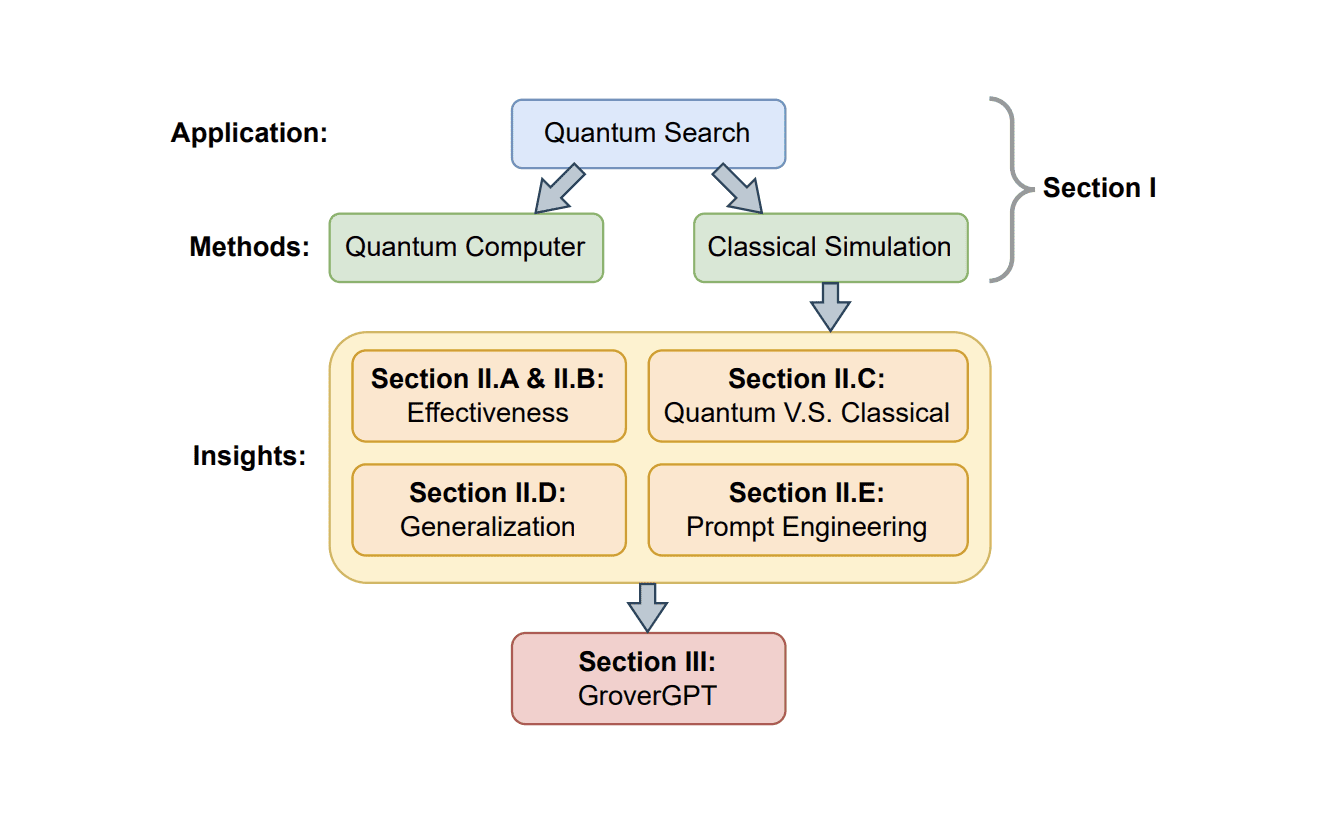
The paper titled “GroverGPT: A Large Language Model with 8 Billion Parameters for Quantum Searching” introduces GroverGPT, a specialized large language model (LLM) designed to simulate the outputs of quantum Turing machines, particularly focusing on Grover’s algorithm. Grover’s algorithm is renowned for providing a quadratic speedup in unstructured search problems compared to classical algorithms.
GroverGPT is built upon the LLaMA architecture and comprises 8 billion parameters. It was trained on a substantial dataset exceeding 15 trillion tokens. Unlike traditional state-vector simulations that require significant computational resources, GroverGPT utilizes pattern recognition techniques to approximate quantum search algorithms without the need for explicit quantum state representations.
The model’s performance was assessed using 97,000 quantum search instances. GroverGPT achieved nearly 100% accuracy on 6- and 10-qubit datasets when trained on 4-qubit or larger datasets. It also demonstrated strong generalization capabilities, attaining over 95% accuracy for systems with more than 20 qubits when trained on 3- to 6-qubit data. In comparison, OpenAI’s GPT-4 achieved 45% accuracy on similar tasks.
The findings suggest that GroverGPT effectively captures the quantum characteristics of Grover’s search algorithm rather than merely identifying classical patterns. This is further supported by the implementation of novel prompting strategies that enhance the model’s performance. Although the model’s accuracy decreases as the system size increases, the research provides valuable insights into the practical limits of classical simulations of quantum algorithms. The study indicates that task-specific LLMs like GroverGPT can outperform general-purpose models in learning quantum algorithms and may serve as powerful tools in advancing quantum research.
GroverGPT represents an advancement in the intersection of quantum computing and machine learning. By leveraging large language models to simulate quantum algorithms, this research opens new avenues for exploring the boundaries of classical simulations of quantum processes and contributes to the development of more efficient computational tools in quantum information science.
Researchers have made a breakthrough in quantum computing by developing a new model called GroverGPT which can simulate Grover’s Algorithm a fundamental quantum search algorithm developed by Lov Grover. This algorithm can search through an unstructured database of items much faster than classical computers.
The team used Qiskit a software development kit for quantum computing developed by IBM to establish ground truth data for training and evaluation. The model was trained on datasets ranging from 3 to 20 qubits and showed impressive performance with the addition of QASM prompts and conversation components. The study suggests that a multi modal approach to quantum algorithm description might be optimal for both performance and accessibility. The work has important implications for the design of future quantum simulation interfaces and educational tools. Companies like IBM are at the forefront of quantum computing research and development.
External Link: Click Here For More


