

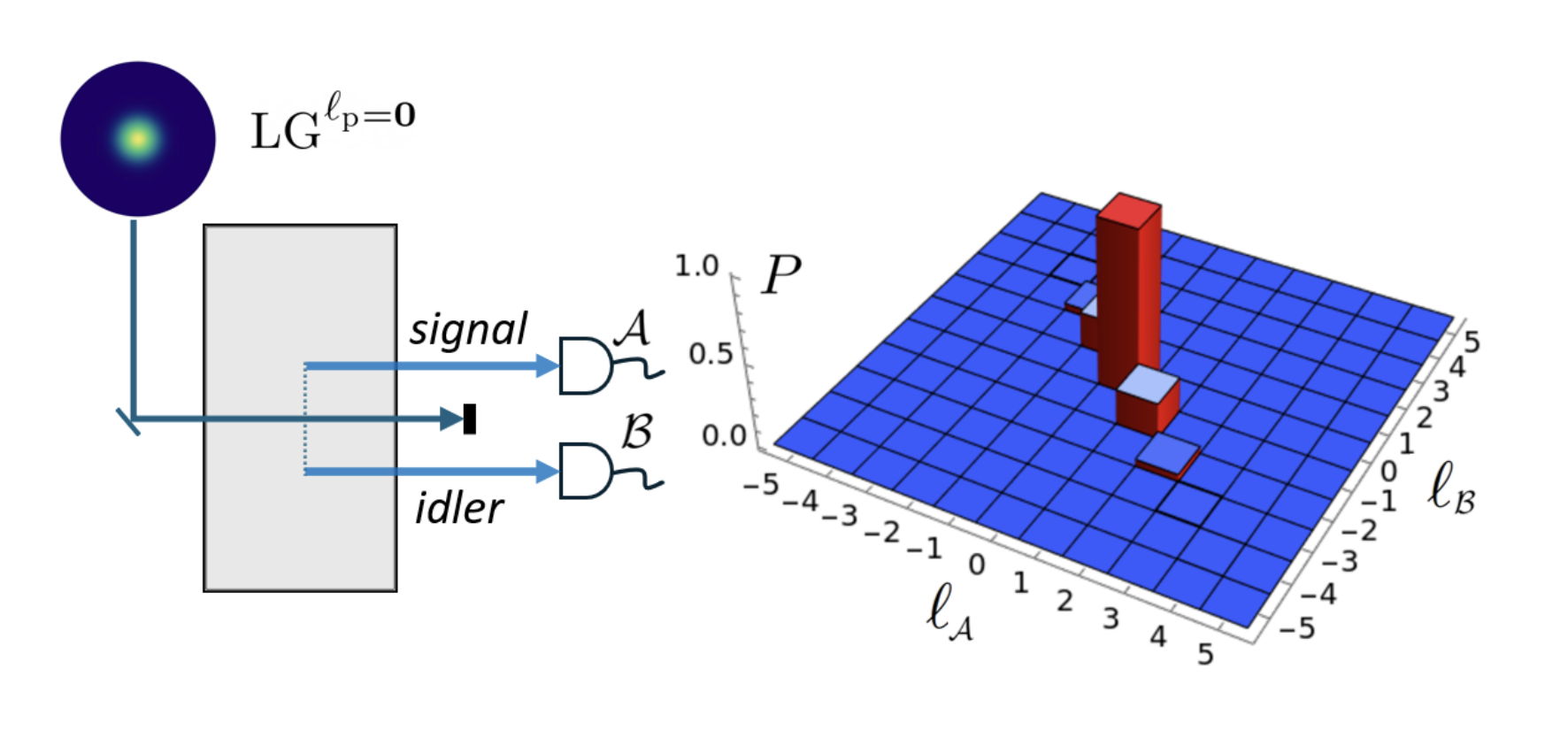
The quest for reliable sources of complex light states drives innovation in quantum technologies, and researchers are increasingly focused on creating high-dimensional entanglement. Richard Bernecker, Baghdasar Baghdasaryan, and colleagues at the Friedrich-Schiller-Universität Jena investigate a promising technique known as ‘path identity’, which combines light from multiple sources to generate these complex states. Their theoretical work explores how to precisely control the properties of these combined light beams, specifically using a property called orbital angular momentum, to create maximally entangled photon pairs with the highest possible fidelity. By identifying an optimal balance between the complexity of the light and the control needed to create it, this research provides a crucial step towards building more powerful and efficient quantum communication and computation systems.
Research focuses on sources of high-dimensional entangled states (HDES) that reliably prepare high-fidelity target states. The concept of overlapping photon paths from distinct, yet indistinguishable, sources recently emerged as a method for creating HDES, a process known as entanglement by path identity. Orbital angular momentum (OAM) modes offer a promising avenue for this approach, as they provide a high-dimensional and discrete space for encoding information. This work addresses a gap in understanding how the OAM distribution of photon pairs can be engineered to maximise entanglement, identifying an optimal dimensionality.
High-Dimensional Entanglement with Spatial Light Modes
A comprehensive body of research explores quantum entanglement, specifically focusing on high-dimensional entanglement using orbital angular momentum (OAM) and other spatial modes of light. This research centres on encoding quantum information in degrees of freedom beyond polarization or time-bin, allowing for higher-dimensional quantum states and increased information capacity. Spontaneous Parametric Down-Conversion (SPDC) is the primary source of these entangled photons. A significant portion of the research deals with optimising SPDC sources for generating high-dimensional entangled states, including careful selection of crystals, precise phase matching, shaping of the pump beam, and designing efficient collection optics.
A major emphasis is placed on maximising the brightness, efficiency, and quality of entangled photon sources through careful control of the SPDC process and the properties of the generated photons. Detecting and characterising high-dimensional entangled states presents a challenge, and research covers techniques for measuring the spatial modes of photons and performing quantum state tomography. Several studies explore the use of high-dimensional entanglement for secure communication protocols like Quantum Key Distribution (QKD). Advanced techniques, such as spectral shaping, custom poling of nonlinear crystals, and the use of spatial light modulators (SLMs) for wavefront control, are also investigated.
The research can be broadly categorised into theoretical foundations, SPDC source development, detection and characterisation, applications, and advanced techniques. Research into SPDC source development focuses on crystal selection and poling, pump beam shaping, collection optics, brightness enhancement, and spectral properties. Studies on detection and characterisation cover spatial mode measurement, quantum state tomography, indistinguishability measurement, single-photon detectors, and interferometry. Applications explored include QKD, quantum imaging, and quantum computing. Advanced techniques investigated include SLMs, q-plates, integrated photonics, and piezoelectric mirror control.
Potential areas of focus include improving brightness and efficiency, enhancing mode purity and control, developing scalable and integrated platforms, and overcoming challenges in long-distance communication. Research also explores high-dimensional QKD, advanced detection schemes, and the exploitation of novel spatial modes. Controlling the correlations between the spectral and spatial degrees of freedom of entangled photons is also a key area of investigation.
Laser Beam Shaping Enhances Photon Entanglement
Researchers are developing innovative techniques to create high-quality entangled photon pairs, essential for emerging quantum technologies. These photons possess a property called orbital angular momentum (OAM), which allows them to carry information in a high-dimensional format, vastly increasing their data-carrying capacity. A key challenge lies in reliably generating photon pairs with precisely controlled OAM states, particularly those exhibiting maximal entanglement. Recent work focuses on engineering the properties of the laser beam used to create these photon pairs. Traditionally, a simple laser beam produces entangled photons with unevenly distributed OAM values, limiting the quality of entanglement.
However, by shaping the laser beam into a superposition of different OAM states, researchers can significantly improve the distribution of OAM in the resulting photon pairs. This involves carefully controlling the contribution of each OAM component in the pump laser, allowing for precise tailoring of the entangled photon’s properties. When a carefully designed pump beam is used, the resulting photon pairs exhibit a more uniform distribution of OAM, bringing them closer to the ideal state of maximal entanglement. The team demonstrated that by carefully adjusting the pump beam’s composition, they could create a state where three specific OAM values, negative one, zero, and positive one, have equal probability.
This targeted approach achieved a subspace fidelity of 0. 876, meaning the generated state closely matches the desired maximally entangled state when considering only these three OAM values. While this represents a substantial improvement, the overall fidelity across all possible OAM values remains lower at 0. 401, indicating that a significant portion of the photon pairs still fall outside the desired entangled state. Furthermore, researchers are exploring methods to directly manipulate the OAM of the generated photons using optical components like spiral phase plates.
These plates twist the wavefront of the photons, effectively adding or subtracting units of OAM. By applying these manipulations to both photons in the entangled pair, researchers can fine-tune their OAM states and further enhance the quality of entanglement. This combination of pump beam engineering and post-generation OAM manipulation offers a powerful pathway towards creating high-fidelity, maximally entangled photon pairs for advanced quantum applications.
Orbital Angular Momentum Limits Entanglement Fidelity
This research investigates the creation of high-dimensional entangled states, crucial for advanced technologies that rely on manipulating numerous quantum properties simultaneously. The team explored a method using the orbital angular momentum of photons, effectively encoding information in the ‘twists’ of light, and combining it with a technique called path identity, where multiple photon paths are combined to create complex states. They demonstrate that carefully engineering the distribution of these ‘twists’ is key to maximizing the quality of the resulting high-dimensional states. The study reveals fundamental limitations to achieving perfect fidelity when using certain photon configurations.
Consequently, the researchers recommend utilizing setups with fewer crystals, each configured to produce high-fidelity building blocks, rather than attempting to create more complex states directly. A particularly effective configuration involves two crystals, generating a four-dimensional entangled state, identified as the optimal dimensionality achievable with this approach. The authors acknowledge inherent fidelity bounds for biphoton states generated with specific pump modes, limitations that cannot be overcome through beam shaping or collection optics. Future work may explore customized phase-matching functions to further refine the amplitude of orbital angular momentum modes, potentially pushing the boundaries of high-dimensional entanglement. This research provides valuable insights into the practical challenges and optimal strategies for creating and manipulating complex quantum states, paving.
🗞 Quantum state engineering of maximally entangled photon pairs by path identity
🧠 ArXiv: https://arxiv.org/abs/2508.13638


