
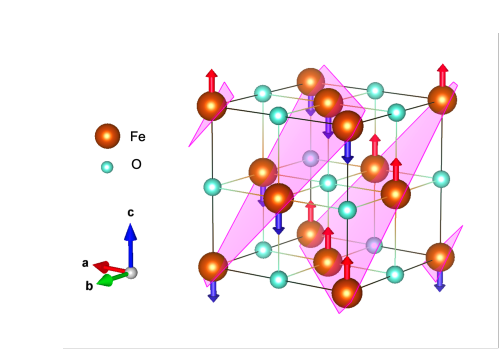
Transition metal oxides present a significant challenge for theoretical physicists seeking to accurately model the behaviour of correlated electrons, a key factor in designing advanced materials. Suvadip Das from Birla Institute of Technology and Science Pilani Hyderabad, and Suvadip Das from George Mason University, alongside their colleagues, address this challenge by systematically comparing several computational methods for understanding these complex materials. Their work focuses on iron monoxide, a prototypical correlated compound, and establishes a robust approach for achieving converged solutions to the quantum many-electron problem. The team demonstrates that a hybrid functional scheme offers the best balance between accuracy and computational efficiency, paving the way for more reliable modelling of oxide interfaces and the development of improved thermoelectric and photovoltaic devices.
Electronic Structure Methods for Transition Metal Oxides
This collection of research explores computational methods for understanding the electronic behaviour of materials, with a strong focus on transition metal oxides. These materials present a significant challenge to traditional modelling techniques due to the complex interactions between their electrons. Researchers investigate methods like density functional theory, alongside more advanced approaches such as GW approximation and the Bethe-Salpeter Equation, to accurately predict material properties and design new technologies. The studies highlight the importance of choosing the right computational tools to overcome the limitations of simpler methods.
Density functional theory forms the foundation for many calculations, but its accuracy is often limited when dealing with strongly correlated electrons. To address this, researchers employ methods like DFT+U, which incorporates additional parameters to account for electron interactions. The GW approximation further refines these calculations by providing a more accurate description of quasiparticle energies, while the Bethe-Salpeter Equation allows for the calculation of optical properties like absorption spectra. The research also focuses on improving the efficiency of these calculations, developing algorithms that can handle complex systems without sacrificing accuracy. A key challenge is balancing computational cost with the need for accurate results, particularly when dealing with strongly correlated systems. This requires careful parameter tuning and the development of robust computational strategies.
Benchmarking Electronic Structure Methods for Iron Monoxide
Researchers undertook a detailed comparison of several computational techniques to accurately model the electronic behaviour of iron monoxide, a representative transition metal oxide. Recognizing the limitations of standard methods, they employed advanced quasiparticle techniques, which account for the complex interactions between electrons. This involved solving intricate equations to determine the energy and behaviour of electrons within the material, aiming to improve the accuracy of predictions for future quantum devices and energy technologies. A key aspect of the study was the careful selection of initial wavefunctions, ensuring they adhered to fundamental principles to achieve reliable and converged solutions.
Researchers systematically tested variations of these methods, including hybrid functionals that combine the strengths of density functional theory with more accurate, but computationally demanding, approaches. The study demonstrates that hybrid functionals offer the optimal balance between computational cost and accuracy for large-scale simulations of correlated electronic systems. By systematically comparing different computational techniques for iron monoxide, researchers gained valuable insights into the strengths and limitations of each approach. This detailed analysis provides a roadmap for future investigations of other transition metal oxides, accelerating the development of new materials and devices with tailored electronic properties.
Iron Monoxide Properties, Accurate Computational Benchmarking
Researchers have conducted a comprehensive study of iron monoxide to identify the most reliable computational methods for predicting its properties. Accurate modelling of these materials is essential for designing improved thermoelectric and photovoltaic devices, but traditional methods often struggle with the complex interactions between electrons. This work benchmarks several advanced computational approaches, including density functional theory, hybrid functionals, and quasiparticle calculations, to determine which best balances accuracy and computational efficiency. The investigation reveals that standard density functional theory often incorrectly predicts iron monoxide to be a metal when it is actually a semiconductor.
This discrepancy arises from the difficulty of accurately describing the behaviour of correlated electrons within the material. To address this, researchers explored density functional theory augmented with Hubbard interactions, a method designed to better account for electron correlation. The most significant gains in accuracy are achieved through the use of hybrid functionals, which incorporate non-local interactions between electrons. These hybrid functionals consistently outperform other methods in predicting the low-energy electronic properties of iron monoxide, offering the best trade-off between accuracy and the computational resources required for large-scale simulations. By establishing a clear hierarchy of computational methods, this research provides a valuable guide for materials scientists seeking to accurately model and ultimately improve the performance of correlated electronic systems like iron monoxide.
Hybrid Functionals Accurately Model Iron Monoxide
This study rigorously benchmarks several first-principles methods to determine the most effective approach for modelling the electronic properties of transition metal oxides, specifically iron monoxide. The research demonstrates that standard density functional theory often inaccurately predicts the metallic nature of these materials due to limitations in treating localized electrons. While methods like DFT augmented with Hubbard U corrections and various hybrid functionals improve upon these predictions, they either rely on empirically determined parameters or exhibit convergence challenges. The findings establish hybrid functionals, particularly HSE03 and HSE06, as the optimal balance between computational efficiency and accuracy for large-scale simulations of correlated electronic systems.
These functionals provide excellent starting wavefunctions for the more advanced quasiparticle self-consistent GW method, yielding accurate band gaps, band edges, and spectral features. A well-chosen starting point is therefore crucial for obtaining reliable results. Future work could focus on refining the convergence criteria for the GW method and exploring the application of these optimised techniques to a wider range of transition metal oxides and complex materials.
👉 More information
🗞 The alloying of first-principles calculations with quasiparticle methodologies for the converged solution of the quantum many-electron states in the correlated compound Iron monoxide
🧠 ArXiv: https://arxiv.org/abs/2508.08941