

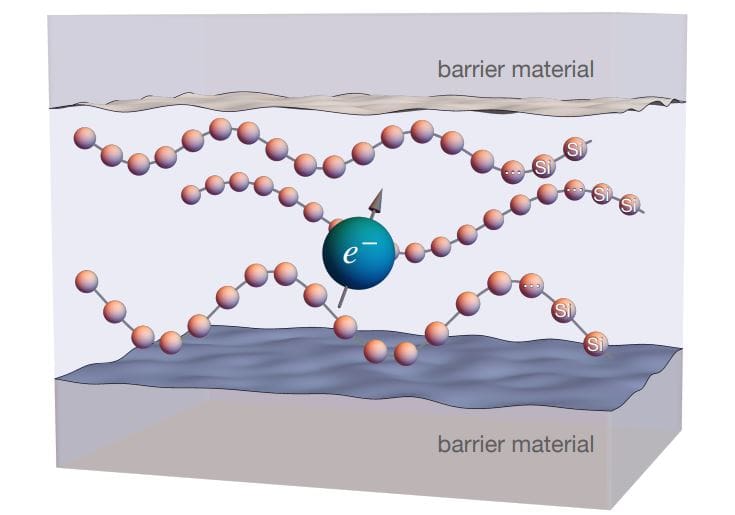
Spin qubits represent a promising avenue for realising practical quantum computers, offering the potential to operate at comparatively warmer temperatures than many other quantum systems. Irina Heinz, from University of Konstanz, Forschungszentrum Jülich, and RWTH Aachen University, alongside Jeroen Danon of the Norwegian University of Science and Technology, and Guido Burkard from University of Konstanz, investigated a puzzling phenomenon affecting these qubits: a temperature-dependent shift in their operating frequency. The team’s work reveals that interactions between spin qubits and vibrations within the semiconductor material, known as phonons, drive this frequency shift, explaining previously observed non-monotonic behaviour. This understanding is crucial because it allows scientists to identify a ‘sweet spot’ temperature where qubits are least sensitive to disruptive fluctuations, paving the way for more stable and reliable quantum computations.
Spin qubits represent a promising candidate for quantum computation, and some realizations already benefit from advanced device manufacturing within the semiconductor industry. Compared to superconducting platforms, spin qubits can operate at higher temperatures, ranging from tens of millikelvin up to a few kelvin. However, recent experiments demonstrate a non-trivial and often non-monotonic dependence of the spin qubit frequency on temperature, featuring a region of decreased sensitivity to temperature fluctuations. Understanding this interaction promises to improve qubit stability and performance in practical quantum computing applications.
Silicon Quantum Dot Decoherence and Noise Sources
Scientists are actively researching silicon-based quantum dots as qubits, aiming to build stable and controllable quantum systems. Silicon offers long spin coherence times and compatibility with existing semiconductor manufacturing techniques, but several challenges remain. Researchers are investigating the factors that limit how long a qubit can maintain its quantum state, a phenomenon known as decoherence. Multiple sources contribute to qubit decoherence, and understanding these is crucial for building practical quantum computers. Key areas of investigation include the vibrations of the silicon lattice, known as phonons, which can disrupt the qubit’s spin.
Different types of phonons are under scrutiny, including those originating from the bulk material, those localized at the interfaces of the quantum dot, and specific modes that strongly interact with electron spin. The quality of the interface between the quantum dot and surrounding materials is particularly important. Other factors under investigation include the interaction of electron spin with the nuclear spins of silicon isotopes, random fluctuations in electric fields, imperfections within the silicon lattice, and coupling between a hole’s valley index and its orbital motion. Scientists are also exploring the effects of electric fields inducing spin flips and random fluctuations from defects possessing two energy levels.
Research focuses on improving interface quality, modifying the phonon spectrum through isotope purification and surface treatment, and optimizing the quantum dot’s shape and size to minimize phonon coupling. Material choice, theoretical modelling, and advanced experimental characterization are also essential components of this research. A growing area of research focuses on using hole spins as qubits, which can offer advantages over electron spin qubits, but are more sensitive to valley-orbit coupling. Scientists are also working to understand and mitigate heating effects within quantum dots, which can lead to decoherence and errors. Recent research highlights the importance of localized phonon modes at interfaces and their contribution to decoherence. The overarching goal is to build qubits robust enough to perform complex quantum computations, and overcoming the challenges of decoherence is a critical step in that direction.
Temperature-Dependent Spin Qubit Frequency Shifts Explained
Scientists have demonstrated a detailed understanding of temperature-dependent frequency shifts in electron spin qubits within silicon quantum dots, achieving insight into the underlying physics governing these shifts at low temperatures. The research focuses on the interaction between the spin qubit and phonon modes within the host material, revealing a connection between thermal activation and qubit frequency shifts. Experiments quantitatively reproduce observed data, demonstrating a megahertz shift attributable to the combined effects of thermal activation and phonon interactions. The team derived an effective low-energy Hamiltonian describing the spin qubit coupled to phonons, considering various energy scales including orbital confinement, valley splitting, Zeeman splitting, and spin-orbit interactions.
This model incorporates the influence of acoustic phonons, approximating a linear dispersion relation for low-energy phonons with a velocity relevant to the temperature regime studied. Calculations show that the frequency shift is influenced by the sound velocity in each phonon branch and the wave vector of the phonons. Furthermore, the study details the impact of imperfections at the silicon heterostructure interface, which induce valley-orbit coupling and a magnetic gradient field employed for electric-dipole spin resonance. The team’s model accounts for these factors, demonstrating how they contribute to the overall frequency shift. The research provides a foundation for optimizing qubit performance by controlling phonon interactions and understanding the role of material properties in determining qubit sensitivity to temperature fluctuations.
Phonon-Induced Qubit Frequency Shifts Explained
Scientists have gained new insight into the behaviour of spin qubits, a promising technology for quantum computing. Their work investigates how temperature affects the precise frequency at which these qubits operate, revealing a complex relationship where frequency can fluctuate with temperature changes. The research focuses on the interaction between the spin of an electron, used to represent quantum information, and the vibrations of the material hosting the qubit, known as phonons. By modelling this interaction, the team demonstrates that phonons can indeed influence qubit frequency, causing it to shift with temperature.
Calculations indicate that the magnitude of this shift depends on the energy levels within the material and the strength of the coupling between the electron spin and the phonons. While the predicted shifts are currently smaller than those observed in some experiments, the findings establish a clear physical mechanism for temperature-dependent frequency fluctuations. This understanding is crucial for developing more stable and reliable quantum computers based on spin qubits. The authors acknowledge that other factors, such as electric dipoles arising from imperfections at material interfaces, could also contribute to these frequency shifts.
Future research should focus on measuring frequency fluctuations at different magnetic fields and in qubits of varying sizes to further validate the model. Additionally, exploring the role of electric dipoles and their interaction with the qubit could provide a more complete picture of this complex phenomenon. The team hopes these findings will guide the development of strategies to mitigate temperature-induced errors and improve the performance of spin-based quantum computers.
👉 More information
🗞 Phonon-induced frequency shift in semiconductor spin qubits
🧠 ArXiv: https://arxiv.org/abs/2511.23077


