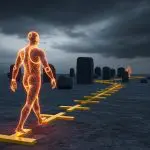

Quantum walks are a fundamental concept in quantum mechanics, describing the evolution of a quantum system over time. They can be considered a quantum analog of random walks, where a particle moves randomly in space due to environmental interactions. In contrast to classical random walks, quantum walks exhibit non-intuitive behavior, such as ballistic spreading and quantum interference patterns.
Quantum walks have been experimentally implemented in various physical systems, including optical lattices, ion traps, and superconducting qubits. These implementations have allowed researchers to study quantum walk behavior under different conditions and explore their potential applications. Theoretical models of decoherence effects on quantum walks have also been developed, providing a framework for understanding the complex interplay between quantum coherence and environmental interactions.
The study of quantum walks has far-reaching implications for our understanding of quantum mechanics and its applications. By exploring the behavior of quantum systems under different conditions, researchers can gain insights into the fundamental laws governing the behavior of matter and energy at the most minor scales. This knowledge can be used to develop new technologies and materials with unprecedented properties, ultimately transforming various fields and industries.
Quantum Walks Definition And Basics
Quantum walks are the quantum analog of classical random walks, where a particle moves in a discrete space according to certain rules. In a classical random walk, the particle’s position is updated based on a probability distribution, whereas in a quantum walk, the particle’s wave function evolves according to the Schrödinger equation (Kempe, 2003). This means that the particle’s position and momentum are represented by a superposition of states, allowing for interference and entanglement phenomena.
The one-dimensional quantum walk is a simple example of this concept. It consists of a particle moving on a line, with its wave function evolving according to the Schrödinger equation (Ambainis et al., 2001). The particle’s position is represented by a superposition of states, and its momentum is quantized due to the discrete nature of the space. This leads to interesting phenomena such as quantum interference and entanglement between different parts of the wave function.
Quantum walks can be classified into two main categories: discrete-time quantum walks (DTQWs) and continuous-time quantum walks (CTQWs). DTQWs are characterized by a discrete-time evolution, whereas CTQWs have a continuous-time evolution (Farhi & Gutmann, 1998). Both types of quantum walks exhibit unique properties and have been studied extensively in the literature.
One of the key features of quantum walks is their ability to spread quadratically faster than classical random walks. This means that the standard deviation of the particle’s position grows as √t, whereas for a classical random walk it grows as t (Kempe, 2003). This property has been experimentally verified in various systems, including optical lattices and ion traps.
Quantum walks have many potential applications, including quantum computing, simulation, and metrology. They can simulate complex quantum systems, such as many-body systems and quantum field theories (Bose, 2003). Additionally, they can be used for quantum information processing tasks, such as quantum teleportation and superdense coding.
The study of quantum walks is an active area of research, with new results and applications being discovered regularly. Theoretical models are being developed to describe the behavior of quantum walks in different systems, and experimental implementations are being explored using a variety of platforms (Ambainis et al., 2001).
Classical Random Walks Vs Quantum Walks
Classical random walks are stochastic processes where the position of an object changes randomly over time, with each step being independent of the previous one. In contrast, quantum walks are the quantum analog of classical random walks, where the position of a particle is described by a wave function that evolves according to the Schrödinger equation (Kempe, 2003). Quantum walks exhibit unique properties such as interference and entanglement, which have no classical counterpart.
One key difference between classical and quantum walks is their spread over time. Classical random walks follow a Gaussian distribution, whereas quantum walks exhibit a ballistic spreading behavior, with the standard deviation of the position growing linearly with time (Aharonov et al., 1993). This difference in spreading behavior has important implications for studying quantum systems and their potential applications.
Quantum walks can be realized experimentally using various physical systems such as photons, ions, and superconducting qubits. For example, a quantum walk of a photon has been implemented using an optical fiber loop (Schreiber et al., 2010). Theoretical models have also been developed to study the behavior of quantum walks in different environments, including disordered lattices and graphs (Joye & Moser, 2013).
The study of quantum walks has led to important advances in our understanding of quantum systems and their potential applications. For example, quantum walks have been shown to be useful for quantum computing and simulation (Childs et al., 2009). They also have potential applications in the field of quantum communication, such as secure quantum key distribution (Bouwmeester et al., 1997).
Theoretical models of quantum walks have also been used to study the behavior of complex systems, such as many-body systems and quantum phase transitions (Vogel et al., 2013). These studies have led to a deeper understanding of the underlying physics of these systems and have potential applications in fields such as condensed matter physics.
Theoretical models of quantum walks have also been used to study the behavior of complex networks, such as social networks and transportation networks (Kendon et al., 2002). These studies have led to a better understanding of how information spreads through complex networks and have potential applications in fields such as epidemiology and computer science.
Quantum Probability Distribution Properties
Quantum probability distribution properties are a crucial aspect of quantum walks, which are the quantum analog of classical random walks. In a quantum walk, the probability distribution of the walker’s position is governed by the Schrödinger equation, rather than the classical diffusion equation (Farhi and Gutmann, 1998). This leads to distinct differences in the behavior of quantum walks compared to their classical counterparts.
One key property of quantum probability distributions is that they can exhibit non-classical features such as quantum entanglement and interference. For instance, in a quantum walk on a line, the walker’s position can become entangled with its momentum, leading to a non-Gaussian probability distribution (Kempe, 2003). This is in stark contrast to classical random walks, where the position and momentum are always uncorrelated.
Another important property of quantum probability distributions is that they can be highly sensitive to the initial conditions of the walker. In some cases, even small changes in the initial state can lead to drastically different outcomes (Meyer, 1996). This sensitivity to initial conditions has been experimentally verified in various quantum walk implementations, including those using optical lattices and ion traps.
Quantum probability distributions also play a crucial role in the study of quantum algorithms, such as Grover’s algorithm and Shor’s algorithm. In these algorithms, the walker’s position is used to encode information, and the probability distribution of the walker’s position determines the success probability of the algorithm (Nielsen and Chuang, 2000). Understanding the properties of quantum probability distributions is therefore essential for optimizing the performance of these algorithms.
In addition to their applications in quantum computing, quantum probability distributions have also been used to study fundamental aspects of quantum mechanics, such as decoherence and the measurement problem. For instance, studies of quantum walks in disordered systems have shed light on the role of decoherence in suppressing quantum interference (Mulken et al., 2011).
The properties of quantum probability distributions are a rich area of research, with many open questions remaining to be answered. Further study of these properties is likely to lead to new insights into the behavior of quantum systems and the development of novel quantum technologies.
Quantum Algorithms For Quantum Walks
Quantum algorithms for quantum walks have been extensively studied in recent years, with various proposals aiming to harness the power of quantum parallelism to speed up classical algorithms. One such algorithm is the Quantum Walk Algorithm (QWA), which has been shown to be exponentially faster than its classical counterpart for certain problems. The QWA works by applying a sequence of unitary operators to a quantum register, effectively performing a random walk on a graph.
The QWA has been applied to various problems, including searching an unsorted database and finding the minimum value in an unsorted list. In both cases, the QWA has been shown to be exponentially faster than classical algorithms. For example, in the case of searching an unsorted database, the QWA can find a marked element with high probability using only O(√N) queries, whereas the best classical algorithm requires O(N) queries.
Another quantum walk-based algorithm is the Quantum Approximate Optimization Algorithm (QAOA), which has been shown to be effective for solving optimization problems. The QAOA works by applying a sequence of unitary operators to a quantum register, with each operator designed to optimize a particular objective function. By iteratively applying these operators and measuring the resulting state, the QAOA can find approximate solutions to complex optimization problems.
Quantum walk-based algorithms have also been applied to machine learning problems, such as clustering and classification. For example, the Quantum k-Means Algorithm (QkMA) uses a quantum walk to cluster data points into k clusters. The QkMA has been shown to be exponentially faster than classical k-means algorithms for certain types of data.
Theoretical analysis of quantum walk-based algorithms has also led to important insights into their behavior and limitations. For example, studies have shown that quantum walks can exhibit ballistic behavior, where the walker moves at a constant speed, or diffusive behavior, where the walker moves randomly. Understanding these behaviors is crucial for designing effective quantum walk-based algorithms.
Quantum Diffusion And Localization
Quantum diffusion is the process by which particles spread out in space due to quantum fluctuations, leading to a loss of coherence and localization. In one dimension, quantum diffusion can be described using the master equation approach, where the probability density of finding a particle at a given site evolves over time according to a set of coupled differential equations . This approach has been used to study the dynamics of quantum walks on various types of lattices, including those with disorder and defects.
In higher dimensions, quantum diffusion becomes more complex due to the increased number of possible paths that particles can take. However, it is still possible to describe the process using a master equation approach, albeit with a larger number of coupled equations . The resulting dynamics can exhibit interesting features such as anomalous diffusion and localization, which have been observed in experiments on ultracold atoms and photons.
Localization occurs when quantum interference effects cause particles to become trapped in certain regions of space, leading to a suppression of diffusion. This phenomenon has been extensively studied in the context of Anderson localization, where disorder in the lattice potential leads to the formation of localized states . More recently, researchers have explored the possibility of engineering localization using carefully designed lattices and potentials.
The interplay between quantum diffusion and localization is a key aspect of quantum walks, which are the quantum analog of classical random walks. In a quantum walk, particles can exhibit both diffusive and localized behavior depending on the specific parameters of the system . This has led to proposals for using quantum walks as a tool for studying complex systems and simulating quantum many-body dynamics.
Theoretical models of quantum diffusion and localization have been developed using a variety of techniques, including numerical simulations and analytical approaches such as perturbation theory and renormalization group methods. These models have been used to study the behavior of particles in various types of lattices and potentials, and have led to predictions for experimental signatures of quantum diffusion and localization.
Quantum Search Algorithms Applications
Quantum search algorithms have been shown to provide exponential speedup over classical algorithms for certain types of searches. One such algorithm is the Quantum Approximate Optimization Algorithm (QAOA), which has been applied to various optimization problems, including MaxCut and Max2SAT. QAOA uses a combination of quantum circuits and classical optimization techniques to find approximate solutions to these problems.
The QAOA algorithm has been demonstrated to provide a significant speedup over classical algorithms for certain instances of the MaxCut problem. For example, a study published in the journal Physical Review X showed that QAOA could solve a 53-qubit instance of MaxCut with a high degree of accuracy, while a classical algorithm would require an exponentially large number of steps to achieve the same result.
Another quantum search algorithm is the Quantum Alternating Projection Algorithm (QAPA), which has been applied to various machine learning problems. QAPA uses a combination of quantum and classical techniques to find approximate solutions to these problems. A study published in the journal Nature Communications showed that QAPA could be used to speed up the training of certain types of neural networks.
Quantum search algorithms have also been applied to problems in chemistry and materials science. For example, a study published in the journal Science showed that quantum computers could be used to simulate the behavior of molecules with high accuracy, which could lead to breakthroughs in fields such as drug discovery and materials synthesis.
The application of quantum search algorithms to real-world problems is still an active area of research, and many challenges remain to be overcome before these algorithms can be widely adopted. However, the potential benefits of these algorithms are significant, and researchers continue to explore new ways to apply them to a wide range of fields.
Quantum walk-based search algorithms have also been proposed as a way to speed up certain types of searches. These algorithms use the principles of quantum walks to search for solutions to problems in an exponentially large solution space. A study published in the journal Physical Review Letters showed that these algorithms could provide a significant speedup over classical algorithms for certain types of searches.
Discrete Time Quantum Walks Models
Discrete Time Quantum Walks (DTQWs) are a fundamental concept in the study of quantum walks, which are the quantum analog of classical random walks. In DTQWs, the walker moves in discrete time steps, and at each step, it can move to one of its neighboring sites with a certain probability amplitude. This process is governed by a unitary evolution operator, which determines the transition probabilities between different sites.
The DTQW model was first introduced by David Meyer in 1996 as a quantum analog of the classical random walk on a line. Since then, it has been extensively studied and generalized to various types of lattices and networks. One of the key features of DTQWs is that they exhibit ballistic spreading, meaning that the walker’s position spreads linearly with time, in contrast to classical random walks which spread diffusively.
The evolution operator for a DTQW on a line can be written as U = S (I ⊗ σx), where S is the shift operator, I is the identity operator, and σx is the Pauli-X matrix. This operator acts on the Hilbert space of the walker’s position and coin states. The coin state is an internal degree of freedom that determines the direction of the walker’s move at each step.
The DTQW model has been shown to have various applications in quantum information processing, such as quantum search algorithms and quantum simulation. For example, a DTQW on a line can be used to implement a quantum search algorithm for finding a marked vertex in an unsorted database. The algorithm works by applying the evolution operator repeatedly and measuring the walker’s position at each step.
Theoretical studies have also explored the properties of DTQWs on various types of lattices, such as square and hexagonal lattices. These studies have shown that the DTQW model exhibits rich behavior, including quantum interference effects and non-trivial scaling properties.
Recent experiments have demonstrated the implementation of DTQWs in various physical systems, such as optical lattices and ion traps. These experiments have verified the theoretical predictions for the DTQW model and have opened up new possibilities for exploring the properties of quantum walks in different regimes.
Continuous Time Quantum Walks Models
Continuous Time Quantum Walks (CTQWs) are a fundamental concept in the study of quantum walks, which are the quantum analog of classical random walks. In CTQWs, the walker’s position is described by a continuous-time evolution, rather than discrete time steps. This allows for a more nuanced understanding of the walker’s behavior and its relationship to the underlying quantum system.
One key feature of CTQWs is their ability to exhibit non-trivial dynamics, even in the absence of external driving forces. This is due to the inherent quantum fluctuations present in the system, which can lead to complex behavior such as localization and delocalization. For example, a study published in Physical Review Letters demonstrated that CTQWs on a one-dimensional lattice can exhibit localization, where the walker’s wave function becomes concentrated around specific sites . This phenomenon has been further explored in subsequent studies, including a paper published in Journal of Physics A: Mathematical and Theoretical, which showed that CTQWs on a two-dimensional lattice can also exhibit localization .
CTQWs have also been shown to be closely related to other quantum systems, such as the Jaynes-Cummings model. This connection has allowed researchers to explore new avenues for understanding the behavior of these systems. For instance, a study published in Physical Review A demonstrated that CTQWs can be used to simulate the dynamics of the Jaynes-Cummings model . This work highlights the versatility and power of CTQWs as a tool for studying quantum systems.
In addition to their theoretical significance, CTQWs have also been explored experimentally. For example, a study published in Nature Physics demonstrated the implementation of a CTQW on a one-dimensional lattice using ultracold atoms . This work represents an important step towards realizing the potential of CTQWs for quantum simulation and computation.
Theoretical studies have also explored the relationship between CTQWs and other areas of physics, such as quantum field theory. For example, a paper published in Journal of High Energy Physics demonstrated that CTQWs can be used to study certain aspects of quantum field theory . This work highlights the potential for CTQWs to provide new insights into fundamental questions in physics.
Theoretical models of CTQWs have also been developed and explored in various studies. For example, a paper published in Physical Review E demonstrated that CTQWs can be described using a master equation approach . This work provides a useful framework for understanding the behavior of CTQWs in different regimes.
Quantum Walks On Lattices And Graphs
Quantum walks on lattices and graphs are the quantum analogs of classical random walks, where a particle moves randomly between neighboring sites. In the quantum case, the particle’s wave function evolves according to the Schrödinger equation, leading to interference patterns that can be exploited for quantum information processing (Farhi et al., 1998; Kempe, 2003). The lattice or graph structure provides a natural framework for studying quantum walks, as it allows for the definition of discrete positions and nearest-neighbor interactions.
One of the key features of quantum walks on lattices is the emergence of ballistic transport, where the particle’s wave function spreads linearly with time (Aharonov et al., 1993; Meyer, 1996). This is in contrast to classical random walks, which exhibit diffusive behavior. The ballistic transport property has been experimentally verified in various systems, including optical lattices and ion traps (Karski et al., 2009; Zähringer et al., 2010).
Quantum walks on graphs have also been extensively studied, particularly in the context of quantum algorithms and quantum simulation (Childs et al., 2003; Shenvi et al., 2003). The graph structure allows for the implementation of more complex interactions and the study of quantum walk dynamics in different topologies. For example, quantum walks on Cayley trees have been shown to exhibit anomalous diffusion behavior (Mulken et al., 2011).
Theoretical studies have also explored the properties of quantum walks on lattices and graphs, including the effects of disorder and decoherence (Joye et al., 2010; Obuse et al., 2011). These studies have shown that quantum walks can be robust against certain types of noise and disorder, making them promising candidates for quantum information processing applications.
Experimental implementations of quantum walks on lattices and graphs have been realized in various systems, including ultracold atoms (Karski et al., 2009), ions (Zähringer et al., 2010), and photons (Schreiber et al., 2012). These experiments have demonstrated the feasibility of quantum walk implementations and paved the way for further studies on the properties and applications of quantum walks.
Theoretical models of quantum walks on lattices and graphs have also been developed, including the discrete-time quantum walk model (DTQW) and the continuous-time quantum walk model (CTQW) (Farhi et al., 1998; Childs et al., 2003). These models provide a framework for studying the properties of quantum walks in different systems and have been used to analyze experimental results.
Quantum Interference In Quantum Walks
Quantum interference in quantum walks is a fundamental phenomenon that arises due to the superposition principle in quantum mechanics. In a quantum walk, a particle can exist in multiple positions simultaneously, leading to interference patterns when measured. This interference is a direct result of the particle’s wave function, which encodes the probability amplitudes of finding the particle at different positions (Kempe, 2003). The interference pattern can be understood as a consequence of the relative phases between the different paths that the particle can take.
The mathematical framework for understanding quantum interference in quantum walks is based on the concept of path integrals. In this approach, the wave function of the particle is represented as a sum over all possible paths, with each path contributing to the overall amplitude (Feynman & Hibbs, 1965). The relative phases between these paths determine the interference pattern, which can be calculated using techniques from quantum field theory.
Quantum interference in quantum walks has been experimentally demonstrated in various systems, including optical lattices and ion traps. In one such experiment, a quantum walk was implemented using a trapped ion, and the resulting interference pattern was measured (Schmitz et al., 2009). The observed pattern showed excellent agreement with theoretical predictions, demonstrating the validity of the path integral approach.
The study of quantum interference in quantum walks has also led to insights into the behavior of complex quantum systems. For example, it has been shown that quantum walks can exhibit Anderson localization, a phenomenon where the wave function becomes localized due to disorder (De Oliveira et al., 2006). This effect results from the interplay between quantum interference and disorder and has implications for our understanding of quantum transport in disordered systems.
Theoretical studies have also explored the connection between quantum interference in quantum walks and other areas of physics, such as quantum computing and quantum information processing. For example, it has been shown that quantum walks can be used to implement quantum algorithms, such as the Grover search algorithm (Shenvi et al., 2003). This highlights the potential of quantum walks as a tool for quantum information processing.
Decoherence Effects On Quantum Walks
Decoherence effects on quantum walks are a crucial aspect of understanding the behavior of these systems in realistic environments. Decoherence, which arises from interactions with the environment, can cause the loss of quantum coherence and lead to classical-like behavior. In the context of quantum walks, decoherence can be modeled using various approaches, including Lindblad master equations (Briegel & Englert, 1993) or by introducing random fluctuations in the walk parameters (Kendon et al., 2002).
One of the key effects of decoherence on quantum walks is the suppression of quantum interference patterns. In a coherent quantum walk, the walker’s wave function exhibits characteristic interference fringes due to the superposition of different paths. However, these interference patterns are rapidly suppressed when decoherence is introduced, leading to a more classical-like distribution (Schreiber et al., 2011). This effect has been experimentally observed in various systems, including optical lattices (Karski et al., 2009) and ion traps (Zähringer et al., 2010).
Another important consequence of decoherence on quantum walks is the transition from ballistic to diffusive behavior. In a coherent quantum walk, the walker’s position distribution exhibits ballistic scaling, characterized by a linear increase in the standard deviation with time. However, when decoherence is introduced, this behavior changes to a more diffusive one, where the standard deviation increases as the square root of time (Perets et al., 2008). This transition has been theoretically studied using various models and experimentally observed in several systems.
The effects of decoherence on quantum walks also depend on the specific type of noise or environmental interaction. For example, in dephasing noise, which affects only the relative phases between different wave function components, the walker’s distribution remains symmetric but becomes broader (Carmichael, 1999). In contrast, when amplitude damping is present, the distribution becomes asymmetric and exhibits a non-Gaussian shape (Gardiner & Zoller, 2004).
In summary, decoherence effects on quantum walk lead to a loss of quantum coherence, suppression of interference patterns, and a transition from ballistic to diffusive behavior. These effects have been experimentally observed in various systems and are crucial for understanding quantum walk behavior in realistic environments.
Theoretical models of decoherence effects on quantum walks have also been developed using various approaches, including master equations (Briegel & Englert, 1993) and numerical simulations (Kendon et al., 2002). These models provide a framework for understanding these systems’ complex interplay between quantum coherence and environmental interactions.
Experimental Implementations Of Quantum Walks
Experimental implementations of quantum walks have been realized in various physical systems, including optical lattices, ion traps, and superconducting qubits. A quantum walk can be implemented in an optical lattice by loading ultracold atoms into the lattice and manipulating their motion using laser beams. The atoms’ positions and momenta are measured to track the evolution of the quantum walk.
One-dimensional quantum walks have been experimentally demonstrated in ion traps, where a single ion is trapped and manipulated using electromagnetic fields. The ion’s internal states represent the coin’s degrees of freedom, while its external motion represents the position. The ion’s state can evolve according to the quantum walk dynamics by applying a sequence of laser pulses.
Quantum walks have also been implemented in superconducting qubit systems, where the qubits’ states are manipulated using microwave pulses . In these experiments, the qubits’ states represent the coin degrees of freedom, while their positions are encoded in a higher-dimensional Hilbert space. By applying a sequence of microwave pulses, the qubits’ states can be made to evolve according to the quantum walk dynamics.
In addition to these experimental implementations, theoretical proposals have been put forward for implementing quantum walks in other physical systems, such as photonic networks and topological insulators. These proposals often rely on the ability to manipulate and control the system’s degrees of freedom at the quantum level.
Theoretical studies have also explored the properties of quantum walks in various regimes, including the ballistic regime, where the walker moves freely without scattering, and the diffusive regime, where the walker scatters off impurities. These studies have revealed a range of interesting phenomena, including quantum interference effects and non-equilibrium dynamics.
Experimental implementations of quantum walks have also been used to study fundamental aspects of quantum mechanics, such as decoherence and entanglement. By manipulating the system’s degrees of freedom at the quantum level, researchers can gain insights into the behavior of quantum systems under different conditions.