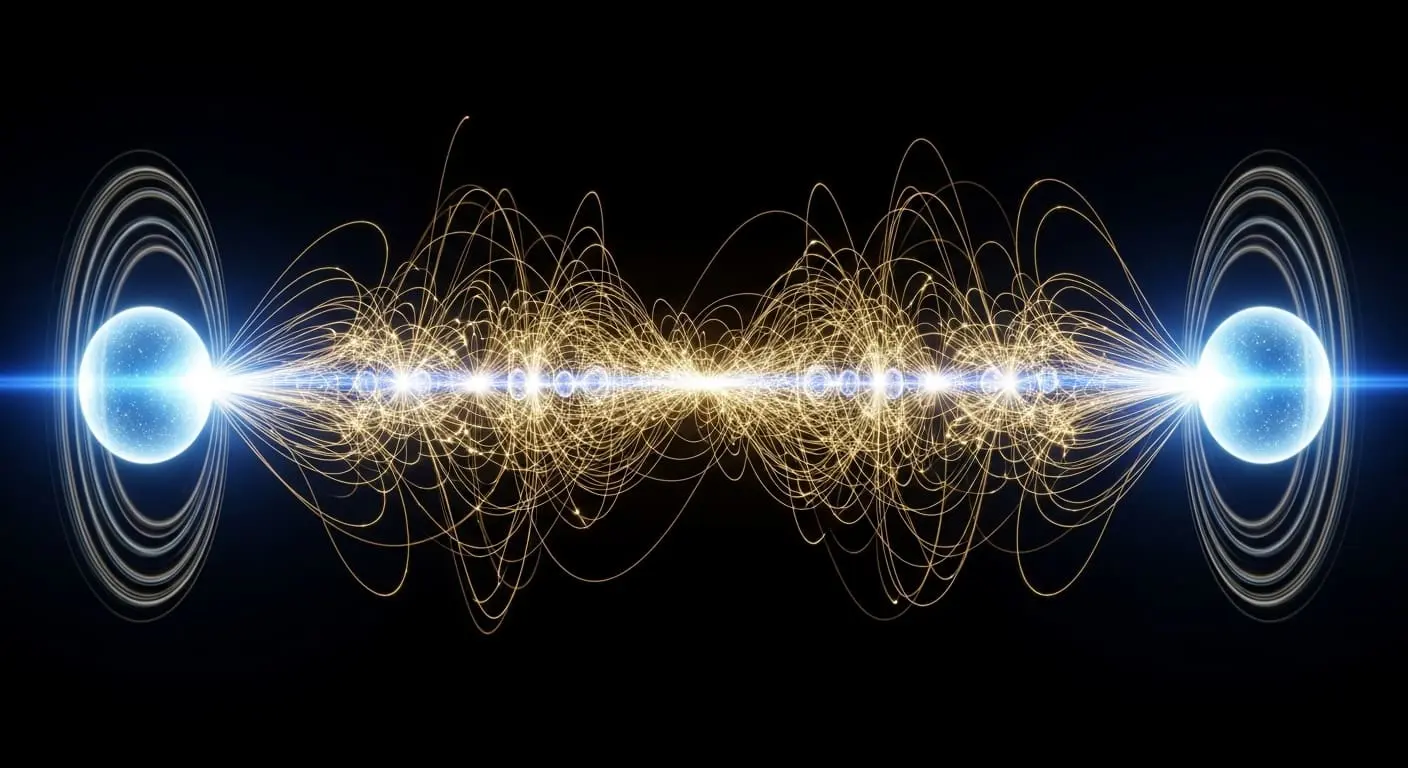
Researchers at the Indian Institute of Technology Guwahati, led by Anupam Ghosh, have developed a theoretical framework for calculating the interaction energy and resultant force between two closely spaced metal plates, modelling the quantum vacuum not simply as empty space, but as a dynamic medium comprised of meson fields. This investigation delves into the subtle attractive force originating from the quantum vacuum, a force that plays a crucial role in attracting nucleons, protons and neutrons, the fundamental building blocks of atomic nuclei. The work offers novel insight into the genesis of the nuclear force, potentially refining our comprehension of the mechanisms governing the cohesion of matter at its most fundamental level.
Relativistic pion fields amplify Casimir force at sub-femtometre separations
Calculations of energy and force reveal a previously unquantified effect: at separations smaller than 1.46 femtometres, the interaction energy and the force between the plates are amplified by a factor of 21 when compared to predictions derived from standard Casimir force models. This amplification stems from the inclusion of the relativistic pion field within the framework describing the quantum vacuum, a significant departure from traditional models which primarily focus on electromagnetic interactions. Both the interaction energy and the force per unit area exhibit a rapid increase as the distance between the plates diminishes, a behaviour explicitly demonstrated by the derived mathematical expressions. The significance of this finding lies in its potential to bridge the gap between quantum field theory and the strong nuclear force, offering a new perspective on short-range interactions.
The calculations are fundamentally dependent on several key physical constants and variables. These include the pion’s Compton wavelength, approximately 1.46 femtometres, which dictates the characteristic scale of the interaction, Planck’s constant (ħ), the speed of light (c), and crucially, the separation distance between the plates. The relativistic pion field, a component of the nuclear force responsible for mediating interactions between nucleons, was explicitly factored into the description of the quantum vacuum. When the plates are brought to separations less than 1.46 femtometres, the interaction energy and the resulting force are amplified by a factor of 21 relative to predictions based solely on electromagnetic interactions, as described by the conventional Casimir effect. This amplification is not merely a quantitative adjustment; it suggests a fundamentally different physical mechanism at play at these tiny scales.
The observed amplification is explained by considering the discrete energy levels available to pions confined between the parallel plates. Unlike standard Casimir calculations, which assume a continuous spectrum of electromagnetic modes, the lowest energy states for the confined pions are unavailable due to the boundary conditions imposed by the plates. This alteration of the vacuum energy density is the root cause of the amplified interaction. At larger separations, the interaction energy saturates, reaching a value of −ħc/24πλ3c, where λ represents the separation distance. Concurrently, the force between the plates diminishes towards zero as the separation increases. It is important to note that these calculations currently rely on highly idealised conditions, neglecting the complex material properties of the plates and any potential surface effects. Addressing these limitations represents a key hurdle before practical applications can be seriously considered. Further research is needed to incorporate realistic material parameters and surface roughness into the model.
Meson fields amplify quantum vacuum force at nanoscale separations
The well-established Casimir effect describes the attractive force between uncharged conducting objects, arising from fluctuations in the electromagnetic field of the quantum vacuum, and is a cornerstone of modern physics and nanotechnology. This current work deliberately moves beyond purely electromagnetic interactions, adopting a more comprehensive approach by modelling the quantum vacuum as also being permeated by meson fields, the particles responsible for the strong nuclear force that binds atomic nuclei. Mesons, unlike photons, possess mass and therefore exhibit relativistic behaviour, influencing the nature of the vacuum fluctuations. While the calculations reveal a substantial amplification of this force at tiny separations, detailing the feasibility of observing this effect experimentally remains a crucial area for future investigation. The challenge lies in creating and maintaining the necessary conditions, specifically, extremely smooth surfaces and precise control over the separation distance at the sub-femtometre scale.
This theoretical work significantly expands our understanding of the quantum vacuum, rigorously deriving the interaction energy and force between two parallel metal plates when they are brought into extremely close proximity. Within the framework of Quantum Hadrodynamics, mesons are not merely carriers of the nuclear force but are also considered to be fundamental constituents of the vacuum itself. The calculations reveal a consistent attractive force between the plates, originating from the quantum vacuum fluctuations, and demonstrate that the magnitude of this force increases rapidly as the distance between the plates decreases. Unlike the electromagnetic Casimir effect, which involves massless photons, this interaction explicitly considers scalar pion fields, resulting in an energy and force that are directly dependent on the pion’s Compton wavelength, Planck constant, and the speed of light. The interaction energy is negative, indicating a binding energy, and the resulting force between the plates is demonstrably attractive. This negative energy suggests the potential for utilising this force to stabilise nanoscale structures or even explore novel energy storage mechanisms, although significant technological hurdles remain.
The research successfully calculated the interaction energy and force between two closely spaced metal plates, originating from fluctuations within the quantum vacuum. This demonstrates that the vacuum is not truly empty but contains energy arising from meson fields, as described by Quantum Hadrodynamics. The resulting attractive force between the plates increases rapidly with decreasing distance and differs from the well-known Casimir effect due to the inclusion of scalar pion fields. The authors highlight the need for future work focused on experimentally verifying this force at the femtometre scale, requiring extremely precise control and smooth surfaces.
👉 More information
🗞 The force of attraction between nucleons due to vacuum fluctuation
🧠 ArXiv: https://arxiv.org/abs/2603.28379