

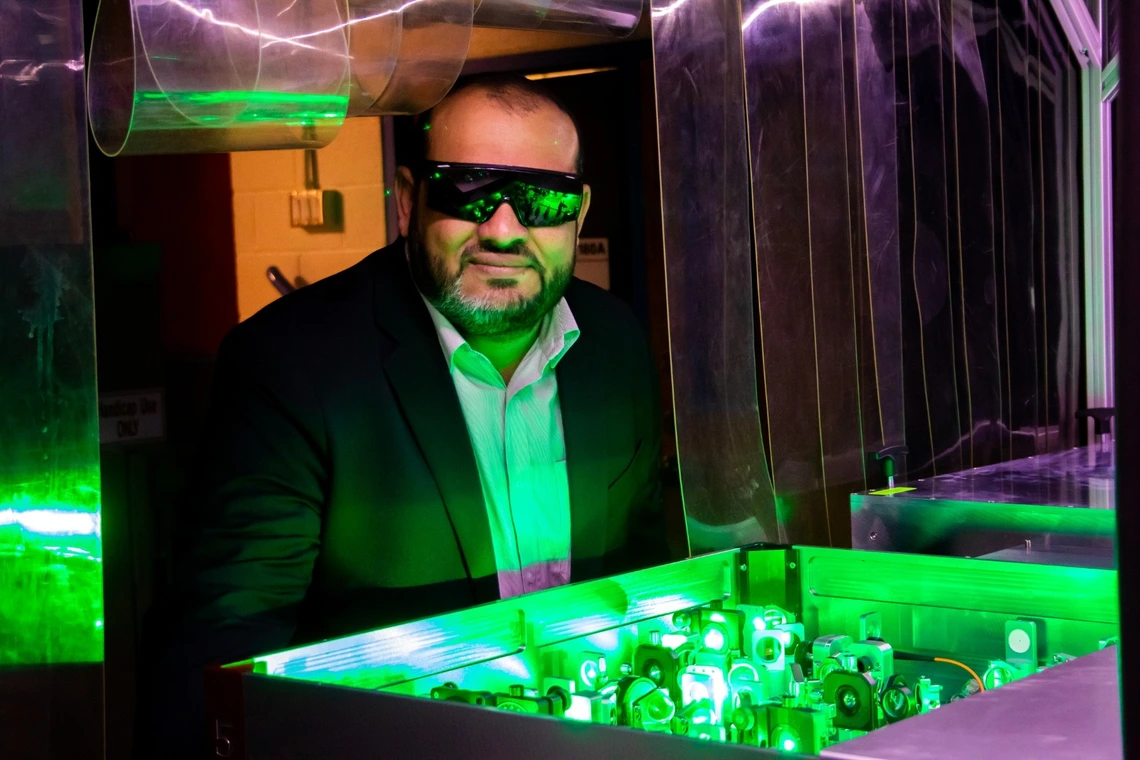
Quantum light that moves at the speed of light’s fastest pulses has been captured and steered in real time by a team at the University of Arizona, a feat that could reshape secure communications and open new pathways for ultrafast quantum sensing. In a paper published this week in Light: Science & Applications, the researchers demonstrate the first generation of squeezed light using femtosecond pulses, one quadrillionth of a second, by harnessing a process called four‑wave mixing in fused silica. The breakthrough offers a new toolbox for manipulating quantum uncertainty with unprecedented speed and precision.
From Milliseconds to Femtoseconds: The Speed Leap
Squeezed light, a form of quantum light where one property of a photon, such as its phase or intensity, is measured with reduced uncertainty at the expense of the other, has long been a staple in precision experiments. Gravitational‑wave observatories like LIGO already employ squeezed states to suppress background noise and enhance the detection of spacetime ripples. However, until now the generation of such light relied on laser pulses lasting milliseconds, orders of magnitude slower than the ultrafast regimes explored in modern photonics.
The Arizona team, led by associate professor Mohammed Hassan, turned to four‑wave mixing, a nonlinear optical interaction where three input photons combine to produce a fourth photon with new properties. By splitting a single laser beam into three identical copies and directing them through a block of fused silica, the researchers created the conditions for efficient four‑wave mixing. Crucially, they introduced a small angular offset between the beams, a tweak that controls the temporal overlap of the photons as they traverse the silica. When the beams are perfectly aligned, the photons arrive together; a slight misalignment delays one photon relative to the others, enabling the team to toggle between intensity‑squeezed and phase‑squeezed states on the fly.
This method eliminates the need for complex phase‑matching setups that traditionally limited ultrafast squeezed‑light experiments. Hassan remarked,
“The main technical challenge was phase‑matching between lasers of different colors, which usually requires complex setups. I realized our technology could overcome this problem.”
The result is a compact, scalable platform that produces squeezed light on femtosecond timescales, paving the way for ultrafast quantum optics, a field that had previously been confined to either slow squeezed‑light generation or fast, but unquantum, light pulses.
Stretching the Quantum Balloon: Intensity vs. Phase Squeezing
In quantum physics, light is described by two linked properties, analogous to a particle’s position and momentum, that cannot both be measured with perfect precision. The product of their uncertainties is bounded by a fundamental limit, much like a balloon’s volume cannot be compressed beyond a certain point. Ordinary light behaves like a round balloon, with uncertainty evenly spread between its two properties. Squeezed light, by contrast, stretches the balloon into an oval: one axis becomes quieter and more precise, while the other swells with noise.
Hassan explained the significance of being able to switch between these axes:
“If you squeeze a photon’s intensity, you can later switch to squeezing its phase by adjusting the position of the silica relative to the split beam. This is the first-ever demonstration of ultrafast squeezed light, and the first real‑time measurement and control of quantum uncertainty.”
The ability to toggle between intensity and phase squeezing on femtosecond timescales means that quantum information can be encoded, transmitted, and processed with a flexibility that was previously unattainable. In practical terms, the team can now tailor the quantum state to the needs of a particular application, whether that requires minimal phase noise for interferometry or minimal intensity noise for secure communication.
Guarding the Quantum Wire: Secure Communications
One of the most immediate applications of ultrafast squeezed light lies in quantum‑secure communication. Traditional optical networks transmit binary data using classical light pulses, but quantum light adds an extra layer of security: any attempt to intercept the signal inevitably disturbs its quantum state, alerting the sender and receiver to the intrusion.
The Arizona researchers have taken this principle a step further. By combining ultrafast pulses with intensity squeezing, they create a scenario where an eavesdropper must know not only the cryptographic key but also the exact amplitude of each pulse to reconstruct the data accurately. Any interference alters the squeezing, corrupting the measurement and rendering the intercepted information unusable.
Hassan elaborated on the security implications:
“Using our method, an eavesdropper not only disturbs the quantum state but also must know both the key and the exact pulse amplitude. Their interference affects the amplitude squeezing, meaning they cannot determine the correct uncertainty, and any decoded data is inaccurate.”
This dual requirement dramatically raises the bar for potential attackers, making the technology attractive for high‑value communications such as government, finance, and critical infrastructure.
Beyond the Horizon: New Frontiers in Sensing and Biology
While secure communication is a compelling use case, the broader impact of ultrafast squeezed light extends into quantum sensing, chemistry, and biology. The team’s technique could enable more precise measurements of molecular vibrations, leading to better drug‑discovery protocols. In environmental monitoring, the heightened sensitivity afforded by squeezed states could detect trace gases or pollutants at concentrations previously unreachable.
Moreover, the ultrafast nature of the pulses opens possibilities for time‑resolved studies of chemical reactions and biological processes. By capturing fleeting intermediate states with both high temporal resolution and reduced quantum noise, scientists could observe dynamics that were formerly hidden by measurement limitations.
The research was a collaborative effort that spanned continents. Alongside Hassan, graduate student Mohamed Sennary, who penned the paper’s first author line, worked closely with assistant professor Mohammed ElKabbash and partners from the Barcelona Institute of Science and Technology, Ludwig Maximilian University of Munich, and the Catalan Institution for Research and Advanced Studies. This international consortium underscores the global appetite for pushing quantum technologies beyond current boundaries.
Looking Ahead
The University of Arizona’s achievement marks a pivotal step in the maturation of quantum optics. By marrying ultrafast laser science with quantum state engineering, the researchers have unlocked a new regime where quantum uncertainty can be measured and controlled in real time on femtosecond scales. This capability promises to accelerate developments in secure communications, precision sensing, and fundamental physics alike.
As the field moves forward, the next challenges will involve scaling the technology for practical deployment, integrating it with existing photonic platforms, and exploring its limits in complex, noisy environments. If the promise of ultrafast squeezed light can be realized in commercial systems, it may well become a cornerstone of the quantum infrastructure that underpins tomorrow’s secure, high‑speed information networks and advanced scientific instrumentation.


