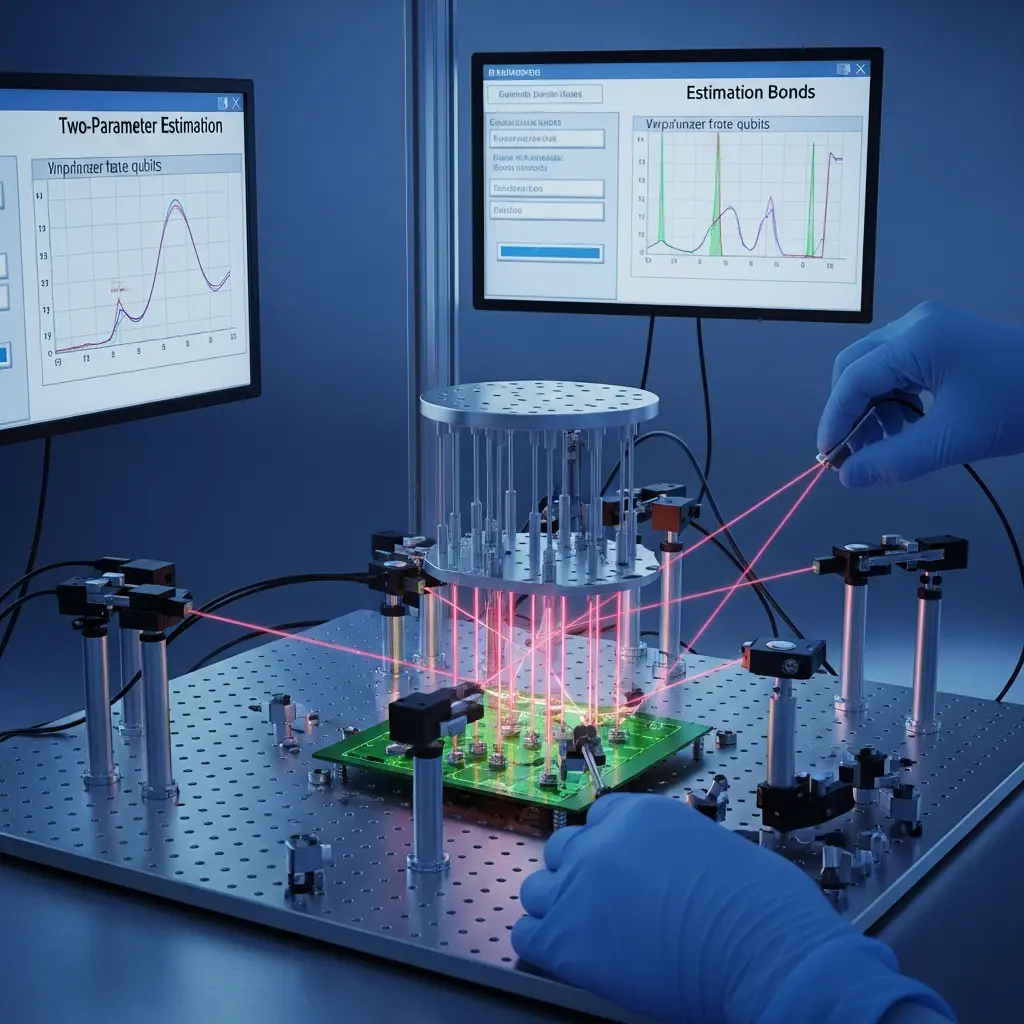
Determining the ultimate limits of precision in parameter estimation represents a fundamental challenge in quantum physics, often complicated by inherent uncertainties in measurement. Simon K. Yung, C. M. Yung, and Lorcán O. Conlon, alongside Syed M. Assad, have now achieved a significant breakthrough in this field, developing a considerably simplified expression for the Cramér-Rao bound, a key measure of estimation accuracy. Their work establishes a new, more accessible method for calculating the ultimate limits of precision when estimating two parameters using pure quantum states, and crucially, identifies the optimal measurements needed to reach those limits. This advancement resolves a long-standing problem in quantum metrology and provides a powerful tool for designing more precise quantum sensors, demonstrated through their analysis of displacement estimation using grid states.
They derive a new Cramér, Rao bound, representing the most informative limit achievable for this task and exceeding previously known boundaries. This bound incorporates a geometric measure, the Bures length, to quantify how distinguishable quantum states are and its impact on estimation precision. The findings have significant implications for quantum metrology, enabling the development of more sensitive sensors and improved parameter estimation techniques in applications such as gravitational wave detection and biological imaging.
The team demonstrates that the Bures length provides a tighter bound than traditional measures like the trace distance, particularly when the parameters are well separated. They also establish a connection between the Cramér, Rao bound and the quantum Fisher information, revealing how optimal probe states can be designed to maximise estimation precision. This provides a deeper understanding of the interplay between quantum information, geometry, and the limits of measurement precision.
Optimal Precision Limits for Dual Parameter Estimation
Scientists developed a new mathematical expression to determine the ultimate precision limits for estimating two parameters simultaneously using pure quantum states. This work addresses a fundamental challenge in multiparameter estimation, overcoming complexities associated with the uncertainty principle and the trade-offs between parameter precision. The team’s approach delivers a considerably simpler formula than existing methods, while fully determining the optimal measurements required to achieve these limits. Experiments employed grid states, superpositions of displaced squeezed states, to encode displacements in phase space.
The study revealed that the quantum Cramér-Rao bound is attainable as the mean photon number of the grid state approaches infinity, corresponding to infinite squeezing. For lower squeezing levels, a small gap exists between the Cramér-Rao bound and the ultimate attainable bound, but the team’s method allows for accurate assessment of this difference. The core of this achievement lies in a novel minimisation procedure that determines both the attainable precision and the optimal measurement strategy.
Researchers at the Joint Quantum Institute and A*STAR Quantum Innovation Centre are advancing the field of quantum metrology. Determining the minimum achievable estimation error is a central task of multiparameter quantum metrology. For estimating parameters encoded in pure quantum states, the ultimate limit is known, but previously required solving a non-trivial minimisation problem.
Simplified Quantum Precision Limit for Parameters
This work presents a significant advance in the theory of quantum parameter estimation, delivering a simplified expression for the ultimate precision limit when estimating two parameters using pure quantum states. Researchers successfully determined both the achievable bound and the optimal measurements required to reach this limit, completing the solution to this longstanding problem. The resulting formula is considerably simpler than previously known alternatives, offering a practical advantage for researchers seeking to understand and optimise sensing protocols. This enables detailed investigations into fundamental precision limits in applications such as sensing with non-Gaussian states, as demonstrated through the analysis of displacement estimation using grid states.
Furthermore, the research reveals a direct link between the optimisation required to calculate precision and the determination of the optimal measurement itself, simplifying the process of identifying the best measurement strategy. While the current results apply specifically to pure states, the researchers acknowledge that their expression provides a lower bound for mixed states. This new understanding offers valuable insights into the fundamental limits of quantum estimation.
🗞 The Most Informative Cramér–Rao Bound for Quantum Two-Parameter Estimation with Pure State Probes
🧠 ArXiv: https://arxiv.org/abs/2511.14950