The search for novel superconducting materials drives innovation in physics and materials science, and recent discoveries involving graphene-based superconductors present exciting new avenues for exploration. Nemin Wei from Yale University, Felix von Oppen from Freie Universität Berlin, and Leonid I. Glazman from Yale University, along with their colleagues, have developed a technique to investigate these materials with unprecedented precision. Their work focuses on a method called tunneling spectroscopy, applied using a specially designed instrument called the quantum twisting microscope, which allows researchers to map the energy and momentum of electrons within a superconductor. The team demonstrates that this approach reveals crucial details about the superconducting state, including the size of the energy gap where superconductivity emerges, and offers a powerful new way to understand the behaviour of two-dimensional materials like twisted bilayer graphene, potentially accelerating the development of future superconducting technologies.
Twisted Graphene’s Local Density of States Resolved
Researchers are advancing our understanding of graphene-based superconductors and the mechanisms driving their unique properties. This work presents a theoretical investigation of tunneling spectroscopy performed on twisted bilayer graphene, employing a novel technique called the quantum twisting microscope. This method spatially resolves the local density of states using a scanning tunneling microscope while simultaneously controlling the relative twist angle between the graphene layers, allowing for precise mapping of the superconducting gap and identification of spatially varying order parameters, revealing how topological defects and disorder influence superconductivity. The research demonstrates that the quantum twisting microscope is a powerful tool for characterizing two-dimensional superconductors and exploring the interplay between twist angle, disorder, and superconducting properties.
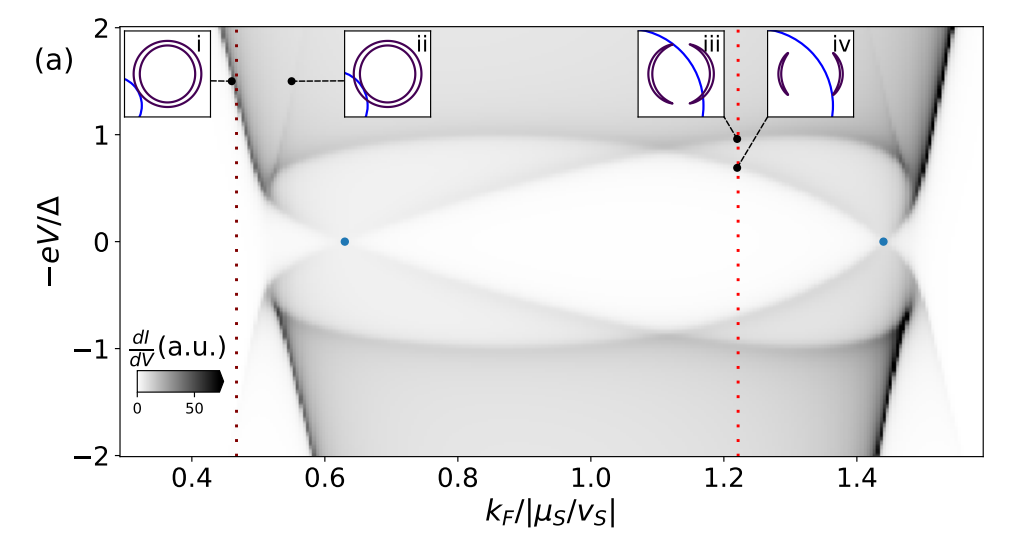
The team investigated superconducting orders using a theoretical framework designed for the quantum twisting microscope, examining tunneling across a planar junction formed by a normal monolayer graphene tip and a superconducting graphene sample. The research demonstrates that the bias dependence of the tunneling conductance exhibits singularities, providing momentum-resolved information about the Bogoliubov quasiparticle spectra, including the superconducting gap. By modeling superconducting twisted bilayer graphene, the team illustrates that simultaneously tuning the tip doping level and the tip-sample twist angle allows for detailed investigation of the system.
Twisted Bilayer Graphene Superconductivity Research Overview
Research into twisted bilayer graphene and related two-dimensional materials has rapidly expanded our knowledge of superconductivity, focusing on understanding the mechanisms, properties, and tunability of superconductivity in these materials. Several proposed mechanisms are under investigation, including traditional phonon-mediated superconductivity enhanced by flat bands, the role of Van Hove singularities in enhancing pairing, and more exotic mechanisms like band-off-diagonal pairing, nematicity, isospin order, and chiral superconductivity.
A key aspect of this research is the unique electronic structure created by twisting the graphene layers and the resulting Moiré pattern, which enhances correlations and facilitates superconductivity. Researchers are exploring ways to tune the superconducting properties of these materials through pressure, electric fields, precise control of the twist angle, and proximity effects with other materials. This research extends beyond graphene to other twisted bilayer systems, including twisted bilayer WSe2 and MoTe2, and investigates unusual superconducting states such as finite-momentum superconductivity, chiral superconductivity, nodal superconductivity, and the Fulde-Ferrell-Larkin-Ovchinnikov state.
A significant portion of the research involves theoretical calculations and simulations to understand experimental observations and predict new phenomena. Emerging trends include a growing emphasis on understanding the strong-coupling nature of superconductivity using techniques like Eliashberg theory, the importance of electron-electron interactions and correlations, and connections to other quantum phenomena like nematicity and charge density waves. There is also interest in exploring the possibility of topological superconductivity and the emergence of Majorana fermions, as well as using heterostructures and proximity effects to engineer new superconducting states and functionalities.
This research field is rapidly evolving, with new papers appearing constantly and our understanding of the underlying mechanisms still incomplete. It is a highly interdisciplinary field, bringing together condensed matter physics, materials science, and theoretical chemistry, with strong synergy between experimental and theoretical work. While twisted bilayer graphene remains a central focus, research is expanding to explore other twisted bilayer systems and to understand the general principles governing superconductivity in these materials. The discovery of superconductivity in 2D materials opens up the possibility of new technological applications, such as high-performance electronics, quantum computing, and energy-efficient devices.
Mapping Superconducting Gaps with Quantum Twisting
Researchers have developed a new method for investigating superconductivity in two-dimensional materials using a quantum twisting microscope. They successfully demonstrated momentum-conserving tunneling between a normal graphene tip and a superconducting graphene sample, revealing information about the superconducting quasiparticle spectra and the superconducting gap. By carefully tuning both the tip’s doping level and the angle between the tip and sample, the team showed it is possible to map the momentum-resolved superconducting gap in twisted bilayer graphene.
The study introduces a “triangulation” method for locating nodes within the Brillouin zone of a superconductor, offering a way to understand the electronic structure of these materials over a wider area than previously possible. This technique allows for probing the superconducting gap along the entire Fermi line of the sample, providing a more complete picture of the material’s properties. The authors acknowledge limitations related to electrostatic constraints when tuning the tip’s doping level and the potential for more complex pairing mechanisms in certain materials, suggesting future work may require device modifications to independently control doping and displacement fields. Despite these challenges, this research establishes the quantum twisting microscope as a promising tool for exploring superconductivity in van der Waals materials and understanding their complex electronic structures.
🗞 Tunneling spectroscopy of two-dimensional superconductors with the quantum twisting microscope
🧠 ArXiv: https://arxiv.org/abs/2509.22902