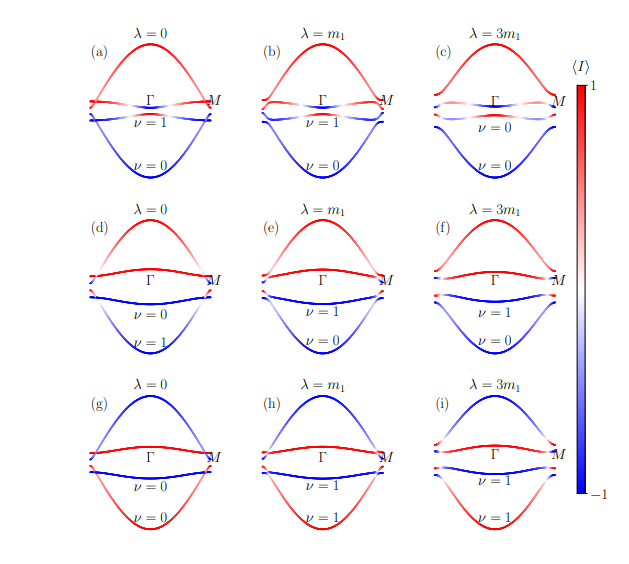
The interplay between a material’s geometric properties and its electronic behaviour is a growing area of interest in modern physics, with implications for future technologies. Xun-Jiang Luo from Hong Kong University of Science and Technology, alongside Xing-Lei Ma and K. T. Law, now demonstrate a new way to precisely control both the quantum metric and band topology within a specifically designed material system. The team achieves this control using a bilayer Dirac model, effectively combining two distinct electronic structures and tuning their interaction, and importantly, they show that this allows flexible manipulation of electronic properties across a wide range of material symmetries. This breakthrough establishes a new platform for exploring the fundamental connection between a material’s geometry and its electronic characteristics, potentially paving the way for novel device designs and a deeper understanding of quantum materials.
Topological Materials, Chern Insulators and Edge States
A comprehensive body of research details significant advances in topological materials, establishing the foundations of topological insulators and superconductors, and exploring symmetry and the prediction of edge and surface states. Studies also investigate Chern insulators and the quantum Hall effect, highlighting the importance of Berry curvature and topological invariants, and extend to topological Kondo insulators, examining the interplay between strong correlations and topology. A major theme throughout this work is quantum geometry, particularly the quantum metric, which describes the geometry induced by the wavefunction. This property is increasingly recognized as crucial for influencing transport, localization, and other material characteristics.
Investigations into quantum weight and flat bands enhance quantum geometric effects and can lead to novel topological phases, demonstrating how quantum geometry affects localization and transport properties, such as resistivity and coherence length. Research extends beyond condensed matter physics, demonstrating the application of topological concepts to acoustic and photonic materials, allowing for the creation of topological devices and exploration of fundamental physics in new contexts. Classical circuits are also explored as a means to simulate topological phenomena and potentially create quantum-inspired information processing devices. Theoretical developments include the use of symmetric Wannier states for characterizing topological bands and the exploration of boundary topological insulators and superconductors. The field is becoming increasingly interdisciplinary, with connections to condensed matter physics, materials science, acoustics, photonics, and classical circuit design. The exploration of topological phenomena in different physical systems provides new insights and opportunities for technological applications.
Tunable Topology and Metric in Dirac Bilayers
Scientists have developed a novel bilayer Dirac model that allows precise control over both band topology and quantum metric properties. This model combines two Dirac Hamiltonians, one producing dispersive bands and the other yielding flatter bands, and weakly couples them through hybridization. By inducing a band inversion, researchers achieve flexible control over band topology and metric scaling near the band inversion point, realizing topological flat bands through three distinct mechanisms. The team demonstrates that the resulting flat bands are topologically nontrivial, and that the quantum metric can be significantly enhanced and tuned within this model. Researchers established a direct link between band inversion and the ability to manipulate the quantum metric, demonstrating that this process is essential for achieving substantial metric values. This breakthrough delivers a platform for exploring the interplay between band topology and quantum metric, potentially leading to new materials with tailored electronic properties.
Tunable Quantum Metrics Control Boundary State Localization
This work introduces a new approach to engineering topological bands with a tunable quantum metric, achieved through coupled bilayer Dirac models. By combining Dirac Hamiltonians with differing energy scales and inducing band inversion, researchers demonstrate flexible control over both band topology and metric scaling. The team investigated the localization properties of gapless boundary states, revealing how the quantum metric influences these states. Results show that manipulating parameters within the model directly affects the quantum weight and decay length of the boundary states, with increasing certain parameters leading to a measurable decrease in quantum weight. Researchers suggest that materials like heterobilayers and SmB6 offer promising platforms for realizing and investigating these enhanced quantum metric effects, and that metamaterials can simulate these theoretical models. The authors acknowledge that the presented model and results serve as a foundation for future research.
🗞 Tunable quantum metric and band topology in bilayer Dirac model
🧠 ArXiv: https://arxiv.org/abs/2509.23622