

Clock synchronization forms the bedrock of secure communication and critical infrastructure, but its reliance on predictable communication channels creates a weakness to asymmetric delay attacks. Hui Han, Haotian Teng, and Hailong Xu, along with colleagues, demonstrate this vulnerability by introducing a novel, tunable attack that dynamically adjusts delays to manipulate synchronization accuracy. This research moves beyond static attack methods, revealing how precisely tailored delays can selectively compromise system stability in diverse scenarios, and highlights the need for robust clock synchronization systems capable of resisting customizable attacks. The team’s work uncovers fundamental weaknesses in current protocols, paving the way for the development of more secure and resilient communication networks.
Asymmetric Delay Attacks on Quantum Clock Synchronization
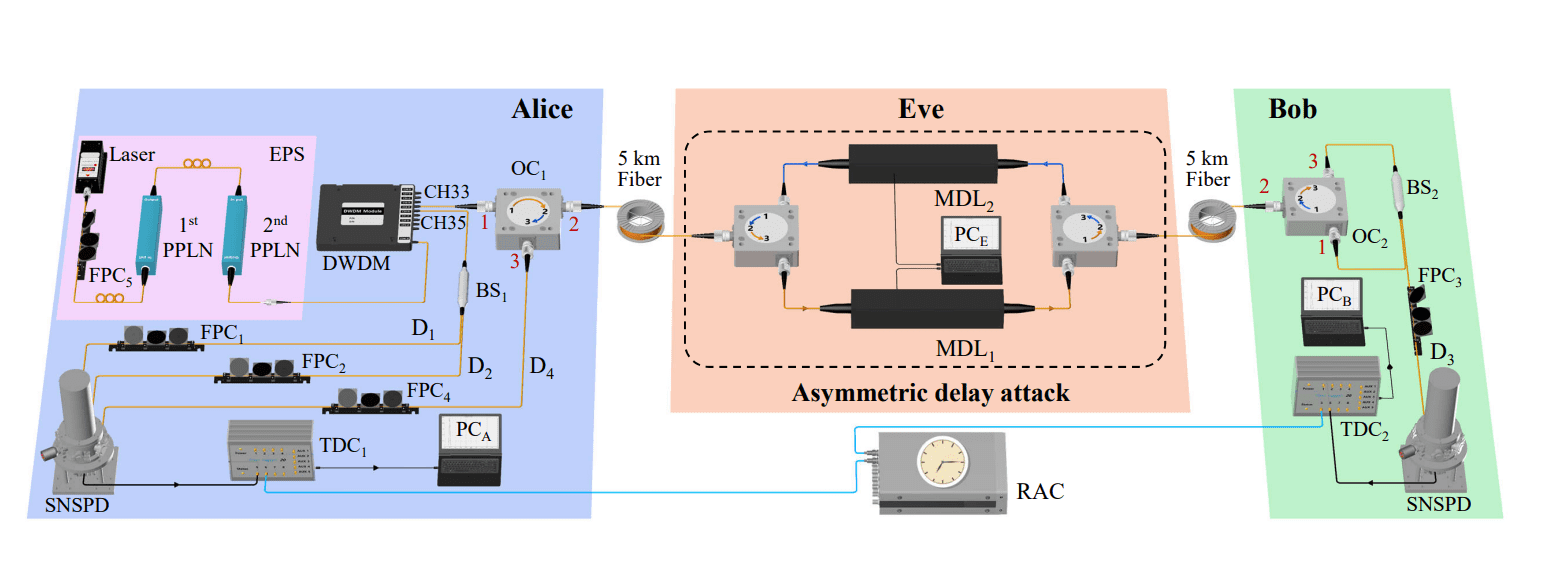
This research details a system and methodology for launching and mitigating asymmetric delay attacks (ADAs) against two-way fiber-based quantum clock synchronization (QCS) systems, potentially compromising their security and reliability. Quantum clock synchronization relies on entangled photons transmitted through a fiber optic network to achieve precise time synchronization between two locations. The core concept of the ADA is to introduce a controlled, asymmetric delay in the optical paths, disrupting time synchronization. This is achieved by manipulating optical delay lines, with an attacker controlling these lines to inject the asymmetric delay.
The research team explored three primary attack patterns: jump attacks, involving a sudden change in delay; spike attacks, designed to cause temporary disruption; and gradual attacks, slowly increasing or decreasing delay to be subtle and harder to detect. The attack system strategically inserts optical circulators and motorized delay lines into the fiber network, allowing precise control and analysis of the attack. Experiments demonstrate that the ADA successfully disrupts time synchronization, causing a measurable difference in clock readings, with the impact varying depending on the attack pattern and magnitude. The research implies the need for countermeasures such as anomaly detection, redundancy, and physical security.
Tunable Asymmetric Delays Assess Quantum Synchronization
This work pioneers a tunable asymmetric delay attack (T-ADA) scheme to comprehensively assess vulnerabilities in quantum clock synchronization (QCS) systems, moving beyond limitations of static delays. The research team engineered a hardware module incorporating optical circulators and motorized optical delay lines to introduce precisely controlled asymmetric delays into entangled photon transmission paths, delivering the capability to model a wide range of QCS systems and attack scenarios. The T-ADA scheme operates through a four-step process, beginning with hardware deployment. The system configuration is then determined based on the specific QCS system, and asymmetric delay attacks are modeled using bidirectional photon path delays. The researchers defined a tampered clock difference to quantify the impact of the attack, categorizing attacks based on their dynamic characteristics over time, encompassing fluctuating, sudden, and progressive perturbations.
Asymmetric Delay Attacks Disrupt Quantum Clock Stability
This research demonstrates critical vulnerabilities in quantum clock synchronization systems, revealing how tailored asymmetric delay attacks can compromise stability and accuracy. Researchers implemented a tunable asymmetric delay attack, meticulously controlling delay parameters in a 10km round-trip quantum clock synchronization system. Experiments revealed that jump attacks significantly degraded long-term stability, while transient spike attacks induced short-term instability, and gradual drift attacks caused significant stability degradation. These findings demonstrate that quantum clock synchronization systems are vulnerable across multiple dimensions when facing asymmetric delay attacks, underscoring the need for secure solutions resilient to adaptable threats.
Asymmetric Delays Undermine Quantum Clock Stability
This research extends beyond previous work on static delays by dynamically controlling attack parameters to manipulate clock synchronization accuracy. Through experimental validation, scientists successfully generated distinct attack patterns: jump, spike, and gradual, each targeting specific stability regimes within quantum clock synchronization systems. These findings reveal that the effectiveness of an asymmetric delay attack depends not on the magnitude of the offset, but on whether the attack introduces deviations in the intended mode, with smaller, well-calibrated shifts posing a significant risk. The work establishes a formalized model for analysing asymmetric delay threats, enabling quantitative vulnerability assessment across diverse quantum clock synchronization protocols, and proposes multi-path redundant design as a potential defence strategy.
👉 More information
🗞 Tunable Asymmetric Delay Attack in Quantum Clock Synchronization
🧠 ArXiv: https://arxiv.org/abs/2510.21101