

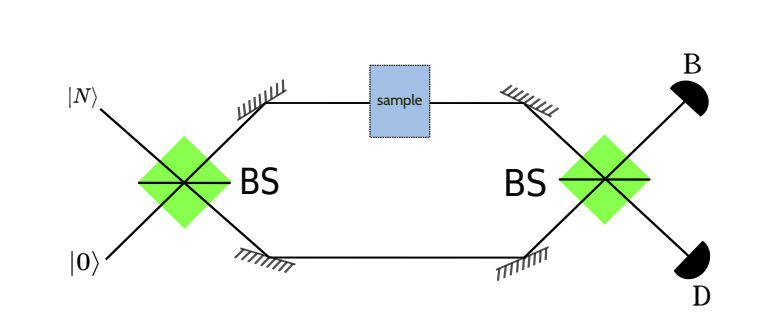
Precise temperature measurement is fundamental to maintaining the coherence of quantum systems, as thermal fluctuations introduce noise that degrades performance. Researchers are continually seeking methods to improve the accuracy of quantum thermometry, pushing the boundaries of what is achievable in determining a system’s operating temperature. Daniel Y. Akamatsu, Lucas Ferreira R. de Moura, et al., from the Universidade Federal de Goiás and collaborating institutions, now present an analytical and simulation-based investigation into the limits of dispersive quantum thermometry. Their work, entitled ‘Probing the Limits of Dispersive Quantum Thermometry with a Nonlinear Mach-Zehnder-Based Quantum Simulator’, details a novel approach utilising a nonlinear Mach-Zehnder interferometer, realised through digital simulation, to benchmark thermometric capabilities and explore the precision limits imposed by the number of field excitations. The simulation’s flexibility allows for the preparation of atomic ensembles with both positive and effective negative temperatures, offering a versatile platform for testing advanced thermometric strategies.
Quantum technologies necessitate precise temperature measurement to minimise disruptive thermal effects. Maintaining quantum coherence, crucial for both computation and sensing, demands an understanding and mitigation of these thermal influences, particularly within Noisy Intermediate-Scale Quantum (NISQ) devices. This prompts ongoing research into improving the accuracy and precision of thermometry techniques.
Quantum parameter estimation theory provides a framework for evaluating the performance of quantum probes in estimating unknown parameters, such as temperature, in a quantifiable manner. Central to this theory is the quantum Fisher information (QFI), which defines the ultimate limit of precision achievable with a given probe and sensing resource. The QFI essentially measures how distinguishable different quantum states are, indicating the sensitivity of the probe to changes in the parameter being estimated. Traditional thermometry, assuming thermal equilibrium, often finds precision limited by the heat capacity of the probe itself, motivating investigations into dynamical approaches to enhance precision beyond this standard quantum limit.
This work focuses on estimating temperature within a
This work focuses on estimating temperature within a dispersive atom-light system, critically examining the validity of assumptions and their feasibility in realistic physical implementations. Researchers present an analytical analysis of the joint atom-field evolution, aiming to determine the fundamental limits of precision achievable without approximations, and propose and simulate a thermometer based on a nonlinear Mach-Zehnder interferometer. This interferometer offers a flexible platform for benchmarking thermometric capabilities in quantum simulators.
Accurate temperature estimation represents a fundamental challenge in physics, particularly when dealing with delicate quantum systems where thermal fluctuations can rapidly destroy coherence. This research improves the precision of thermometry, specifically for collections of two-level atoms interacting with light, demonstrating that standard techniques, even when meticulously applied, are ultimately limited by classical constraints. The investigation centres on a dispersive probing technique, where atoms are subtly influenced by a quantized electromagnetic field, allowing researchers to infer the temperature without directly measuring it.
To explore these limitations and test their analytical findings, researchers propose and implement a thermometer based on a nonlinear Mach-Zehnder interferometer, realised through digital simulation. This interferometer splits and recombines light beams to detect subtle changes in phase, and a key innovation lies in the ability to initialise the atomic ensemble with both positive and effective negative temperatures. Negative temperatures, arising when higher energy states are more populated than lower ones, create a population inversion, and this capability allows researchers to systematically explore how different temperature regimes affect the precision of the thermometer.
Digital simulation offers several advantages, providing complete control over the system’s parameters, eliminating experimental noise and imperfections, and allowing for the exploration of a wider range of conditions than would be feasible in a physical experiment. Researchers leverage this flexibility to investigate the interplay between atomic state preparation, temperature estimation, and the ultimate precision achievable. The digital simulation serves as a powerful tool for testing and validating these theoretical predictions, offering a comprehensive understanding of the challenges and opportunities in achieving high-precision temperature measurement in quantum systems.
Ultimately, this research contributes to a deeper understanding
Ultimately, this research contributes to a deeper understanding of the fundamental limits of thermometry and provides a valuable platform for benchmarking thermometric capabilities in simulated environments. While the findings demonstrate that surpassing the standard quantum limit is challenging, the insights gained from this work can inform the development of more effective thermometric strategies and pave the way for improved temperature control in sensitive quantum technologies. The ability to manipulate and characterise systems with negative temperatures further expands the possibilities for exploring novel thermometric approaches and pushing the boundaries of precision measurement.
Researchers currently investigate methods to surpass classical limits in temperature measurement, leveraging quantum phenomena to achieve enhanced precision, and this work presents a detailed analysis of thermometry applied to a collection of identical, independent two-level atoms, probed dispersively by a single-mode quantized electromagnetic field. The authors demonstrate, through rigorous analytical methods, that the joint evolution of the atom-field system achieves, at best, the standard quantum limit concerning the number of field excitations, establishing a fundamental benchmark for the precision attainable in this system.
The development of robust and precise thermometers is essential for advancements in diverse fields, including materials science, condensed matter physics, and quantum technologies, and this research provides a solid theoretical foundation and a versatile simulation platform for continued exploration of the limits and possibilities of quantum thermometry, paving the way for more accurate and sensitive temperature measurements in the future.
🗞 Probing the Limits of Dispersive Quantum Thermometry with a Nonlinear Mach-Zehnder-Based Quantum Simulator
🧠 DOI: https://doi.org/10.48550/arXiv.2507.04246


