

Preparing complex, high-dimensional functions represents a significant challenge for quantum computers, and researchers are actively seeking methods to overcome limitations in scalability and accuracy. Marco Ballarin, Juan José García-Ripoll, David Hayes, and colleagues address this problem by developing tensor network algorithms that efficiently prepare these functions, while also accounting for the practical realities of gate errors and the troublesome ‘barren plateau’ phenomenon that hinders optimisation. The team demonstrates the power of their approach by accurately preparing a 17-dimensional Gaussian function encoded within 102 qubits through numerical simulation, and experimentally realising a 9-dimensional Gaussian using 54 qubits on Quantinuum’s H2 processor, marking a substantial step towards utilising quantum computers for complex data analysis and modelling. This work showcases a promising pathway for encoding and manipulating increasingly complex functions on near-term quantum hardware.
IQSP Algorithm Prepares High Resolution Gaussians
Researchers have developed a novel algorithm, IQSP, for efficiently preparing multi-dimensional Gaussian distributions on quantum computers, achieving high resolution and accuracy with the potential to encode distributions in up to 100 qubits per dimension. IQSP outperforms traditional methods by maintaining larger gradients during optimization, leading to faster convergence and improved results, as demonstrated by preparing a 9-dimensional Gaussian on the H2-2 quantum computing platform. Experiments on the H2-2 platform, utilizing 1024 measurements, yielded detailed results, including estimated mean values and a comprehensive covariance matrix, demonstrating remarkably low infidelity around 4. 3×10 -3 .
Comb Tensor Networks Smooth Quantum Circuit Optimization
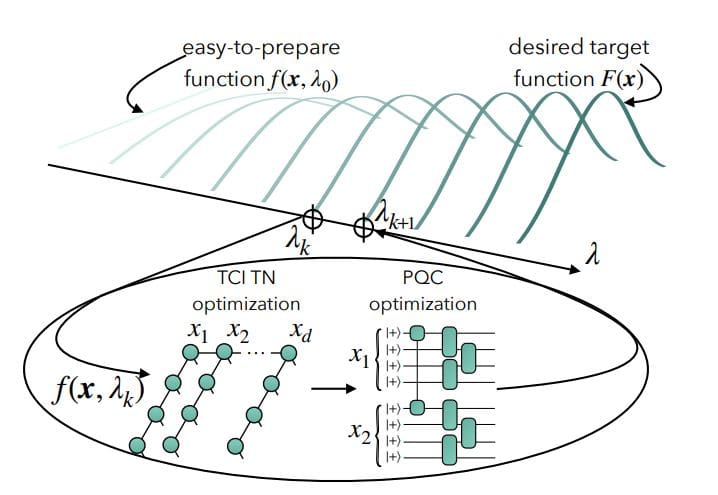
Scientists have pioneered a new approach to preparing complex functions on quantum computers, termed Interpolative Quantum State Preparation, or IQSP. This method addresses the challenge of vanishing gradients by utilizing tensor networks, specifically comb tensor networks, to efficiently encode high-dimensional functions and optimize circuits composed of hardware-native gates while accounting for gate errors. The algorithm begins with a function defined on a multi-dimensional domain, mapping it onto a quantum state and computing a tensor network approximation using Tensor Cross Interpolation. Through numerical simulations, researchers successfully trained circuits to represent a 17-dimensional Gaussian encoded within 102 qubits, and further validated this by realizing a 9-dimensional Gaussian on Quantinuum’s H2-2 trapped-ion device, utilizing 255 two-qubit and 564 single-qubit gates. IQSP demonstrated a significant reduction in the number of two-qubit gates required, exceeding a ten-fold improvement when preparing a 2-dimensional Ricker wavelet and a Student’s t-distribution.
High-Dimensional Gaussian Encoding on Quantum Hardware
Researchers have developed an optimization technique, IQSP, to efficiently prepare high-dimensional functions on quantum computers, accurately encoding complex data, specifically Gaussian distributions, into quantum states using a practical number of qubits. Through numerical simulations, the team successfully prepared a 17-dimensional Gaussian encoded within the state of 102 qubits, showcasing the scalability of the method. Further validation came from experiments conducted on Quantinuum’s H2 processor, realizing a 9-dimensional Gaussian using 54 qubits. The researchers meticulously analyzed IQSP’s performance, measuring overlap with the target function and the magnitude of gradients during circuit optimization, demonstrating that IQSP effectively avoids the “barren plateau” phenomenon.
While gradients decreased exponentially with system size for randomly initialized circuits, IQSP maintained large gradients with no significant system size dependence, achieving a final infidelity of 4. 3×10 -3 for the 17-dimensional Gaussian. Incorporating experimental noise into the IQSP algorithm, specifically modeling Quantinuum’s hardware, significantly improved performance, achieving an infidelity of 0. 028 for a four-dimensional Gaussian. Experimental demonstration on the H2-2 quantum computer confirmed the accuracy of the approach, with measured covariances closely matching theoretical predictions and noiseless simulations, and the optimized circuits reduced the two-qubit gate count by approximately 20%, from 318 to 255 gates.
IQSP Accurately Prepares High-Dimensional Functions on Hardware
This work introduces IQSP, an algorithm designed to efficiently prepare high-dimensional functions on current quantum computers, successfully demonstrating its ability to accurately encode complex multivariate functions, including a 17-dimensional Gaussian using 102 qubits in simulations and a 9-dimensional Gaussian realized with 54 qubits on Quantinuum’s H2 processor. The algorithm overcomes the common problem of vanishing gradients by smoothly transforming circuits from easily prepared initial states to the desired target functions. Experimental results confirm that IQSP accurately represents the 9-dimensional Gaussian on hardware, aligning closely with both exact covariance matrix calculations and noiseless simulations. Researchers propose circuit cross interpolation as a potential method to remove the need for tensor networks altogether, potentially broadening the algorithm’s use, although initial findings suggest the tensor network-based version remains more efficient for the problems currently studied.
👉 More information
🗞 Efficient quantum state preparation of multivariate functions using tensor networks
🧠 ArXiv: https://arxiv.org/abs/2511.15674


