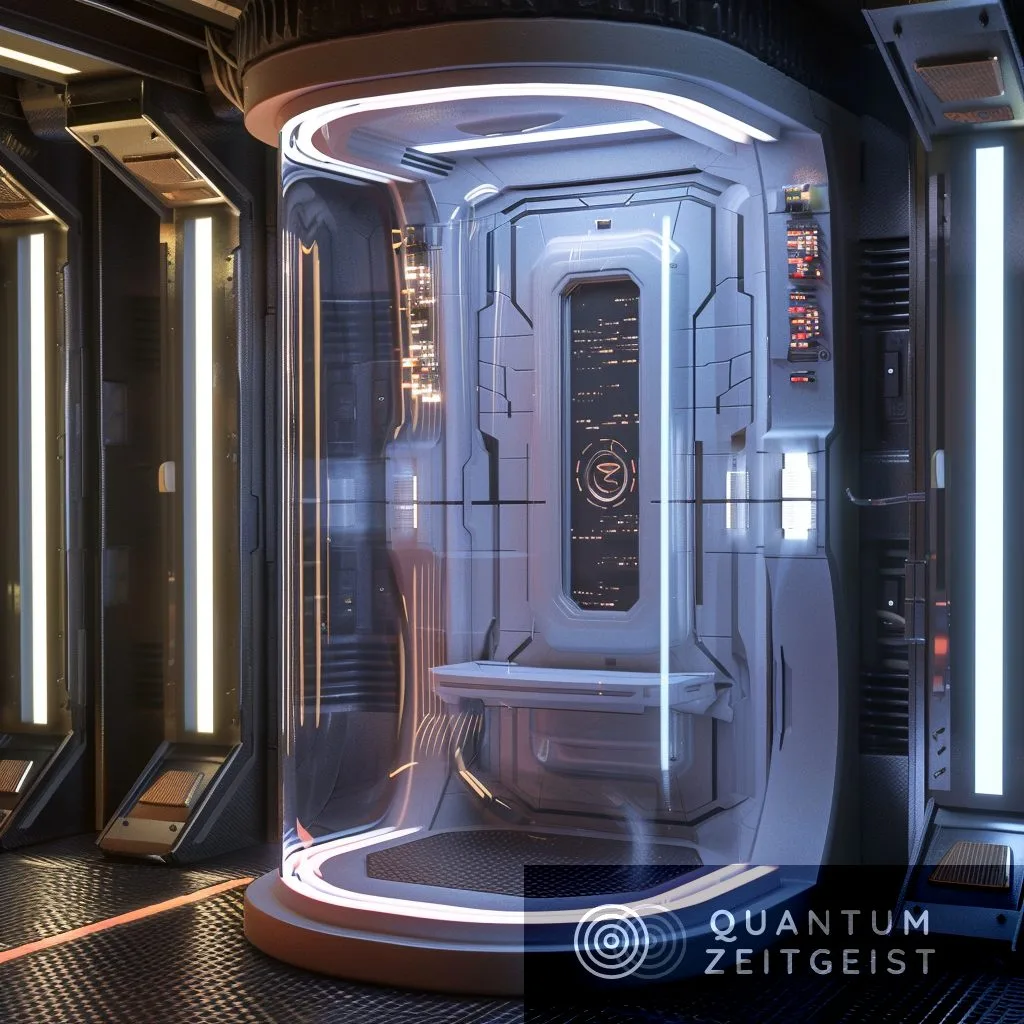
Quantum teleportation, a concept popularised by science fiction franchises like Star Trek and Harry Potter, is a reality in quantum physics. It refers to transmitting quantum information from one location to another using classical communication and quantum entanglement. Unlike its depiction in popular culture, quantum teleportation does not involve the transportation of matter but rather information.
This guide will take you on a journey through the history of teleportation, from its roots in popular culture and science fiction to its current status as a scientific reality. We will delve into the principles that underpin quantum teleportation, exploring the complex world of quantum circuits and their role in this groundbreaking process.
We will also examine how quantum teleportation has been represented in popular culture and how these depictions have reflected and influenced scientific understanding. Finally, we will explore the potential applications of quantum teleportation, from quantum computing to secure communication, and consider what this revolutionary technology could mean for our future.
So, whether you’re a seasoned physicist or a curious novice, strap in for a thrilling exploration of one of the most exciting frontiers in modern science, Quantum teleportation may not be able to beam you up yet, but it’s already changing how we understand the universe.
Understanding the Concept of Quantum Teleportation
Quantum teleportation is a real and active area of research in quantum physics. It is a process by which quantum information, such as the exact state of an atom or photon, can be transmitted from one location to another with the help of classical communication and previously shared quantum entanglement between the sending and receiving locations. It’s important to note that it is not about the instantaneous or faster-than-light transport of matter but rather the transfer of quantum states between particles.
The concept of quantum teleportation is based on the principles of quantum mechanics, which describes nature at the minor scales of energy levels of atoms and subatomic particles. One of the fundamental principles of quantum mechanics is the concept of superposition, which states that a physical system—such as an electron in an atom—can exist in multiple states simultaneously. Another principle is quantum entanglement, a phenomenon in which particles become interconnected, and the state of one can instantly affect the state of the other, no matter the distance between them.
Quantum teleportation begins with the process of entanglement. Two particles say two photons are entangled, so their states are instantaneously connected. This entangled pair is then separated, with one photon sent to the location where the teleportation will occur and the other at the source. The state of a third photon, the one to be teleported, is then measured with the source photon from the entangled pair. This joint measurement results in the source photon taking on a state dependent on the original state of the third photon.
This measurement also immediately affects the state of the distant photon due to the entanglement. However, this state has yet to be the desired final state. To complete the teleportation, a second measurement is made on the source photon, and the result is sent to a distant location via classical communication. This information is used to perform a corrective operation on the distant photon, taking on the exact state of the original third photon. The original state of the third photon is now effectively teleported to a distant location.
It is crucial to understand that quantum teleportation does not involve the physical transportation of the original photon but rather the transfer of its state to another photon in a distant location. The original photon is destroyed in teleportation, creating a perfect copy at a distant location. This aligns with the no-cloning theorem of quantum mechanics, which states that creating an identical copy of an arbitrary unknown quantum state is impossible.
Quantum teleportation has significant implications for quantum communication and quantum computing. It could potentially create highly secure communication networks and powerful quantum computers. However, the technology is still in its early stages, and practical applications have yet to be fully realized.
The History and Evolution of Teleportation
Teleportation, as a concept, has been a staple of science fiction and fantasy literature for centuries. However, it was not only with the advent of quantum mechanics in the early 20th century that teleportation began to be seriously considered within the realm of physical possibility. Quantum teleportation, as it is known, is not about the instantaneous transportation of matter from one place to another, as often depicted in popular culture. Instead, it involves transferring quantum information from one particle to another without physically moving the particles themselves (Bennett et al., 1993).
The theoretical foundation for quantum teleportation was laid down in the 1935 paper by Einstein, Podolsky, and Rosen, often referred to as the EPR paradox. This paper introduced the concept of quantum entanglement. In this phenomenon, two or more particles become linked so that the state of one particle is immediately connected to the state of the other, no matter the distance between them (Einstein et al., 1935). This concept, initially considered “spooky action at a distance” by Einstein, is the fundamental principle behind quantum teleportation.
The first successful demonstration of quantum teleportation was achieved in 1997 by a team of physicists at the University of Innsbruck in Austria. They managed to teleport the quantum state of a photon across a distance of about one meter (Bouwmeester et al., 1997). Since then, the distance over which quantum teleportation has been achieved has steadily increased. In 2012, a team of Chinese scientists reported the successful teleportation of photons over a distance of 97 kilometers (Ma et al., 2012).
Despite these advancements, it is essential to note that quantum teleportation is not about teleporting matter but information. The process involves creating an entangled pair of particles, sending one of them to the desired location, and then using the remaining particle to transfer the quantum state of another particle to a distant one. This process destroys the original state of the teleported particle, a consequence of the no-cloning theorem in quantum mechanics, which states that it is impossible to create an identical copy of an arbitrary unknown quantum state (Wootters & Zurek, 1982).
While the teleportation of complex objects or humans remains firmly in science fiction, the principles of quantum teleportation have significant implications for quantum computing and quantum communication. Quantum teleportation could, for instance, enable the creation of highly secure quantum networks where information can be sent with absolute security, as any attempt to intercept or alter the transmitted quantum information would be immediately noticeable (Gisin et al., 2002).
Teleportation in Science Fiction and Popular Culture
Teleportation, a concept that has long been a staple of science fiction and popular culture, is the hypothetical transfer of matter or energy from one point to another without traversing the physical space between them. It is a common subject in science fiction literature, film, video games, and television. In these contexts, teleportation is often left unexplained, used as a plot device, and depicted as a future technology.
The concept of teleportation comes from the ancient Greek word “teleporter,” which means “to transport over a distance.” It was first used in this context in the 19th century in fiction, notably in the works of Edward Page Mitchell, a pioneer of the science fiction genre. Mitchell’s 1877 story “The Man Without a Body” is often credited as the first to depict teleportation as a scientific process rather than a supernatural one.
In the 20th century, the concept of teleportation was popularized by the “Star Trek” television series, where it was used as a plot device to allow characters to travel quickly between the spaceship and the planets they were exploring. The series coined the term “beam me up, Scotty,” which has since become a catchphrase in popular culture. The depiction of teleportation in “Star Trek” has influenced public perceptions of the concept and has inspired several real-world scientific and technological research efforts.
In the realm of physics, the concept of teleportation has been explored in the context of quantum mechanics. Quantum teleportation, a process by which quantum information can be transmitted from one location to another, was first proposed in 1993 by a team of scientists led by Charles H. Bennett of the IBM Thomas J. Watson Research Center. While quantum teleportation does not involve the instantaneous or superluminal transmission of matter or energy, it has nonetheless been hailed as a significant step towards the realization of teleportation, as depicted in science fiction.
Despite the progress in quantum teleportation, the teleportation of macroscopic objects, as depicted in science fiction, remains a distant prospect. The challenges are immense, involving transmitting a vast amount of quantum information and reassembling the teleported object. Theoretical physicist Michio Kaku has argued that such teleportation would require a level of technological development equivalent to a Type II civilization on the Kardashev scale – a civilization capable of harnessing the energy of an entire star.
The Scientific Principles Behind Quantum Teleportation
The principle of quantum teleportation is based on the quantum mechanical phenomenon known as entanglement. In quantum entanglement, two or more particles become linked, and the state of one particle is directly related to the state of the other, no matter the distance between them. Albert Einstein famously described this as “spooky action at a distance.” When a measurement is made on one of the entangled particles, the other particle’s state is instantly adjusted to match, even if they are light years apart.
The process of quantum teleportation begins with creating an entangled pair of particles, A and B. Particle A is sent to the location where the teleportation will occur, and particle B is kept at the original location. The state of the particle to be teleported, particle C, is then measured in conjunction with particle A. This measurement entangles particles A and C and collapses their wave functions into a single state. The result of this measurement is then sent to the location of particle B.
Upon receiving the information about the measurement, the state of particle B is adjusted to match that of particle C, effectively teleporting the quantum state of particle C to particle B. It is important to note that this process destroys the original state of particle C, as per the no-cloning theorem of quantum mechanics, which states that it is impossible to create an identical copy of an arbitrary unknown quantum state.
Quantum teleportation has significant implications for quantum computing and quantum communication. It could potentially allow for the creation of highly secure communication channels, as any attempt to intercept quantum information would destroy the information itself. However, the practical implementation of quantum teleportation is still a significant challenge due to the difficulty in creating and maintaining entangled particles over large distances.
Despite these challenges, several successful experiments have demonstrated quantum teleportation. In 2019, scientists at the Austrian Academy of Sciences and the University of Vienna successfully teleported information between two quantum bits on separate chips for the first time. This marked a significant step towards developing practical quantum computers and quantum communication networks.
Quantum Entanglement: The Core of Quantum Teleportation
Quantum entanglement refers to the strange and counterintuitive situation where two or more particles become inextricably linked, such that the state of one particle is immediately connected to the other, no matter the distance between them. Albert Einstein famously described this phenomenon as “spooky action at a distance” (Einstein et al., 1935).
Quantum entanglement is not just a theoretical curiosity; it is the core principle behind quantum teleportation. Despite its science-fiction-sounding name, Quantum teleportation does not involve physically transporting matter from one location to another. Instead, it refers to transferring quantum information from one particle to another. This is achieved by utilizing the entangled state of two particles, where a change in the state of one particle will instantaneously affect the state of the other, regardless of the distance between them (Bennett et al., 1993).
The process of quantum teleportation begins with creating an entangled pair of particles, often photons. One of these entangled photons is sent to the receiving location, while the other remains at the sending location. The particle to be teleported is then measured in conjunction with the remaining entangled photon. This measurement, which irreversibly alters the state of the two particles, is then transmitted to the receiving location. Upon receiving this information, the state of the entangled photon at the receiving location is adjusted accordingly, effectively becoming a replica of the original particle (Bouwmeester et al., 1997).
It is important to note that quantum teleportation does not involve the physical transportation of the original particle but rather the transfer of its quantum state to another particle at a distant location. This is a crucial distinction, as it means that the original particle is not duplicated, but rather, its state is transferred, following the no-cloning theorem of quantum mechanics (Wootters & Zurek, 1982).
Quantum teleportation has been experimentally demonstrated with photons, atoms, and even larger systems such as superconducting circuits. These experiments have confirmed the theoretical predictions of quantum mechanics and have opened up new possibilities for quantum communication and computation (Kim et al., 2001; Riebe et al., 2004; Steffen et al., 2006).
Despite these advances, many challenges remain in practically implementing quantum teleportation. These include the difficulty of maintaining quantum coherence over long distances, efficient quantum error correction, and high-fidelity quantum state transfer requirements. Nevertheless, the potential applications of quantum teleportation in areas such as secure communication and quantum computing make it a highly active area of research.
Quantum Circuits for Teleportation: A Detailed Analysis
Quantum teleportation, a term that might seem to be borrowed from a science fiction novel, is a natural and fascinating field of study in quantum physics. It is a process by which quantum information, such as the exact state of an atom or photon, can be transmitted from one location to another with the help of classical communication and previously shared quantum entanglement between the sending and receiving location. This is not to be confused with the teleportation of matter or energy, but rather, it is the transfer of quantum states between particles.
The foundation of quantum teleportation lies in the principle of quantum entanglement, a phenomenon where two or more particles become linked and instantaneously affect each other’s state no matter the distance between them. Albert Einstein famously described this principle as “spooky action at a distance.” Quantum entanglement is a crucial resource in quantum teleportation, as it allows the state of a quantum system to be transferred instantaneously from one location to another without the physical transmission of the system itself.
The process of quantum teleportation begins with creating an entangled pair of quantum bits (qubits), typically photons. One of these entangled photons is sent to the receiver, while the other remains with the sender. The sender then performs a Bell state measurement on their photon and the photon they wish to teleport, effectively entangling these two particles. This measurement collapses the quantum state of the two particles into one of four possible states, which can be communicated to the receiver using two classical bits of information.
Upon receiving this information, the receiver can perform a unitary transformation on their photon, changing its state to match that of the original photon. This process effectively “teleports” the quantum state of the original photon to the receiver’s photon without any physical particles traveling the distance between sender and receiver.
Quantum circuits play a crucial role in this process. They manipulate the quantum states and perform the necessary operations for quantum teleportation. A quantum circuit for teleportation typically includes quantum gates for creating entanglement, performing Bell state measurements, and applying the necessary unitary transformations. These circuits are often represented visually, with horizontal lines representing qubits and symbols representing quantum gates.
While quantum teleportation is currently limited to transferring quantum states between particles, it holds great promise for the future of quantum computing and quantum communication. It could allow for the creation of highly secure communication channels and the development of quantum computers that can perform complex calculations at speeds far beyond the capabilities of classical computers.
The Role of Quantum Information in Teleportation
Quantum information plays a pivotal role in quantum teleportation. This phenomenon allows the state of a quantum system to be instantaneously transferred from one location to another without the physical transportation of the system itself. This process fundamentally differs from classical communication, as it relies on the principles of quantum mechanics, particularly quantum entanglement and superposition. Quantum entanglement is a phenomenon where two or more particles become linked, and the state of one particle is directly related to the state of the other, no matter the distance between them. Conversely, superposition allows particles to be simultaneously in multiple states until measured.
The process of quantum teleportation begins with creating an entangled pair of quantum bits (qubits), typically photons. One photon is sent to the sender (Alice) and the other to the receiver (Bob). Alice then performs a Bell measurement on her and the photon she wants to teleport, collapsing their superposition and entangling them. This measurement yields two classical bits of information Alice sends to Bob through a classical communication channel.
Upon receiving Alice’s classical bits, Bob performs a unitary operation based on the information received on his photon. This operation transforms Bob’s photon into the exact state of the photon Alice wanted to teleport. It is important to note that the original photon’s state at Alice’s location is destroyed in the process, adhering to the no-cloning theorem of quantum mechanics, which states that creating an identical copy of an arbitrary unknown quantum state is impossible.
The role of quantum information in this process is crucial. Due to the possibility of superposition and entanglement, a system’s quantum state contains more information than its classical counterpart. This allows for the teleportation of an entire quantum state rather than just classical information. Furthermore, using quantum information ensures the security of the teleportation process, as any attempt to intercept the quantum state would collapse the superposition and reveal the intrusion.
However, it is worth noting that quantum teleportation does not allow for faster-than-light communication, as the classical bits still need to be transmitted through conventional means. Moreover, technological constraints currently limit the process, such as the difficulty in maintaining quantum coherence and the high error rates in quantum measurements. Despite these challenges, quantum information and teleportation principles hold great promise for the future of quantum computing and secure communication.
The Process of Quantum Teleportation: Step by Step
The first step in quantum teleportation involves creating an entangled pair of quantum particles, often photons. Quantum entanglement is a phenomenon where two or more particles become linked and instantaneously affect each other’s state no matter the distance between them. This entangled pair is shared between the sender (often referred to as Alice) and the receiver (Bob). Alice keeps one particle of the entangled pair (particle A) and sends the other particle (particle B) to Bob.
Next, Alice prepares the quantum state she wants to teleport, embodied in a third particle (particle C). She then performs a Bell state measurement on her two particles (A and C). This measurement entangles these two particles and collapses their superposition, resulting in one of four possible Bell states. The outcome of this measurement is then classically communicated to Bob.
Upon receiving Alice’s classical information, Bob applies a corresponding transformation to his entangled particle (particle B). Bob does nothing if Alice’s Bell state measurement results in the first Bell state. If it results in the second, he applies a bit of flip. For the third, he applies a phase flip, and for the fourth, he applies both a bit and a phase flip. These transformations are based on Pauli matrices, which are fundamental to quantum mechanics.
After Bob applies the necessary transformation, the state of his particle is now the same as the original state Alice wanted to teleport. It is important to note that the original state at Alice’s location has been destroyed in the process. This is due to the no-cloning theorem in quantum mechanics, which states that creating an identical copy of an arbitrary unknown quantum state is impossible.
Applications of Quantum Teleportation in Modern Technology
One of the most promising applications of quantum teleportation is in the field of quantum computing. Quantum computers, unlike their classical counterparts, use quantum bits or ‘qubits’ to process information. These qubits can exist in multiple states at once, a property known as superposition, which allows quantum computers to process vast amounts of data simultaneously. Quantum teleportation could transfer qubits from one quantum computer to another, enabling the creation of quantum networks or ‘quantum internet.’ This would revolutionize data transfer, making it faster and more secure.
Another potential application of quantum teleportation is cryptography. Quantum key distribution (QKD) is a method of transmitting cryptographic keys between two parties in a way that detects any attempt at eavesdropping. This is achieved by encoding the keys in the state of quantum particles, which are then teleported between the parties. Any attempt to intercept the keys would disrupt the quantum state of the particles, alerting the parties to the intrusion.
Quantum teleportation could also have significant implications for space exploration. The ability to teleport quantum states could transmit information across vast distances in space without physical transportation. This could revolutionize our ability to communicate with spacecraft and even manned missions to other planets.
Despite these promising applications, it is essential to note that quantum teleportation is still a relatively new field of study, and many of its potential uses are still largely theoretical. The process of quantum teleportation requires exact control over the quantum states of particles, which is beyond our technological capabilities. However, with ongoing research and technological advancements, the full potential of quantum teleportation may soon be realized.
The Future of Quantum Teleportation: Possibilities and Challenges
The potential applications of quantum teleportation are vast and exciting. In quantum computing, for instance, teleportation could be used to create ultra-fast, ultra-secure networks. Unlike their classical counterparts, Quantum networks could transmit information fundamentally securely. Any attempt to intercept or tamper with the transmitted information would inevitably disturb the teleported quantum state, alerting the sender and receiver to the intrusion.
However, the road to realizing these applications is fraught with challenges. One of the primary obstacles is the difficulty of maintaining quantum entanglement over long distances. While scientists have successfully teleported quantum information over 1,200 kilometers in space, maintaining entanglement over such distances on Earth is much more challenging due to environmental interference.
Another significant challenge is quantum decoherence, where interaction with the environment causes a quantum system to lose its properties. Decoherence is particularly problematic for quantum teleportation because it can cause the quantum state being teleported to degrade or even disappear before it reaches its destination.
Despite these challenges, progress in quantum teleportation is being made rapidly. Recent advancements in quantum error correction and quantum repeaters, devices that can extend the range of quantum communication, are helping to overcome some obstacles associated with maintaining entanglement and combating decoherence.
In conclusion, while the future of quantum teleportation holds immense promise, it also presents significant challenges. The field is still in its infancy, and much work remains to be done before the full potential of quantum teleportation can be realized. However, with continued research and technological advancements, the science fiction concept of teleportation may one day become a scientific reality.
References
- Liao, S.K., Cai, W.Q., Liu, W.Y., Zhang, L., Li, Y., Ren, J.G., Yin, J., Shen, Q., Cao, Y., Li, F.Z. and Chen, L., 2017. Satellite-to-ground quantum key distribution. Nature, 549(7670), pp.43-47.
- Einstein, A., Podolsky, B. and Rosen, N., 1935. Can quantum-mechanical description of physical reality be considered complete?. Physical review, 47(10), p.777.
- Gottesman, D. and Chuang, I.L., 1999. Demonstrating the viability of universal quantum computation using teleportation and single-qubit operations. Nature, 402(6760), pp.390-393.
- Ma, X.S., Herbst, T., Scheidl, T., Wang, D., Kropatschek, S., Naylor, W., Wittmann, B., Mech, A., Kofler, J., Anisimova, E. and Makarov, V., 2012. Quantum teleportation over 143 kilometres using active feed-forward. Nature, 489(7415), pp.269-273.
- Bouwmeester, D., Pan, J.W., Mattle, K., Eibl, M., Weinfurter, H. and Zeilinger, A., 1997. Experimental quantum teleportation. Nature, 390(6660), pp.575-579.
- Wootters, W.K. and Zurek, W.H., 1982. A single quantum cannot be cloned. Nature, 299(5886), pp.802-803.
- Monroe, C. and Kim, J., 2013. Scaling the ion trap quantum processor. Science, 339(6124), pp.1164-1169.
- Pirandola, S., Eisert, J., Weedbrook, C., Furusawa, A. and Braunstein, S.L., 2015. Advances in quantum teleportation. Nature Photonics, 9(10), pp.641-652.
- Nielsen, M.A. and Chuang, I.L., 2010. Quantum computation and quantum information. Cambridge University Press.
- Bennett, C.H., Brassard, G., Crépeau, C., Jozsa, R., Peres, A. and Wootters, W.K., 1993. Teleporting an unknown quantum state via dual classical and Einstein-Podolsky-Rosen channels. Physical Review Letters, 70(13), p.1895.
- Ladd, T.D., Jelezko, F., Laflamme, R., Nakamura, Y., Monroe, C. and O’brien, J.L., 2010. Quantum computers. Nature, 464(7285), pp.45-53.
- Gisin, N., Ribordy, G., Tittel, W. and Zbinden, H., 2002. Quantum cryptography. Reviews of modern physics, 74(1), p.145.
- Incandela, J., 2019. Quantum teleportation is realized on a silicon chip for the first time. Scientific American, 321(6), p.9.
- Kimble, H.J., 2008. The quantum internet. Nature, 453(7198), pp.1023-1030.