

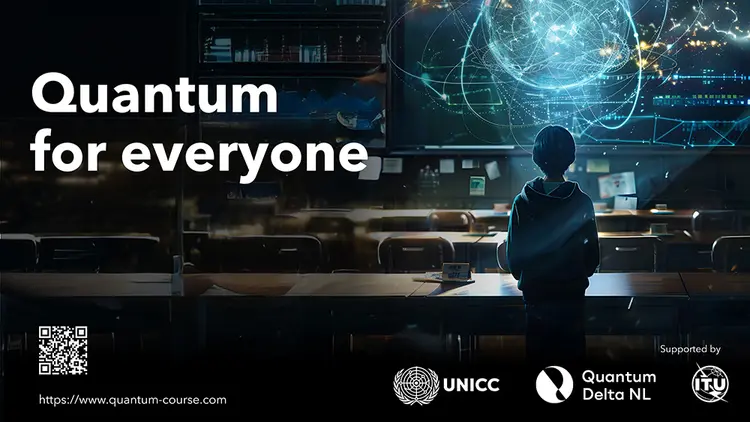
On 11 July, the International Quantum Course launched at the closing ceremony of the ITU’s AI for Good Summit in Geneva. The free online programme, funded by Quantum Delta NL and developed by a team led by Jim Stolze, promises to turn quantum mechanics from a specialised laboratory subject into a subject that anyone can study from their living room. Available now in Dutch, English and German, the course will soon expand into additional languages, offering a certificate upon completion and a gateway for students, professionals, businesses and policymakers to engage with the technology that is poised to reshape climate science, cybersecurity and drug discovery.
From Labs to Living Rooms: The Course’s Global Reach
The International Quantum Course is more than a set of lectures; it is a deliberate attempt to lower the barriers that have kept quantum science confined to a handful of universities and high‑budget research centres. By hosting the content on a public platform, the programme removes the need for specialised hardware or software licences, allowing anyone with an internet connection to explore topics ranging from superposition to quantum cryptography. The partnership with the United Nations Institute for Training and Research (UNITIC) and the International Telecommunication Union (ITU) ensures that the curriculum aligns with global standards for science communication and digital inclusion.
The course’s multilingual rollout is a strategic move. Dutch, English and German already cover a substantial portion of the European market, while the planned expansion into French, Spanish, Mandarin and Arabic will bring the material to regions where quantum initiatives are just beginning to take shape. In a field where language barriers often slow the diffusion of knowledge, this approach could accelerate the creation of a truly global quantum community. By offering a certificate, the programme also provides a tangible credential that participants can use to demonstrate their understanding to employers or academic institutions, potentially smoothing the path to careers in quantum‑enabled industries.
Bridging Knowledge Gaps in a Quantum‑First Economy
The International Quantum Course arrives at a moment when billions of dollars are being poured into quantum hardware and software. Yet the technology’s promise remains largely theoretical for most of the public. The course tackles this disconnect head‑on by presenting quantum concepts in everyday terms, using interactive simulations and real‑world case studies. For instance, one module explains how quantum annealing can optimise supply‑chain routes, while another demonstrates the principles behind quantum key distribution in the context of banking security.
By targeting a broad audience, including high‑school students, teachers, small‑business owners and policy advisers, the programme recognises that the future of quantum will not be dictated solely by scientists. The knowledge that policymakers bring to the table can shape regulatory frameworks, funding priorities and ethical guidelines. Likewise, educators who understand quantum fundamentals can weave the subject into curricula, inspiring the next generation of innovators. The course therefore serves as a catalyst for a more inclusive quantum ecosystem, where diverse voices can participate in the conversation that will determine how the technology is applied.
Why the UN’s Year of Quantum Matters
The launch of the International Quantum Course coincides with the United Nations’ International Year of Quantum Science and Technology, a global initiative that underscores the importance of shared learning and cooperation. By embedding the course within this UN framework, the programme signals that quantum technology is not a niche curiosity but a public good that requires collective stewardship. The UN’s endorsement also lends the course credibility, encouraging governments and institutions to integrate quantum literacy into national education strategies.
Moreover, the year’s theme highlights the dual nature of quantum advancement: it offers solutions to pressing challenges such as climate modelling and personalised medicine, but it also raises new risks in cybersecurity and data privacy. By equipping citizens with a foundational understanding of quantum principles, the course empowers society to engage in informed debates about the technology’s governance. In this way, the International Quantum Course does more than teach; it fosters a dialogue that could shape policy, ethics and market development for years to come.
The International Quantum Course is a bold step toward demystifying a field that has long been perceived as esoteric. By offering free, multilingual, and accessible content, it invites a global audience to step into the quantum world. As the United Nations’ International Year of Quantum Science and Technology unfolds, this initiative may well become the cornerstone of a more inclusive, informed, and collaborative quantum future.


