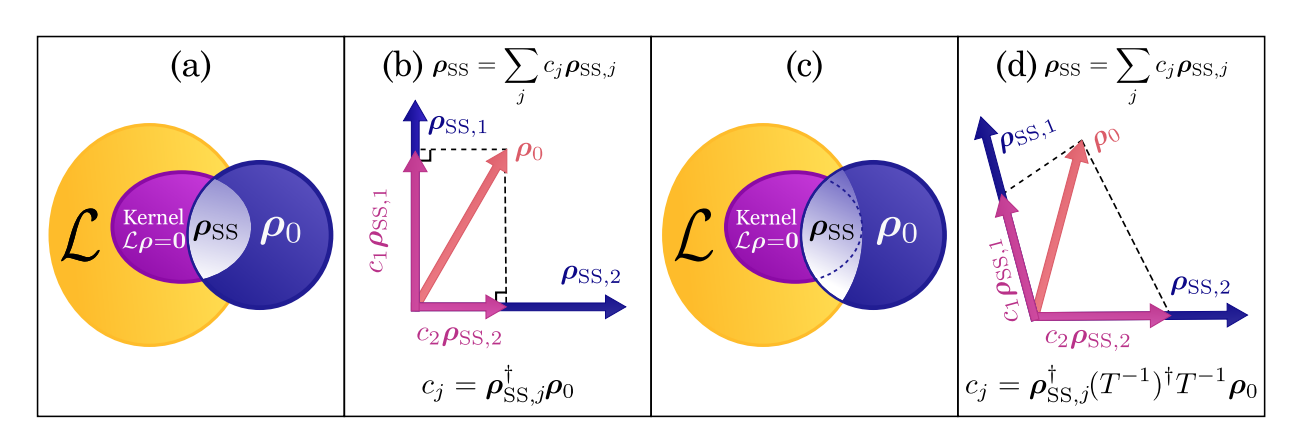
Entanglement, a cornerstone of quantum technologies, typically suffers from environmental noise, yet recent research demonstrates that carefully controlled dissipation can surprisingly create stable, entangled states. Diego Fallas Padilla, Raphael Kaubruegger, and Adrianna Gillman, alongside Stephen Becker and Ana Maria Rey, have now developed a new theoretical framework that predicts how the final, stable state of a complex quantum system depends on its initial conditions. This work extends existing understanding of open quantum systems by revealing that the weights determining the final state are influenced by both the system’s inherent properties and its starting point, offering a powerful analytical tool for predicting and designing stable entanglement. The team identifies specific system configurations where the initial state’s influence is particularly strong, paving the way for new methods to generate useful entangled states in systems like spin ensembles through balanced decay processes.
Initial State Control Creates Entangled Quantum States
This research investigates how precisely controlling the initial state of a quantum system can generate stable, entangled states, even when the system interacts with its environment. Multistable systems, capable of existing in multiple stable configurations, present both challenges and opportunities for creating and sustaining quantum entanglement, a crucial resource for emerging quantum technologies. The team demonstrates that carefully selecting the starting quantum state allows researchers to steer the system towards a desired entangled state, overcoming limitations of traditional methods that require complete isolation from environmental disturbances. This approach offers a pathway to building more robust quantum devices.
The researchers developed a theoretical framework to predict and optimise initial states for achieving high-fidelity entanglement in these complex systems, considering both the system’s inherent multistability and the effects of environmental interactions. This framework enables the design of quantum states resilient to decoherence, enhancing their potential for practical applications in quantum information processing and sensing. The results reveal that the combination of multistability and initial state control provides a powerful mechanism for generating and stabilising entanglement in open quantum systems, paving the way for more robust and scalable quantum technologies.
Efficient Steady State Calculation for Atoms
This research details a new, efficient method for calculating the steady states of multi-level atomic systems, crucial for understanding complex quantum phenomena. Researchers compared their method to established techniques, demonstrating its accuracy and significant speed advantage, particularly for larger systems. The core innovation lies in directly solving for the steady state without needing to simulate the system’s evolution over time, a computationally intensive process.
The team validated their method against standard numerical techniques, including solving the Lindblad equation with Runge-Kutta solvers and Krylov subspace methods, and confirmed its accuracy. Crucially, the new method scales much more efficiently with increasing system size, offering a substantial computational advantage, especially as the number of atoms increases, making it possible to study previously inaccessible systems.
Steady States and Initial State Control
This research presents analytical expressions that determine the steady state of open quantum systems, avoiding lengthy and computationally expensive simulations. Researchers discovered that the steady state depends not only on the system’s inherent properties but also on the specific initial state, offering a new level of control over quantum behaviour. This finding simplifies predictions for certain systems, where the steady state depends solely on the overlap between the initial state and a key system property.
The team demonstrated that tailored initial states can enhance desirable features, such as quantum entanglement, within the resulting steady state, and explored the relationship between system symmetries and the structure of the system’s properties. They proposed a protocol for generating states useful in quantum metrology by leveraging balanced collective decay, potentially achievable in cavity quantum electrodynamics setups, and offer a computationally efficient alternative to simulating long-time evolution.
🗞 Generating Entangled Steady States in Multistable Open Quantum Systems via Initial State Control
🧠 ArXiv: https://arxiv.org/abs/2510.07628